
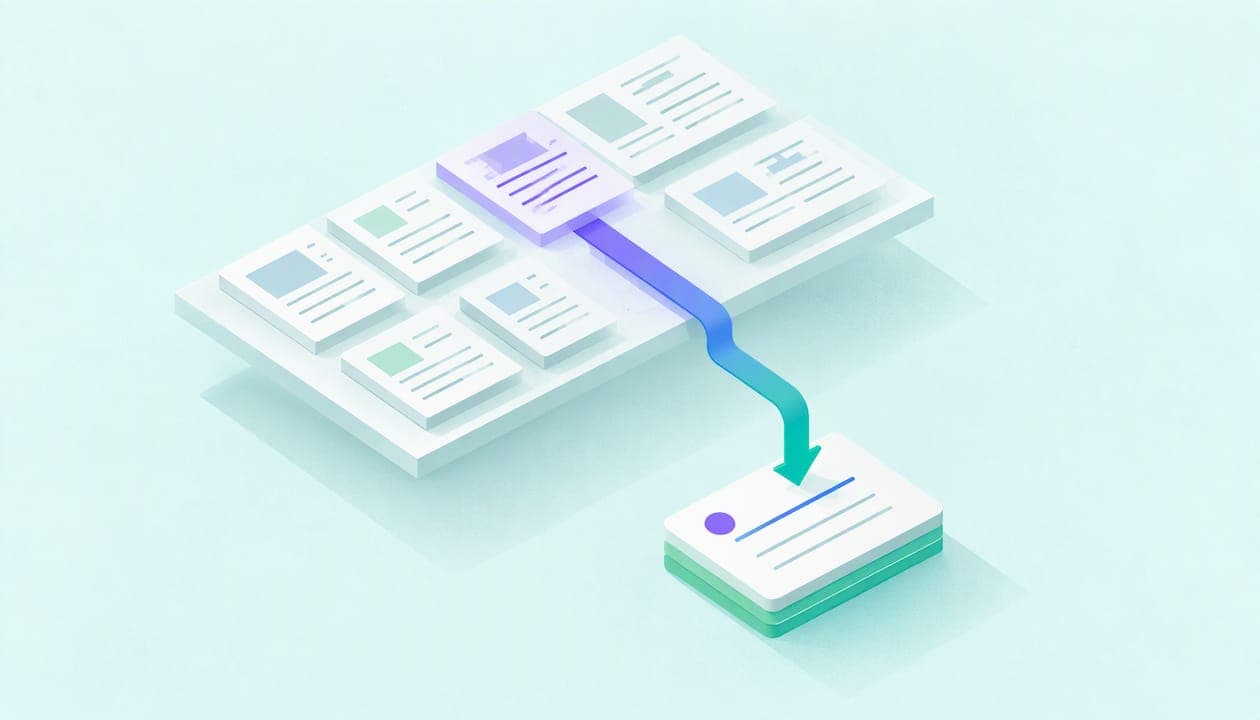
To turn an article into study notes, skim it first, read it in sections, and write the main ideas in your own words. Then turn those ideas into questions you can answer from memory. Notes that only copy or condense the text feel productive but teach very little. Notes that prompt you to recall the material are the ones that help on exam day.
This guide walks through a repeatable workflow for any article, whether it's a journal paper, a textbook chapter, a news feature, or a web page your professor assigned. It covers where AI helps and where it can't do the thinking for you.
TL;DR
- Skim before you read, read in chunks, and write notes in your own words instead of copying sentences.
- Finish every set of notes with questions and flashcards. Retrieval, not rereading, is what builds memory.
- AI can draft summaries, definitions and practice questions fast. You still check them against the source and do the analysis yourself.
- A good note page for one article fits on a single sheet: a thesis line, key ideas, evidence, your questions, and a short summary.
Table of Contents
- Why most article notes don't help you later
- A five-step workflow from article to study notes
- A one-page template for article notes
- What good notes capture from different kinds of articles
- Where AI helps with article notes, and where it doesn't
- Our perspective: notes are a starting line, not a finish
- Turning article notes into flashcards
- A worked example: a 6,000-word article in about 45 minutes
- Common mistakes to avoid
- Doing this faster with AtListen
- FAQ
- Sources
Why most article notes don't help you later
The common routine looks like this: read the article, highlight half of it, then paste the highlights into a document. The result is a shorter version of the article, and rereading it feels easy. That ease is the trap.
Learning-center guidance from Rutgers makes the point that effective notes depend on active reconstruction: you rebuild the idea yourself and then test whether you can recall it without looking. Rereading a summary gives a sense of fluency, but it doesn't prove you can retrieve the material under exam conditions.
So the goal isn't a prettier copy of the article. The goal is a set of notes that makes you do something with the content. That shapes every step below.

A five-step workflow from article to study notes

Step 1: Survey before you read
Spend five to ten minutes looking at the article's structure before reading a word of the body. The SQ3R method (Survey, Question, Read, Recite, Review) puts this survey first, and the University of Arizona's guide describes it as a way to break large, dense texts into manageable sections through active questioning. The method dates back to 1946.
In practice, check:
- The title, abstract or introduction, and the conclusion
- Every heading and subheading
- Figures, tables and captions
- Any bolded terms or pull quotes
Write one sentence guessing what the article argues. You'll revise it later, and the guess alone primes your attention.
Step 2: Turn headings into questions
Before reading each section, convert its heading into a question. "Methods" becomes "How did they test this, and could I trust the result?" A heading like "Causes of the 2008 crisis" becomes "What were the causes, and which does the author weight most?"
These questions give you something to look for while reading. They also become the cue column of your notes and, later, your flashcard fronts.
Step 3: Read one section at a time and annotate
Read a single section, then stop. Annotation guides from university libraries describe it as a dialogue with the text: you note main ideas, but also your reactions, questions, and connections to other readings. That's what moves a passive read toward critical analysis.
A simple margin code keeps this fast:
- ? for something confusing
- ! for something surprising or important
- = for a link to another reading or lecture
- Def for a term you'll need to define
For more on technique, the City University of New York's guide to active reading and annotation is a practical read.
Step 4: Recite, then write the note
Close the article, or look away from it. Say aloud or write what that section claimed, in your own words. Then reopen the text and fix what you missed or got wrong. This recite step is the one students skip, and it's the most valuable.
Now write the note. Keep it short: one to three lines per section. If you can't write it without looking, you haven't understood it yet, and that's useful information.
Step 5: Turn notes into questions and review on a schedule
Finish by converting each note into a question-and-answer pair. These can live in the margin of your notes or in flashcards. Then review them over several days rather than once. Our guides on active recall sessions and making effective flashcards go deeper on timing and card design.
A one-page template for article notes
A layout borrowed from the Cornell system works well for articles. The Cornell format splits the page into a narrow cue column, a wider note-taking area, and a summary at the bottom, with the summary written in your own words soon after you take the notes. For an article, adapt it like this:
| Part of the page | What goes there | Example |
|---|---|---|
| Header | Citation, date read, one-line purpose | "Assigned for Week 6 seminar; why does the author reject the standard view?" |
| Thesis line | The article's central claim in one sentence | "Remote work raised productivity only where managers set clear output goals." |
| Cue column (left) | Your questions from Step 2 | "What evidence supports the claim?" |
| Note column (right) | Key ideas, evidence, definitions, in your own words | "Sample: 1,200 employees, two years; gains strongest in routine tasks." |
| Your reactions | Doubts, links to lectures, possible essay angles | "Conflicts with Tuesday's reading on collaboration." |
| Summary (bottom) | Three sentences, written after closing the article | "The author argues..." |
The example figures in the table are illustrative, not from a real study. The structure is what matters: every piece of the page forces a decision about what the article actually says.
What good notes capture from different kinds of articles
Not every article deserves the same note shape.
Research papers
Capture the question, the method, the sample, the main finding, and the limitations. Skip most of the literature review unless it's the point of your assignment. Read the abstract, then the discussion, then go back for methods.
Argumentative essays and opinion pieces
Write the thesis, each supporting claim, and the type of evidence offered for each (data, anecdote, authority). Then add one line on where you disagree. Instructors often grade you on exactly that.
News and feature articles
Record who, what, when, where and why, then the claim the reporter makes beyond the facts. Note sources: who is quoted, and who is missing.
Textbook chapters and long explainers
Focus on definitions, processes, and worked examples. These convert most easily into flashcards and practice questions.
Where AI helps with article notes, and where it doesn't
AI tools are good at the mechanical parts of this workflow: pulling out key terms, drafting a first summary, and generating practice questions from a text. Research on generative AI in higher education suggests these tools are strong at scaffolding lower-order tasks such as organizing material or clarifying terminology. They show clear limits on analyzing, evaluating and creating, which you still have to do yourself.
That matches how study notes work. Let a tool do the sorting, then spend your own effort on the parts that build understanding.
What the evidence says about accuracy
A 2026 study of pre-clerkship medical students tested AI-generated lecture summaries and flashcards. With carefully engineered prompts, summaries showed no hallucinations and flashcards about 1 error in 21 (roughly 4.8%), while covering all faculty-defined learning objectives. Students reported time savings of 74% for flashcards and 61% for summaries.
Two cautions. First, this was a specific setting with structured prompts, not a guarantee for every tool or every article. Second, even a 4.8% error rate on flashcards means roughly one card in twenty could teach you something wrong. Spot-check cards against the source, especially numbers, names and definitions.
A safe AI routine for articles
- Do Steps 1 and 2 yourself first. Know what you're looking for.
- Give the tool the article and ask for a summary with section-by-section key ideas, definitions, and key facts. Ask it to stay inside the text.
- Compare the output against the article's headings. Anything that doesn't map to the text gets deleted.
- Write your own three-sentence summary before you read the AI's, then compare.
- Generate practice questions and answer them from memory before checking.
The prompt matters. In that same study, optimized prompts cut hallucination and improved coverage compared with default summaries, so tell the tool the format, the depth, and that it must not add outside information.
If your article is a research paper, our guide to summarizing research papers with verification first covers how to check claims. For PDFs, see how to get a bullet summary with page citations, and for general habits, our six-step approach to studying with AI also covers prompts and privacy.
Our perspective: notes are a starting line, not a finish
We built AtListen around a problem we hear from students constantly: there's too much to read and too little time, and the notes they do make rarely get used again. Converting an article into a summary is the easy part. The harder part is getting from a summary to something you can recall.
That's why we think of an article as raw material with three layers. The first is the structure: key concepts, definitions and key facts, which AI can produce in minutes from a PDF, web article, or even a YouTube URL. The second is the depth you need. A quick skim before class and a deep pass before an exam call for different amounts of detail, so we built depth control so you decide how condensed or thorough the output is. The third is the practice: questions with explanations and flashcards built for spaced repetition, so the material comes back at intervals instead of the night before.
What we don't claim is that a generated summary replaces reading. The research above says the opposite: rereading a tidy summary can give a false sense of mastery, and AI is weakest on the analysis your instructors actually grade. Our advice to students is to treat any generated note as a draft. Read it against the source, fix it, and then test yourself on it. A tool earns its place when it gives you more time for that testing, not when it lets you skip it.
— William
Turning article notes into flashcards
Once your notes are clean, flashcards are the fastest way to turn them into something you can practice. A few rules keep cards useful:
- One idea per card. "Why did the author reject the standard view?" beats a card that asks for three reasons at once.
- Write the question in your own words. Copying a sentence from the article tests recognition, not understanding.
- Include the why. Cards that ask "why" and "how" hold up better than pure definitions.
- Cap the first batch. Ten good cards per article beats forty thin ones.
If you want a worked method, see our five-step workflow for turning notes into flashcards and the guide to making ten atomic flashcards in five minutes. Studying a language? The article on turning material into vocabulary flashcards fits that case. Preparing for case-based exams? Try turning course notes into case study practice questions.
Research from Purdue's learning lab on prompting during retrieval practice is also worth a look if you want to see how the way a recall task is cued can change how well it works.
A worked example: a 6,000-word article in about 45 minutes
Say your sociology professor assigns a long article before Thursday's seminar. Here's one way to spend 45 minutes. The timings are a suggestion, not a measured result.
| Minutes | Task |
|---|---|
| 0 to 5 | Survey: headings, abstract, conclusion, figures. Write a one-sentence guess at the thesis. |
| 5 to 10 | Turn each heading into a question and put them in the cue column. |
| 10 to 30 | Read section by section, marking ?, !, = and Def. After each section, look away and write one to three lines. |
| 30 to 35 | Write your three-sentence summary without looking. Then check it against the text. |
| 35 to 45 | Turn notes into eight to ten question-and-answer cards. Answer them aloud once. |
The next day, answer the cards again before looking at anything. Two days later, repeat. By the time of the seminar you aren't rereading, you're retrieving.
Common mistakes to avoid
- Highlighting as note-taking. Highlights show what you noticed, not what you understood.
- Copying whole sentences. Paraphrasing forces processing. Copying doesn't.
- Taking notes on the first pass. Survey first, or you can't tell what matters.
- Trusting generated notes blindly. Check names, dates, figures and definitions against the source.
- Never reviewing. Notes you don't revisit are just storage.
Doing this faster with AtListen
If you'd rather not build every layer by hand, AtListen takes an article (paste it, upload a PDF, or drop in a web or YouTube link) and returns structured study material: a summary, key concepts with definitions, key facts, practice questions with explanations, and flashcards designed for spaced repetition. You choose the depth, and you can ask for a study plan around your exam date.
Plans are published on the site: Free at $0 per month, Pro at $19.99 per month, and Max at $39.99 per month. Start with the free plan on one assigned reading, compare the output to your own notes, and see whether the time saved is worth it. You can find the plans at atlisten.com.
FAQ
How do I take notes from an article without copying it?
Read one section at a time, look away, and write what it said in your own words. Then check the text and correct gaps. Paraphrasing forces you to process the idea, which is the reason to take notes at all.
How long should study notes for one article be?
A page is usually enough: a thesis line, key ideas with evidence, your own questions, and a three-sentence summary. If your notes are a third of the article's length, you're probably condensing rather than selecting. Cut to what you'd need to answer an exam question.
Can AI turn an article into study notes reliably?
It can do the sorting and first draft well, and one 2026 medical-education study found very low error rates with carefully built prompts. But that doesn't cover every tool or text, so verify names, numbers and definitions against the original. Do the analysis and evaluation yourself, since that's where AI is weakest.
Should I take notes before or after reading the full article?
Both, in different forms. Survey the structure first and write down questions. Then take notes section by section as you read, and write a closing summary from memory once you've finished.
What's the best format: outline, Cornell, or mind map?
For most articles, a Cornell-style page works best because the cue column and summary build in self-testing. Outlines suit tightly structured texts, and mind maps suit articles with many linked concepts. Pick the format that ends with questions you can answer from memory.
Sources
- Rutgers Learning Centers: evidence-based study strategies
- University of Arizona: Guide to the SQ3R Method
- Graduate Theological Union Library: Annotation, Reading to Retain Information
- CUNY: Active Reading and Annotation
- Cal Coast: The Cornell Note Taking Method
- BMC Medical Education: From lectures to learning outcomes (2026)
- The Impact of AI-Powered Text Generation on Undergraduate Students' Critical Thinking
- Purdue Learning Lab: Does Providing Prompts During Retrieval Practice Improve Learning?