

The fastest, most reliable way to study is retrieval practice, not rereading. Use flashcards with spaced repetition, timed practice tests or past papers, the Feynman technique, blurting (brain dumps), and question generation from your own notes. Each forces your brain to pull information out of memory instead of just recognizing it on a page, and that struggle is exactly what makes the memory stick.
TL;DR:
- Retrieval practice methods like flashcards, brain dumps, and practice tests significantly improve long-term retention compared to passive rereading.
- Spaced repetition scheduling enhances active recall effectiveness by reviewing material just before it is forgotten, maximizing memory consolidation.
- Creating high-quality flashcards involves focusing on recall-promoting questions, avoiding recognition-based prompts, and regularly revising or rewriting weak cards.
- Short, focused study sessions of five to ten minutes with immediate feedback benefit students with attention challenges like ADHD.
- AI tools can streamline study material creation, reducing setup time and enabling students to dedicate more effort to active retrieval.
Table of Contents
- What Is Active Recall, and Why Does It Beat Rereading?
- What Are the Best Active Recall Techniques to Use?
- How Do You Combine Active Recall With Spaced Repetition?
- What Does a Real Active Recall Study Session Look Like?
- How Do You Write Flashcards That Actually Test Memory?
- How Should You Adapt Active Recall for ADHD or Short Attention Spans?
- What Does the Research Actually Say About Retrieval Practice?
- A Straight-Talking Take on What Actually Works
- Can an AI Study Tool Speed Up Building Flashcards?
- Sources
- FAQ
What Is Active Recall, and Why Does It Beat Rereading?
Active recall is the practice of forcing your brain to retrieve information from memory instead of passively consuming it off a page or a slide. Instead of rereading a chapter and nodding along because the words look familiar, you close the book and try to reproduce the idea from scratch. That gap between "this looks familiar" and "I can actually explain this" is where real learning happens.
The mechanism behind it is called the testing effect. Every time you retrieve a memory, you rebuild it rather than simply replaying it, and that reconstruction process strengthens the neural pathways attached to it. Roediger and Karpicke's foundational work found that students who tested themselves on material retained it far better a week later than students who reread the same material multiple times, even though the rereaders felt more confident going into the final test.
Statistic Callout: A 2024 systematic review found retrieval-practice strategies were consistently associated with better academic outcomes for young adults across a range of study designs and subjects, not just isolated lab experiments.
That consistency across contexts is what separates active recall from most study hacks: it holds up whether you're memorizing anatomy terms or working through calculus problems.
What Are the Best Active Recall Techniques to Use?
Different methods fit different moments in your study cycle. Here's how to pick the right one for the job.
- Flashcards. Best for discrete facts, vocabulary, formulas, and definitions. Write one fact per card, phrase the front as a question, and avoid cramming two ideas onto a single card. Once you're reviewing a large deck, an Anki-style spaced algorithm saves you from wasting time on cards you've already mastered.
- Blurting or brain dumps. Set a timer for five to ten minutes and write down everything you remember about a topic with your notes closed. This is the fastest way to find gaps before you waste time studying material you already know.
- The Feynman technique. Explain a concept out loud in plain language, as if teaching it to someone with no background in the subject. The moment you stumble or reach for jargon to cover a gap, you've found exactly what needs more work.
- Question generation. Turn your lecture notes and textbook headers into test questions, then quiz yourself later without looking. This works especially well alongside Cornell-style notes, where the margin cues become ready-made prompts.
- Practice tests and past papers. The highest-transfer method for exam prep, because it rehearses the exact retrieval conditions you'll face on test day, including time pressure and question phrasing.
Pro Tip: Pair blurting with a blind comparison. After your brain dump, check only the parts you missed against your notes and restudy those gaps. Rereading everything from the top wastes time you don't have.
Vocational and licensing exams reward this same approach. Realistic closed-book practice tests built to mimic certification conditions consistently outperform passive review guides for exam-day readiness.

How Do You Combine Active Recall With Spaced Repetition?
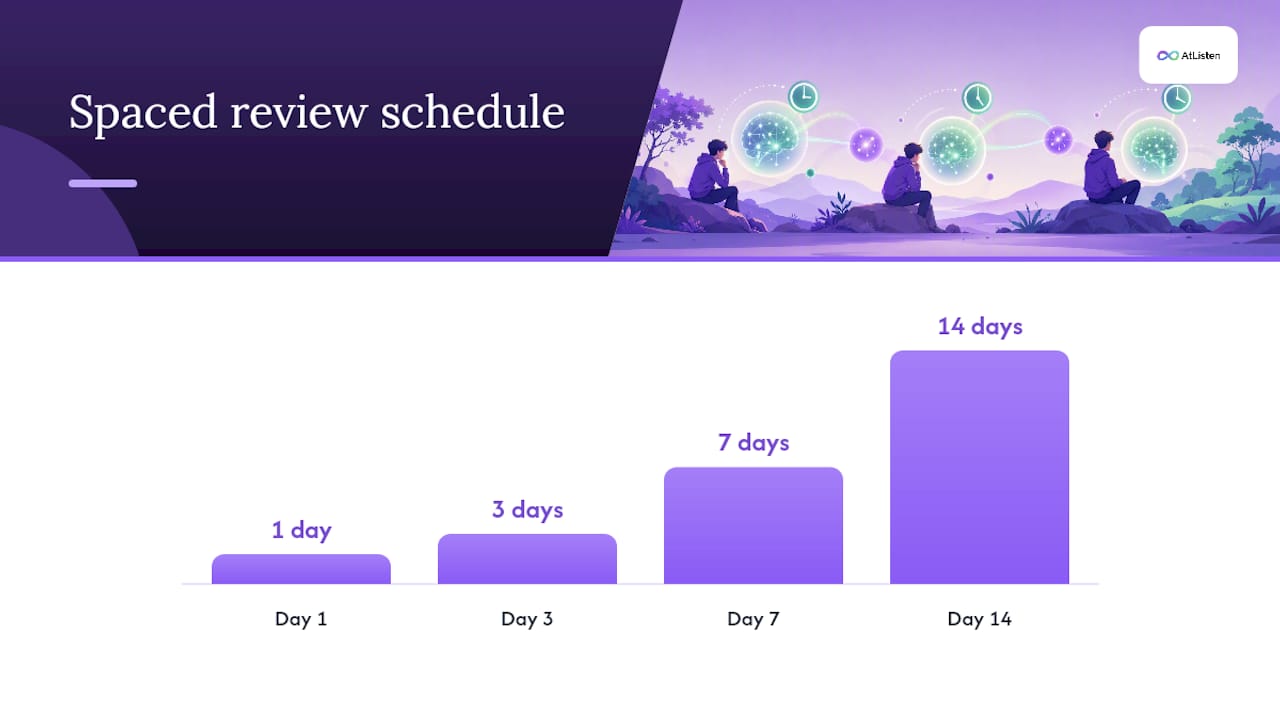
Active recall is the method; spaced repetition is the schedule. Retrieval practice works because it's harder than rereading, but timing your reviews so they land right before you'd naturally forget the material multiplies that effect. Cramming everything into one session wastes effort on facts you already know cold.
A simple schedule that works for most students:
- Day 0: Learn the material and do a first retrieval attempt (flashcards or a brain dump).
- Day 1: Review, focusing only on what you missed the first time.
- Day 3: Retrieve again; anything still shaky gets flagged for extra reps.
- Day 7: One more retrieval pass to lock in medium-term memory.
- Day 14: A final check before the material can be considered stable.
If a card or topic keeps failing, shrink the interval back down instead of pushing forward on schedule. Spacing reviews before forgetting sets in concentrates your remaining study hours on the material that actually needs them. Software like Anki automates the interval math for you; a paper calendar works fine too, as long as you actually follow it.
What Does a Real Active Recall Study Session Look Like?
Theory is useless without a template you can run today. Here are three, sized to how much time you actually have.
- Quick session (15 minutes): Five minutes of blurting on the day's topic with notes closed, then ten minutes of targeted flashcard review on whatever you got wrong.
- Focused topic session (25 to 45 minutes): Read the material once, then spend 10 to 20 minutes retrieving it from memory before checking your notes. Finish with 10 to 15 minutes writing or reviewing cards on the gaps you found.
- Practice-exam block (60 to 90 minutes): Attempt a timed past paper under real exam conditions, self-mark it honestly, then spend the remaining time restudying only the questions you missed.
How Do You Write Flashcards That Actually Test Memory?
Most weak flashcards fail for the same reason: they test recognition, not recall. A card that shows a definition and asks you to match a term is easy to answer wrong on purpose but right by accident, because your brain half remembers the shape of the answer without truly retrieving it.
- Put one fact or one decision per card. If a card needs two answers, split it into two cards.
- Favor "why" and "how" prompts, or application questions, over bare definitions you can pattern match.
- Use contrast prompts ("How does X differ from Y?") for concepts students commonly confuse.
- Tag or delete cards you answer correctly five times in a row; rewrite cards you keep missing into a simpler, more specific question.
- For dense PDFs or slide decks, pull out one concept per slide and turn the slide title into a question before you build the card.
Pro Tip: If you can answer a card correctly without reading the whole question, it's testing recognition, not recall. Rewrite it so the answer requires an actual retrieval effort.
How Should You Adapt Active Recall for ADHD or Short Attention Spans?
Long, unstructured study blocks are the enemy of consistency, especially with attention differences. Shrinking the unit of work, not the ambition, is what makes retrieval practice sustainable.
- Break sessions into five to ten minute retrieval bursts instead of open-ended study blocks, and treat each burst as a complete unit you can walk away from.
- Use a visible timer so the session has a hard, predictable endpoint rather than a vague "study for a while" goal.
- Get immediate feedback: check answers right after each attempt instead of stacking up a pile to review later.
- Rank topics by how shaky they feel and tackle the weakest one first, before focus fatigue sets in.
- Keep a simple checklist of cards or questions completed so small wins are visible in real time.
What Does the Research Actually Say About Retrieval Practice?
The evidence base for active recall isn't a single study; it's decades of converging results. A 2024 systematic review found retrieval-practice strategies linked to better academic outcomes across multiple study designs, adding recent, broad-based confirmation to older classroom research.
- Roediger and Karpicke's classic experiments showed students who tested themselves outperformed rereaders on delayed recall tests, despite feeling less confident right after studying.
- Pre-testing research from the University of Chicago's Learning Lab found that attempting to answer questions before instruction, not just after, improves later retention and transfer.
- For further reading, the Birmingham City University active recall guide and the Kang, Lindsey, Mozer, and Pashler reprints linked above cover the mechanism in more depth than any single blog post can.
A Straight-Talking Take on What Actually Works
Combining timed flashcard decks with real past-paper attempts under exam conditions has always beaten any single method used alone. The hard part is never knowing that retrieval practice works. It's the setup time: pulling questions out of a 40-slide lecture or a dense textbook chapter takes real effort on a normal week. That's the actual bottleneck for most students, not motivation.
An automated workflow that turns raw lecture material into flashcards and questions in minutes removes that bottleneck without changing the underlying method. Atlisten does exactly that.
— William
Can an AI Study Tool Speed Up Building Flashcards?
Building a solid flashcard deck or a set of practice questions from scratch takes hours you probably don't have during midterms. Some AI tools convert lectures, textbook PDFs, slides, and YouTube videos into structured study materials quickly, including summaries, key concepts with definitions, practice questions, and flashcards.

For a student juggling five classes, the time savings show up where it matters most: less time formatting cards, more time actually retrieving from them. Depth control features can let users adjust between quick overviews and detailed exam-ready breakdowns, with instant feedback to flag weak spots during study sessions. If privacy is a concern, the security page covers how your uploaded material is handled, and parents of younger students can check the COPPA privacy policy for details on under-13 use. Upload your next lecture recording or textbook chapter to Atlisten and see your first flashcard deck generated before your coffee gets cold.
Sources
- Systematic review: Active recall strategies associated with academic achievement in young adults
- What is active recall? The best study method explained (and how to use it) - Birmingham City University
- Adding spaced repetition to your study toolkit — Thrive (University of Arizona)
- Selected publications on retrieval practice and test-enhanced learning (Kang/Lindsey/Mozer/Pashler 2014 PDF)
FAQ
What's the 3-2-1 method for studying?
There's no single standardized "3-2-1" study framework backed by research; the name is used loosely across study guides for different systems, so it's best treated as informal advice rather than an established method. If you've seen a specific version cited, check its source before adopting it as a rule.
What is the 2-3-5-7 revision rule?
Like the 3-2-1 method, this isn't a standardized, research-backed framework. It resembles informal spacing schedules some students use, but the reliable version is the day 0, 1, 3, 7, 14 spacing pattern covered earlier in this guide.
Is active recall good for ADHD?
Yes, when it's broken into short bursts. Five to ten minute retrieval sessions with a visible timer and immediate feedback tend to sustain focus far better than long, open-ended study blocks.
What are the best websites or tools for active recall?
Flashcard apps with spaced repetition built in, past-paper archives for your specific exam, and tools like Atlisten that generate flashcards and practice questions directly from your lecture notes all support active recall study effectively.