
Active learning cuts failure rates and raises average scores compared to sitting through lectures or rereading notes. You do not need to redesign a course or your whole study routine to see the benefit. Start with one small swap this week: a 5-minute pause during a lecture, a Think-Pair-Share exchange, or turning your notes into practice questions instead of highlighting them again.
TL;DR:
- Active learning significantly reduces failure rates and improves exam scores, especially benefiting students with lower prior achievement by 1.5 times.
- Implementing brief pauses, Think-Pair-Share, and retrieval practice can be integrated into existing study routines with minimal planning or technology.
- Small, deliberate swaps such as short micro-lectures and structured questioning have measurable effects within a few sessions rather than requiring full course redesigns.
- Resistance from students can be mitigated by explaining the evidence-based benefits, providing low-stakes checks, and gradually increasing task difficulty.
- Tools like Atlisten facilitate quick conversion of recordings and PDFs into active-study materials, saving time and reinforcing concepts through automated practice questions and flashcards.
Table of Contents
- What Passive to Active Learning Actually Means
- The Evidence: What Meta-Analyses and Trials Actually Show
- Simple Swaps and Active Techniques You Can Use Right Now
- A Step-by-Step Plan to Make Active Study a Habit
- How Instructors Can Introduce Active Learning Without a Full Overhaul
- Turning Recordings and Readings Into Active Study Material With Atlisten
- Where Active Learning Runs Into Trouble
- What the Shift Looks Like Across Different Subjects
- The Tools That Make Active Learning Easier to Sustain
- How to Know If the Switch Is Actually Working
- Keeping Motivation From Fading After Week One
- One Swap This Week Is Enough
- Turn Any Lecture or PDF Into Active Study Material
- Sources
What Passive to Active Learning Actually Means
Passive learning happens when you receive information without acting on it: listening to a lecture, rewatching a video, rereading a chapter. Active learning happens when you do something with that information: explain it, apply it, question it, or teach it back.
The shift changes two roles at once. The student stops being a recipient and becomes a builder of understanding. The instructor stops transmitting facts and starts facilitating the work of making sense of them. That distinction sits at the center of most classroom guidance on the topic, including Carnegie Mellon's teaching resources, which frames active learning as asking students to explain, compare, and connect ideas rather than absorb them.
A few side-by-side examples make the contrast concrete:
- Passive: A 50-minute uninterrupted lecture with students taking notes.
- Active: A 40-minute lecture broken into 8-minute chunks, each followed by a 2-minute pause to jot down questions.
- Passive: Rereading a textbook chapter the night before an exam.
- Active: Closing the book and writing five questions you think the exam might ask, then answering them from memory.
This is the deep processing versus shallow processing distinction cognitive scientists talk about. Shallow processing skims the surface of information. Deep processing forces your brain to manipulate it, which is what makes it stick.
The Evidence: What Meta-Analyses and Trials Actually Show
The case for active learning is not soft. It's one of the more replicated findings in education research.
A meta-analysis covering 225 studies found that students in traditional lecture courses were significantly more likely to fail than students in classes using active learning, and average exam scores improved when instructors added active elements, according to the PNAS meta-analysis.
By the numbers: A randomized cross-over trial in medical school found active large-group sessions produced modestly higher test scores and a higher "feeling of learning" than passive lecture format, with the largest gains among students in the lower half of the class by prior achievement, per the randomized trial published in medical education research.
What that means in practice:
- Struggling students gain the most from active formats, which makes active learning as much an equity tool as an engagement tool.
- The failure-rate difference alone (1.5 times higher in lecture-only classes) is large enough that switching formats functions like adding a safety net, not just a nice-to-have adjustment.
- Gains show up in test scores and in self-reported understanding, so the benefit isn't just a testing artifact.
Simple Swaps and Active Techniques You Can Use Right Now
You don't need new software or a semester of planning. You need a timer and a willingness to interrupt the flow.
-
Run a micro-lecture, not a marathon. Cap any single stretch of talking or reading at 5 to 10 minutes. After each chunk, insert a 1 to 5 minute activity: a pause to jot a summary, a question to answer, or a short discussion. The pause procedure research suggests pausing three times for about 2 minutes during a 50-minute lecture produces measurable gains in retention.
-
Use Think-Pair-Share on a real clock. Pose a question. Give students 1 to 2 minutes to think alone and write something down. Pair them up for 2 to 3 minutes to compare answers. Then open the floor for 1 to 2 minutes of shared responses. The full cycle runs 1 to 5 minutes, which makes it usable inside almost any class period without derailing the agenda.
-
Build retrieval practice into every study session. Instead of rereading, close your notes and write out what you remember. Turn headings into questions before you read the answers. Use spaced flashcards that resurface material right before you'd naturally forget it.
Here's what that looks like across a 50-minute session, whether it's a class or a solo study block:
The article offers a typical 50-minute session breakdown combining micro-lectures, brief pauses for note-taking or questions, Think-Pair-Share, and retrieval practice to foster active engagement.
Pro Tip: Set a phone timer for your pauses instead of trusting yourself to remember. The whole method fails quietly when the interruption gets skipped because "we're almost at a good stopping point."
A Step-by-Step Plan to Make Active Study a Habit
Habits beat willpower, and this one builds in about three passes over the same material.
-
Before you study: Set one specific objective ("understand how enzymes lower activation energy," not "study biology"). Skim headings and figures for two minutes. Write three questions you expect the material to answer.
-
During study: Work in focused blocks of 20 to 30 minutes. Read or watch in short chunks, then stop and explain the concept out loud or in writing, in your own words, before moving on.
-
After study: Close everything and take a short practice test from memory. Convert weak spots into flashcards using spaced repetition so they resurface just before you'd forget them. Track a simple number, like the percentage of questions you got right cold, so you can see whether the method is working.
-
Across the week: Increase the difficulty of your retrieval questions as recall improves, and compare how confident you felt against how you actually scored. A gap between confidence and performance is the clearest signal that you were reviewing passively without realizing it.
Pro Tip: If your cold-recall score is above 85 percent every time, the questions are too easy. Push toward material that makes you fail sometimes. That's where the retention gains actually come from.
How Instructors Can Introduce Active Learning Without a Full Overhaul
You don't have to convert a whole syllabus at once. Pick one session, swap one ten-minute chunk of lecture for an active routine, and see what happens before scaling further.
- Add a single Think-Pair-Share or pause procedure per class and build from there rather than redesigning every session simultaneously.
- Tell students why you're changing the format. Resistance drops sharply when students understand the shift is backed by evidence, not classroom filler, an argument Johns Hopkins' academic support center makes directly when discussing student pushback.
- Use quick, low-stakes checks for understanding, such as a one-question exit ticket, so you're not relying only on exam results to know whether the swap worked.
- When your own feedback bandwidth is limited, structure peer feedback with a short rubric or checklist so students still get a response to their thinking, not just a grade weeks later.
- End each active segment with a specific debrief prompt, like "write one thing that changed about how you'd answer this now," so students leave with something concrete instead of a vague sense that "class was interactive today."
Piloting one swap for five sessions before expanding is a pattern backed by practical guidance on scaffolding active learning transitions, and it also protects instructors from the burnout that comes with rebuilding a whole course overnight.
Turning Recordings and Readings Into Active Study Material With Atlisten
Building active-study materials by hand, questions, flashcards, summaries, takes time most students don't have. A tool converts lecture recordings, PDFs, textbooks, and video into structured study packages: summaries, key concepts with definitions, practice questions with explanations, and flashcards built for spaced repetition, with depth control so you decide how detailed the output gets.
Two workflows show how this plugs into the swaps above. Upload a recorded lecture and get a set of practice questions ready for retrieval practice before your next study block. Upload a textbook chapter and get flashcards plus a spaced review plan, skipping the manual work of writing your own cards. The Atlisten platform handles the conversion in minutes.
Where Active Learning Runs Into Trouble
Active learning isn't a fix that works identically everywhere, and pretending otherwise sets people up to abandon it after one rough session.
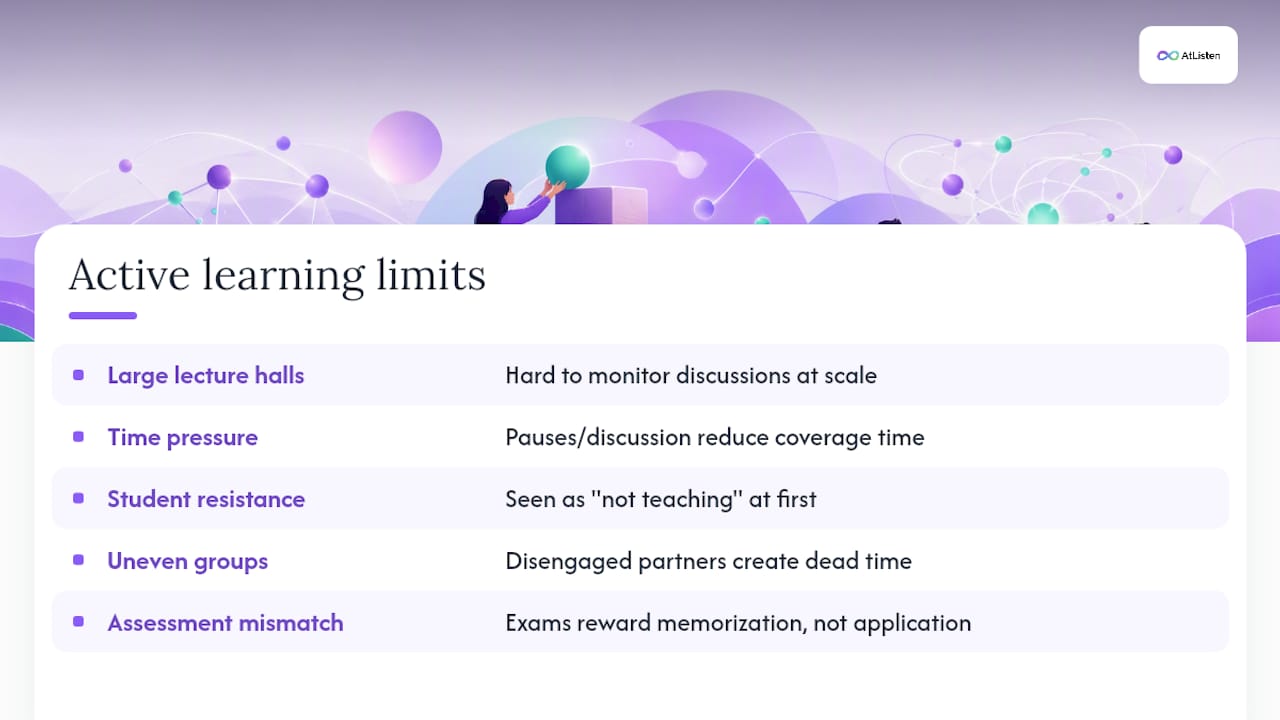
Large lecture halls make some techniques harder to run. A 300-person auditorium doesn't allow for roaming discussion the way a 25-person seminar does, though Think-Pair-Share and pause procedures still scale reasonably well because they don't require instructors to monitor every conversation.
Time pressure is real on both sides. Instructors covering a fixed amount of content worry that pauses and discussion eat into material they need to get through. Students juggling multiple courses sometimes see active study techniques as slower than rereading, even though rereading produces weaker retention for the same time invested.
Student resistance shows up early. Some students interpret discussion time as the instructor "not teaching," especially if they've spent years in lecture-based classrooms and associate learning with note-taking volume. This fades with repetition and clear explanation of why the format changed, but it rarely disappears the first week.
Uneven group dynamics can undercut peer-based activities. Think-Pair-Share and group work depend on partners who actually engage; a disengaged partner can turn a 3-minute pairing into dead time for the other student.
Assessment mismatch is a quieter problem. If exams reward memorization of lecture content word for word, active learning that emphasizes conceptual application can feel disconnected from how students are ultimately graded, which undermines motivation to keep doing it.
None of these limitations erase the size of the effect. They mean the rollout has to be deliberate rather than assumed to work identically in every room.
What the Shift Looks Like Across Different Subjects
The passive-to-active shift takes a different shape depending on what's being learned, but the underlying move, replacing reception with construction, stays consistent.
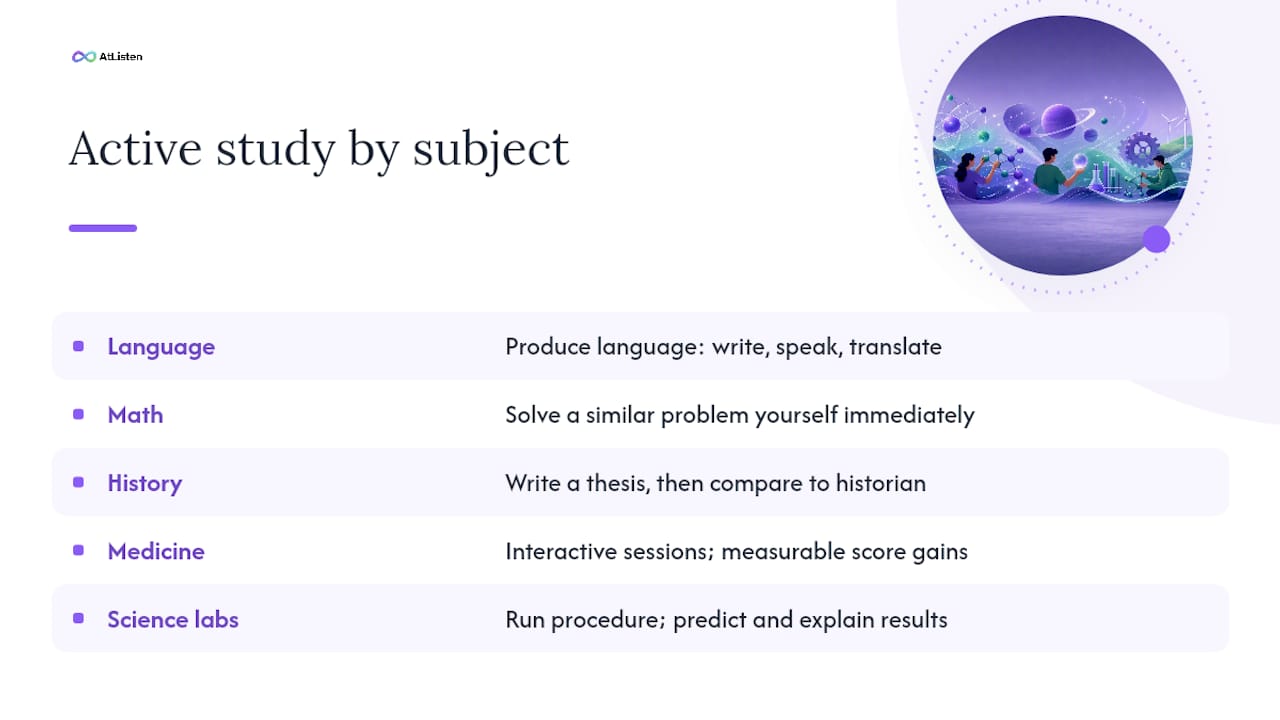
In language learning, passive study means listening to audio or reading vocabulary lists. Active study means producing the language: writing sentences with new words, having a short conversation, or translating a paragraph without looking at a reference. Recall-based flashcard drilling with spaced repetition outperforms passive relistening for vocabulary retention.
In math and quantitative subjects, passive learning means watching an instructor solve a problem on the board. Active learning means solving a similar problem yourself immediately after, ideally before seeing the full solution, so you engage with the struggle rather than just the demonstration.
In history and humanities, passive learning means reading a textbook chapter start to finish. Active learning means writing your own thesis statement about a historical event before checking how a historian argued it, then comparing your reasoning to theirs.
In medicine and clinical training, the randomized trial cited earlier tested exactly this shift in large-group sessions, replacing the passive lecture format with interactive components, and found measurable score gains, particularly for students starting from a weaker baseline, according to the PMC analysis of the trial.
In science labs, passive learning is watching a demonstration. Active learning is running the procedure yourself, predicting the outcome before you see it, and explaining any mismatch between prediction and result.
The common thread across every discipline: whatever the subject, the passive version has you observing someone else's thinking, and the active version has you producing your own.
The Tools That Make Active Learning Easier to Sustain
Technology doesn't create active learning by itself, but the right tool removes enough friction that people actually keep doing it.
Classroom response systems and polling tools let instructors run quick comprehension checks mid-lecture without stopping to collect paper. Spaced-repetition flashcard systems automate the timing of review, which matters because most students underestimate how quickly memory fades without a nudge. Note-to-question converters, including AI tools like Atlisten, take passive inputs, lecture recordings, PDFs, slides, and turn them into the retrieval-ready formats (practice questions, flashcards, summaries) that active study actually depends on.
Multimodal materials matter too. Some learners engage more deeply with visual or narrative formats than with straight text; research summarized by Brainie Comics on graphic novels points to real engagement gains for readers who struggle with dense prose, a reminder that "active" doesn't have to mean "text-based drilling" for every learner.
The common failure mode with technology isn't picking the wrong tool. It's picking a tool that makes review easier without making retrieval harder, since retrieval difficulty is exactly what drives the memory benefit. A flashcard app that lets you passively flip through cards without testing yourself first offers little advantage over rereading. The tools worth keeping are the ones that force you to produce an answer before you see it.
How to Know If the Switch Is Actually Working
Assessment for active learning has to measure more than whether students showed up and participated.
Short, frequent low-stakes quizzes track retention over time better than a single midterm, because they catch forgetting early enough to correct it. Comparing pre- and post-test scores on the same content, before and after introducing an active segment, isolates whether the specific swap helped rather than just general course exposure.
Confidence-versus-performance tracking is one of the more useful individual metrics: if a student rates themselves as "very confident" but scores poorly on a cold retrieval test, that gap flags an illusion of competence that passive review tends to produce. Instructors can build this into exit tickets by asking students to predict their own score before checking it.
For instructors, participation data alone is a weak proxy. A student who talks during Think-Pair-Share hasn't necessarily learned more; what matters is whether their explanation, written or spoken, shows they can apply the concept in a new context, not just repeat a phrase from the lecture.
The clearest signal remains outcome-based: exam scores, failure rates, and retention on delayed tests weeks later, not just immediate quiz performance. The PNAS meta-analysis measured exactly these outcomes across 225 studies, which is part of why its findings carry more weight than a single classroom's satisfaction survey.
Keeping Motivation From Fading After Week One
The hardest part of switching to active learning usually isn't the first session. It's week three, when the novelty wears off and the extra effort starts to feel like a tax.
Small, visible wins help more than long-term promises. Tracking a simple recall percentage week over week gives students concrete proof the method is working, which sustains effort better than being told it "should" help eventually.
Pacing the difficulty matters too. If retrieval questions stay too easy, the exercise feels pointless; if they jump too hard too fast, it feels discouraging. Increasing difficulty gradually, in step with rising confidence and accuracy, keeps the activity in a productive middle zone.
For instructors, checking in explicitly about the format, not just the content, keeps students from silently disengaging. A brief mid-semester question like "is the pause procedure helping or just interrupting?" surfaces problems before they calcify into resentment.
Pairing active techniques with lower-stakes grading initially reduces the anxiety of doing something new in front of peers, which matters because much of the early resistance to active learning comes from fear of visible failure rather than disagreement with the method itself.
The students who stick with active study techniques tend to be the ones who saw a measurable result early. That's the real argument for tracking something, anything, from the first week rather than waiting for a final exam to find out if the swap was worth it.
One Swap This Week Is Enough
The biggest mistake people make with active learning is treating it as an all-or-nothing renovation. It isn't. Pick one lecture, one study session, one habit, and swap it. The discomfort of doing something new fades within a few tries, and the payoff, in retention, in confidence, in actual scores, shows up faster than most people expect. Track something simple. Adjust. Repeat.
— William
Turn Any Lecture or PDF Into Active Study Material
Reading and rereading is the easiest passive habit to fall back into, especially when you're short on time and just need something to review before an exam. Atlisten skips the manual work of building your own practice questions and flashcards by converting what you already have, lecture recordings, textbook PDFs, class notes, YouTube videos, straight into retrieval-ready study packages in minutes.
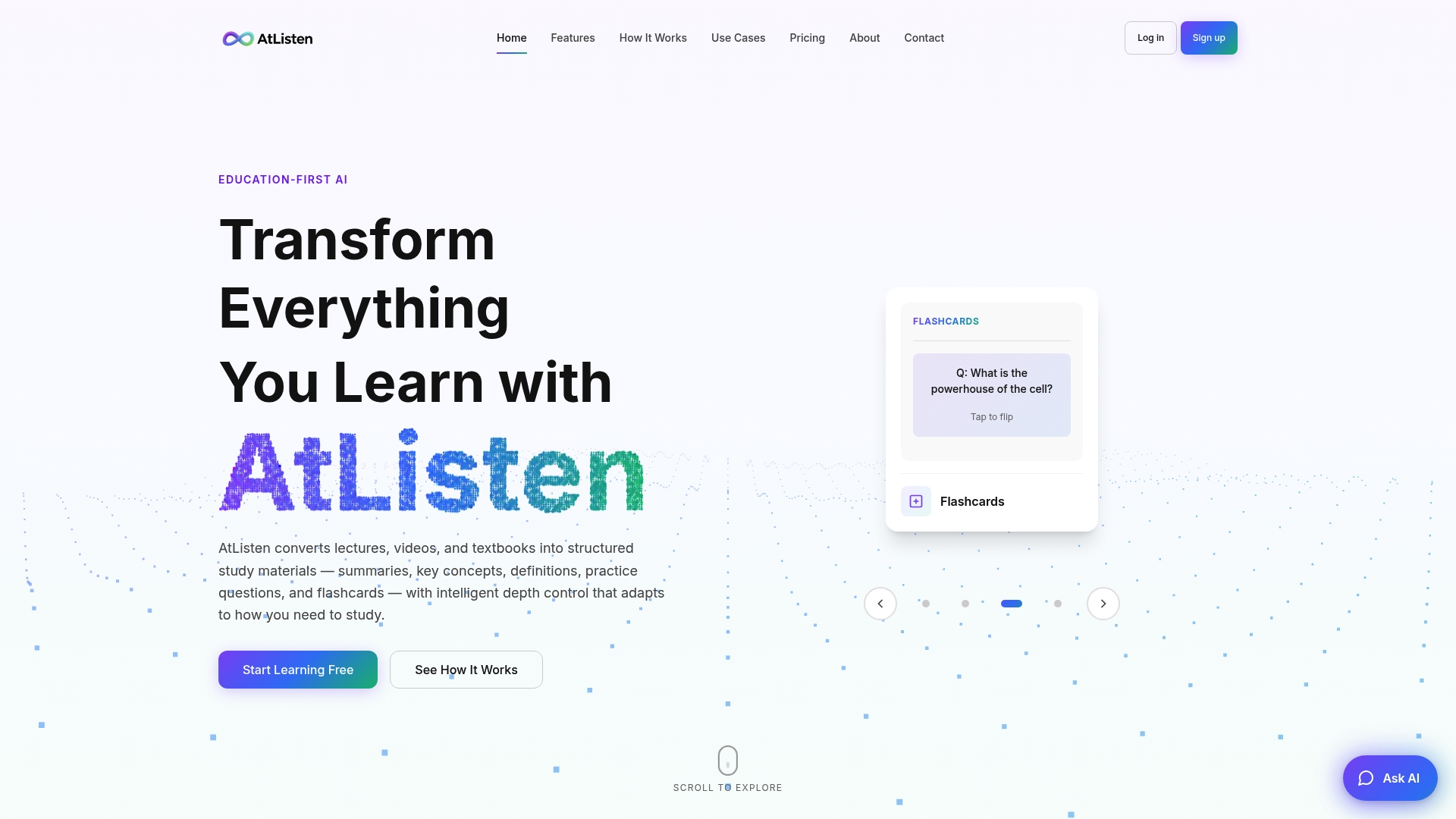
You control the depth, so a dense chapter can become a tight set of key concepts or a full breakdown with practice questions and explanations, whichever your study block calls for. Instructors and parents evaluating the platform for younger students can review how Atlisten handles data for users under 13 before signing up. Try the free tier on the Atlisten landing page with your next lecture recording or PDF and see how much study time a converted set of flashcards actually saves you.