
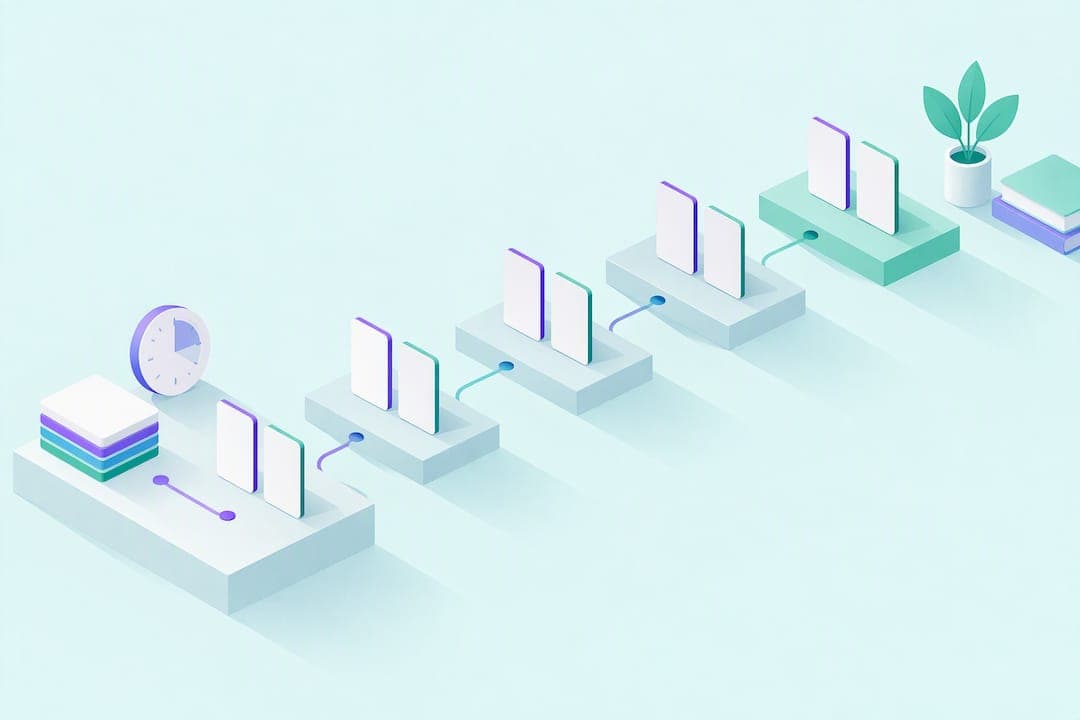
The fastest way to revise with flashcards is to use active-recall cards combined with spaced retrieval and brief elaboration on each card. In the next five minutes, pick one topic, write 10 atomic cards, and run a single timed self-test to see what actually sticks. Tools like AtListen can automate the card-making step so you spend your time testing yourself instead of formatting index cards.
TL;DR:
- Spaced review sessions significantly outperform cramming, with research showing long-term retention improves when distribution intervals extend over days.
- Creating atomic flashcards that prompt recall with concise answers and meaningful elaboration increases effectiveness compared to broad, recognition-based cards.
- Using a scheduling system like Leitner, where correct answers move to less frequent review boxes, optimizes spacing and minimizes review of mastered material.
- Automating flashcard generation from lecture recordings or textbooks with tools like AtListen helps produce deep, atomic cards quickly, saving hours of manual work.
- Ignoring the self-test and retention schedule steps diminishes flashcard routines and can lead to superficial learning despite frequent exposure.
Table of Contents
- What flashcards are and why they work
- How to make effective flashcards
- How to study with flashcards: spacing, Leitner, and a real schedule
- Paper versus digital flashcards: pick the format you will actually use
- Using AtListen to turn notes into spaced, elaborated flashcards
- Common mistakes that quietly wreck a flashcard routine
- Fitting flashcards into a broader study method
- Tools and apps worth considering for flashcard creation and review
- A quick study session, in practice
- Let AtListen build your flashcard deck for you
- FAQ
- Sources
What flashcards are and why they work
A flashcard pairs a prompt with an answer you must produce from memory, not recognize from a list. That act of pulling information out of your head, called active recall, strengthens memory more than rereading notes or highlighting text.
Spacing out your review sessions over days instead of cramming them into one sitting produces meaningfully better long-term retention. In a 2009 study by Kornell, spaced flashcard practice outperformed massed cramming for the vast majority of participants, even though many of those same learners said afterward that cramming felt more effective. That gap between what feels productive and what actually works is called the fluency illusion, and it is the main reason flashcard routines fail: people mistake quick recognition for durable memory.
Each mechanism points to a concrete payoff. Retrieval practice surfaces exactly what you have not learned yet, and spacing locks in what you have, which together beat rereading on almost any exam.
How to make effective flashcards
Good cards follow a few rules that make them easy to schedule and hard to fake.
- Keep each card atomic: one fact, one date, one definition, one relationship per card, never a compound question with two answers hiding in it.
- Write the front as a prompt that forces recall, like a question or a fill-in-the-blank, not a statement you can passively reread.
- Write the back as a short, direct answer, then add one sentence of paraphrase and a self-generated example. This elaboration step, sometimes called Flashcards-Plus, was linked to higher exam scores in classroom studies compared with plain flashcards.
- Add an image or mnemonic only when it removes genuine ambiguity, not as decoration. A cue should shrink the answer, not pad it.
- If a card's answer needs more than one short paragraph to state correctly, split it into two cards. That keeps every card makable as right or wrong.
Pro Tip: Rate your recall by how much effort it took to retrieve the answer, not by how obvious it seems once you flip the card.
This last point matters more than it sounds. Flipping a card and thinking "oh yes, I knew that" is recognition, not recall, and it is exactly the fluency illusion that makes cramming feel deceptively productive.
How to study with flashcards: spacing, Leitner, and a real schedule
Spacing beats cramming because memory consolidates between sessions, not during them. Kornell's comparison found that spreading practice across sessions produced stronger retention than massing the same practice into one block, even at equal total study time.

The Leitner system turns that principle into a simple routine: cards you get right move to a box reviewed less often, cards you miss drop back to a box reviewed daily. A basic three-box version works on paper or inside most flashcard apps that track correct and incorrect answers automatically.
A practical four-week plan for an exam-sized topic:
- Week 1: build 10 to 15 atomic cards per session, test immediately, and review the same deck the next day.
- Week 2: add new cards daily, but review week-1 cards every two to three days instead of daily.
- Week 3: stretch review intervals to four to five days for mastered cards, keep missed cards on a daily cycle.
- Week 4: run full-deck practice tests every other day, mixing new and old material, and retire any card you have gotten right five times in a row.
A single study session should follow a fixed shape:
- Warm up with five previously mastered cards to build momentum.
- Work through new cards for the session's topic, writing the answer before flipping.
- Review due cards from the Leitner schedule, moving each one forward or back based on accuracy.
- Finish with a short self-test, written from memory without the deck, covering the session's full topic.
Paper versus digital flashcards: pick the format you will actually use
Paper cards are cheap, portable, and force full handwriting, which some learners find strengthens recall. Digital decks automate spacing schedules, support audio and images, and sync across devices, which matters for mixed-media subjects like language learning.
Neither format wins on its own. Some recent classroom and randomized studies on digital flashcards show they support engagement and retention, but format alone does not guarantee better results. What matters is whether you are actually retrieving, not recognizing.
- On paper, cover the answer fully and say it aloud or write it before looking.
- On an app, turn off multiple-choice or hint modes and use a recall-only setting that requires typing or speaking the answer.
- Schedule at least one fully written self-test per week, regardless of format, since writing from memory exposes gaps that flipping cards can hide.
Using AtListen to turn notes into spaced, elaborated flashcards
Building atomic, elaborated cards by hand for a full course takes hours most students do not have. AtListen converts lectures, PDFs, textbooks, and even YouTube videos into structured study material, including flashcards designed for spaced review, so the construction step described above happens automatically.
A typical workflow looks like this:
- Upload a lecture recording, slide deck, or textbook chapter in whatever format you already have it.
- Let the tool generate atomic flashcards with depth control, so each card targets one fact or concept.
- Add a one-sentence paraphrase or personal example to a handful of cards, applying the Flashcards-Plus elaboration step yourself.
- Schedule spaced reviews across the following days using the plan outlined above.
Pro Tip: Run one lecture through the free plan before your next quiz to see whether the auto-generated cards match how you actually think through the material.
The instant feedback feature is useful here too: it flags weak answers immediately instead of waiting for a test to reveal the gap.
Common mistakes that quietly wreck a flashcard routine
The biggest mistake is building recognition cards instead of recall cards, questions with the answer embedded in multiple-choice options or obvious context clues. These feel productive and teach almost nothing.
Cramming an entire deck the night before an exam is the second most common error, and it directly contradicts the spacing research above. A related mistake is making cards too broad: a single card asking "explain the French Revolution" cannot be marked right or wrong, so it never gets scheduled properly.

Many learners also skip the self-test step entirely, flipping through a deck once and assuming exposure equals learning. Without an effort-based judgment of recall, as described earlier, it is easy to mistake a quick glance for mastery.
Finally, letting a deck grow without ever retiring mastered cards turns review sessions into slow slogs through material you already know, which kills momentum faster than almost anything else. Prune a card once you have nailed it several times in a row and trust the schedule to bring it back if you start to slip.
Fitting flashcards into a broader study method
Flashcards are strongest as a retrieval layer on top of other study methods, not a replacement for them. Read or watch a lecture first to build context, then convert the material into atomic cards for the facts, definitions, and relationships worth memorizing long-term.
Pair flashcards with practice problems for subjects that require application, like math or chemistry, since cards handle recall of formulas and definitions, while worked problems handle the reasoning steps. For essay-based subjects, use cards for key terms and dates, then write short practice outlines from memory to test structural recall. Dunlosky et al.'s review of study strategies found that practice testing and distributed practice are among the most effective techniques available, far ahead of rereading or highlighting, which supports combining flashcards with low-stakes self-quizzing rather than passive review.
Distributed practice also transfers well outside academic subjects. A simulator-based training approach for pilots preparing for line-oriented evaluations uses the same spacing logic: short, spaced practice sessions beat one long cramming block, whether the material is vocabulary or a flight procedure.
Tools and apps worth considering for flashcard creation and review
A good flashcard tool should make atomic card creation fast and enforce spacing automatically, since manual tracking is where most routines fall apart. AtListen fits this role when your starting material is a lecture, PDF, or video rather than material you are typing from scratch, since it extracts structured cards directly from the source instead of requiring manual entry.
For learners who prefer typing their own decks from a blank slate, a general flashcard app with a built-in spaced-repetition algorithm handles the scheduling math so you do not have to track Leitner boxes by hand. Whatever app you choose, confirm it supports a recall-only mode and lets you add a short paraphrase or example to each card, since those two features map directly to the evidence-based routine covered above.
The right choice depends on your starting point: convert existing course material automatically, or build a deck manually in an app with strong spacing controls. Either path works as long as the cards stay atomic and the review schedule stays spaced.
A quick study session, in practice
Last week I converted one dense lecture into 10 atomic cards and ran a 20-minute cycle: five minutes writing cards, ten minutes testing myself aloud, five minutes scheduling follow-up reviews for two and five days out. One card read: front, "what does the fluency illusion cause learners to do," back, "mistake easy recognition for real mastery, often leading them to under-review material they haven't actually learned." The follow-up review two days later caught exactly that gap on two cards I had rated too confidently. Adjust the 20-minute cycle to whatever block fits between your own classes.
— William
Let AtListen build your flashcard deck for you
Turning a two-hour lecture into a usable flashcard deck by hand is the part of this routine most students skip, which is exactly why decks end up thin or recognition-based instead of atomic and recall-focused. AtListen uploads handle PDFs, lecture recordings, textbooks, and video links, then generate structured flashcards with depth control so you land on atomic, testable cards instead of vague summaries.

- Start on the Free plan to test whether the generated cards match your course material and study habits.
- Move to Pro or Max for deeper depth control and higher usage limits as your course load grows. Current prices are on the pricing page.
- Everything you upload is handled under our security practices, which matter when you are uploading full lecture recordings or class notes.
Try AtListen's plans on your next lecture and see how close the auto-generated deck gets to the cards you would have built by hand.
FAQ
Are flashcards a good way to revise?
Yes, flashcards are effective when they force active recall rather than recognition, and when review sessions are spaced over days rather than crammed into one. Dunlosky et al.'s review ranks practice testing, the core mechanism behind flashcards, among the most effective study strategies available.
How do I use flashcards for revision?
Write atomic cards with one fact per card, test yourself by producing the answer before flipping, and add a short paraphrase or example to deepen understanding. Schedule review using a Leitner-style system so cards you get wrong return daily and cards you master get reviewed less often.
Is studying with flashcards effective?
It is effective specifically when paired with spacing and self-testing, not when used for passive rereading. Kornell's 2009 study found spaced flashcard practice was more effective for the vast majority of participants, even though many preferred cramming subjectively.
How do I make flashcards for revision?
Keep each card to a single fact or concept, phrase the front as a question or prompt that requires recall, and write a concise answer on the back followed by a one-sentence paraphrase or example. Split any card whose answer takes more than a short paragraph into two separate cards so it stays easy to mark right or wrong.
Sources
- Optimising learning using flashcards: Spacing is more effective than cramming - Kornell - 2009 - Applied Cognitive Psychology
- Strengthening the student toolbox: study strategies to boost learning — John Dunlosky et al., American Educator (2013)
- Studies on Flashcards-Plus effectiveness — Appleby / Flashcards-Plus (2017)