
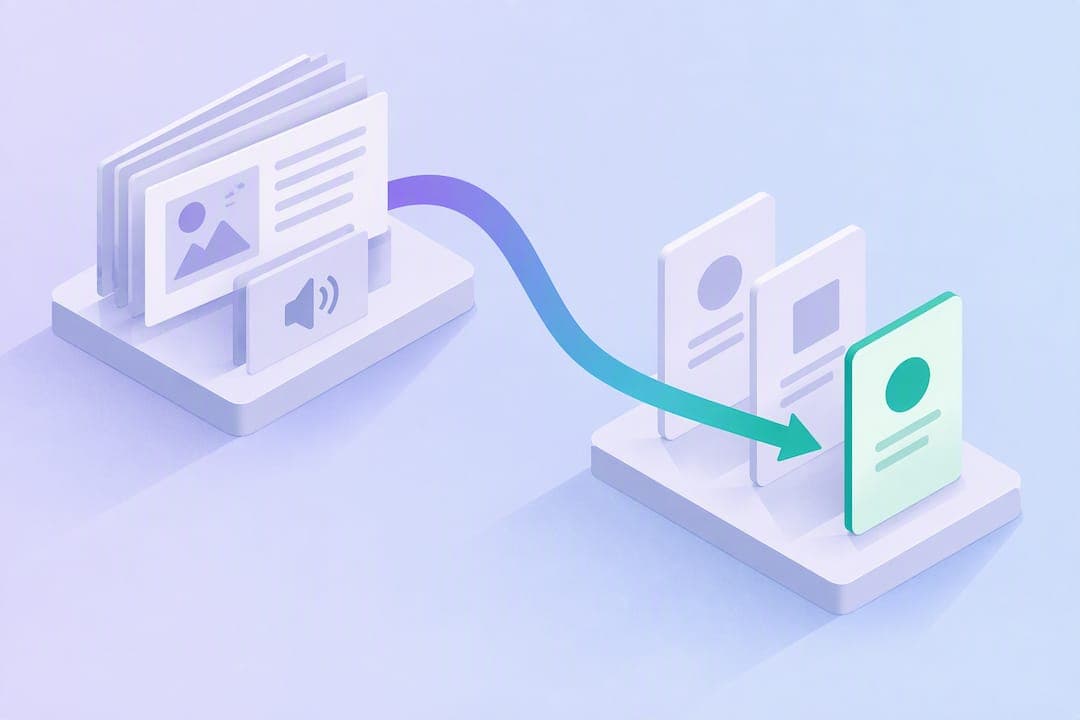
Use ready-made flashcard sets built for your exact goal, then run them through spaced retrieval instead of one big cram session. That combination beats homemade cards on time and beats casual review on retention. If you're studying from lecture recordings, PDFs, or class notes, a tool like Atlisten can turn that material into flashcards in minutes, so you skip straight to the part that actually builds memory.
TL;DR:
- Using premade flashcard sets aligned with your specific exam or coursework can save time while still providing targeted vocabulary practice.
- Spaced review intervals, especially expanding over time, significantly enhance long-term retention compared to continuous massed practice.
- Creating your own cards offers a memory boost through active retrieval, but editing premade sets can balance speed and personalized learning.
- Digital platforms with a spaced-repetition engine, example sentences, and audio support improve vocabulary gains more than basic flip cards or printable sets.
- Turning course materials into flashcards with tools like Atlisten allows efficient, customized review sessions, especially before exams or quizzes.
Table of Contents
- Which Vocabulary Flashcards Should You Actually Use?
- How Do You Use Flashcards Effectively?
- Should You Make Your Own Flashcards or Use Premade Sets?
- Digital Apps or Printable Cards: What Actually Helps You Learn?
- How Atlisten Turns Course Material Into Study-Ready Flashcards
- Try Atlisten: Which Plan Fits Your Study Needs
- The Real Problem With Flashcard Advice
- Sources
- FAQ
Which Vocabulary Flashcards Should You Actually Use?
The right flashcard set depends entirely on what you're studying for, not which app has the flashiest interface. A learner cramming for the GRE needs something different from a ninth grader building general vocabulary or a parent printing cards for a seven-year-old at the kitchen table.
Exam-focused libraries work best when they're built around the actual test. Good SAT or GRE sets group words by Latin and Greek root families, which helps you decode unfamiliar words on test day even when you've never seen that exact term before. Look for sets that track which cards you've mastered and which keep tripping you up.
Core academic lists matter for college coursework, especially in fields with dense, specialized terminology like biology, law, or economics. These sets should tie each word to the discipline it comes from, not a generic dictionary definition.
High-frequency and general vocabulary lists serve anyone building broader reading comprehension or preparing for standardized tests without a narrow syllabus.
Printable packs still matter. Not every study session happens near a screen, and offline cards work well for younger learners or anyone who wants a distraction-free format.
Before committing to a set, run it through a short checklist:
- Does it cover the words your specific exam or course actually tests?
- Are there example sentences, not just isolated definitions?
- Is part of speech labeled clearly?
- Can you track which cards you've learned versus which need more work?
- How recently was the set updated?
How Do You Use Flashcards Effectively?
Most people use flashcards wrong. They flip through the whole deck once, feel like they've studied, and move on. That's called massed practice, and it produces weak, short-lived recall. The fix is spacing: reviewing cards at increasing intervals instead of all at once.
A 2012 study on the spacing effect found that school-aged learners who spaced their vocabulary review had better meaning recall at both one week and five weeks compared to learners who massed their practice. The gap didn't shrink over time. It held.
Spacing works because it times review to happen right before you'd otherwise forget, not right after you learned something. That single principle explains most of why flashcards succeed or fail.
Here's a routine that puts that research into practice:
- Learn a batch of new words in one sitting, testing yourself immediately after seeing each one.
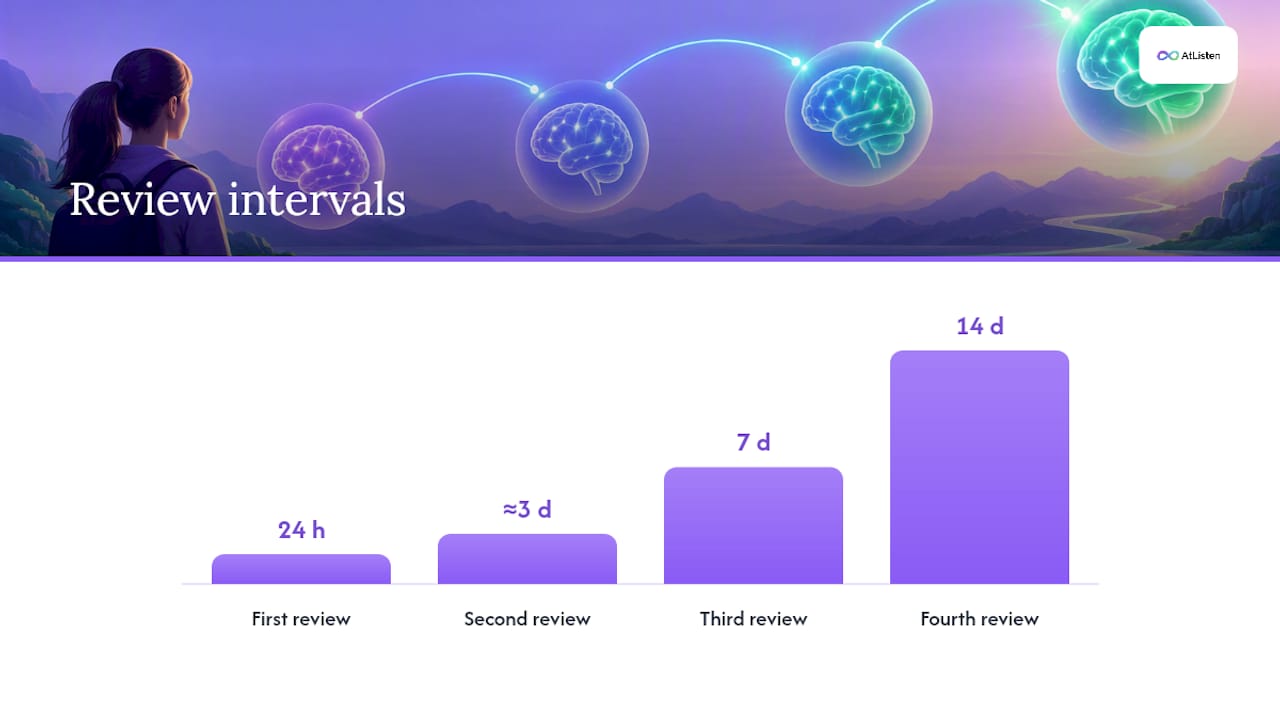
- Review that batch again within 24 hours.
- Space subsequent reviews further apart, roughly 3 days, then 7, then 14, adjusting based on how well you recall each card.
- Actively recall the answer before flipping the card. Don't just read the front and back passively.
- Note every miss and shorten that card's next interval.
Research on L2 vocabulary learning confirms that spacing improves both meaning recall and meaning-to-form matching compared to massed schedules. The mechanism is retrieval practice: forcing your brain to pull an answer from memory strengthens that memory far more than simply rereading it does.
Pro Tip: Expanding intervals (gradually lengthening the gap between reviews) show a modest edge over fixed, equal spacing in controlled comparisons. In practice, start with short, equal gaps for brand-new words, then switch to expanding intervals once a card feels easy. Trying to expand too early on a genuinely hard word just means you forget it before the next review.
Should You Make Your Own Flashcards or Use Premade Sets?
Making your own cards has a real research edge, but it costs time most learners don't have. Across six experiments comparing user-generated and premade digital flashcards, self-generated cards produced better delayed test performance, with an effect size around d ≈ 0.45 for definition recall. Generating content forces a round of retrieval before you even start formal review, and that extra effort pays off later.
Premade sets win on speed. If you're facing an exam in two weeks, building 400 cards from scratch eats into study time you don't have.
A simple framework for deciding:
- Tight timeline, broad topic: use a premade set as-is.
- Specialized course material: premade sets rarely match your syllabus closely enough, so build your own or edit a premade base.
- Plenty of time, personal mastery goal: generate your own cards for the retrieval boost.
The middle path works for most people: pick a solid premade set, then rewrite the trickiest cards in your own words or add a personal example sentence. That small generative step captures some of the self-generation advantage without the full time cost. Before trusting any premade set, check it for accuracy, real usage context (not just a bare definition), and whether it's built around a spaced-repetition algorithm rather than a static list.
Digital Apps or Printable Cards: What Actually Helps You Learn?
Format matters less than the features behind it. A flashcard app with no spacing engine is just a digital version of the same static deck you'd print at home.
Look for these in any digital tool:
- A spaced-repetition engine that adjusts intervals automatically based on your performance, not a fixed daily list.
- Flexible scheduling so you can review on your own timeline instead of the app's.
- Example sentences and audio pronunciation, especially for language learning where sound and usage matter as much as spelling.
- Export and import options so your work isn't locked into one platform.
Interaction type matters too. Typed recall and cloze deletion (fill-in-the-blank) formats push deeper encoding than a simple flip card, because you have to produce the answer rather than just recognize it. If a platform only offers multiple-choice or basic flipping, you're getting weaker retrieval practice than you could.
For printable cards, clarity beats decoration. Label part of speech clearly, and group related words by root or affix (like all the "-tion" or "bio-" words together) so patterns emerge naturally as you review.
A 2023 study on mobile-assisted vocabulary learning found that digital flashcard users showed larger vocabulary gains than students using traditional materials, partly because the format supported better self-regulation, goal-setting, and progress tracking built right into the review process. If you study across a phone, tablet, and laptop, syncing progress across devices keeps that tracking intact instead of resetting every time you switch screens.
How Atlisten Turns Course Material Into Study-Ready Flashcards
Most students don't lack motivation. They lack time to convert three hours of lecture recording into something they can actually review. That's the gap Atlisten closes: upload a lecture, a PDF, a textbook chapter, or a YouTube link, and it generates structured flashcards, key terms, and practice questions built for spaced retrieval.
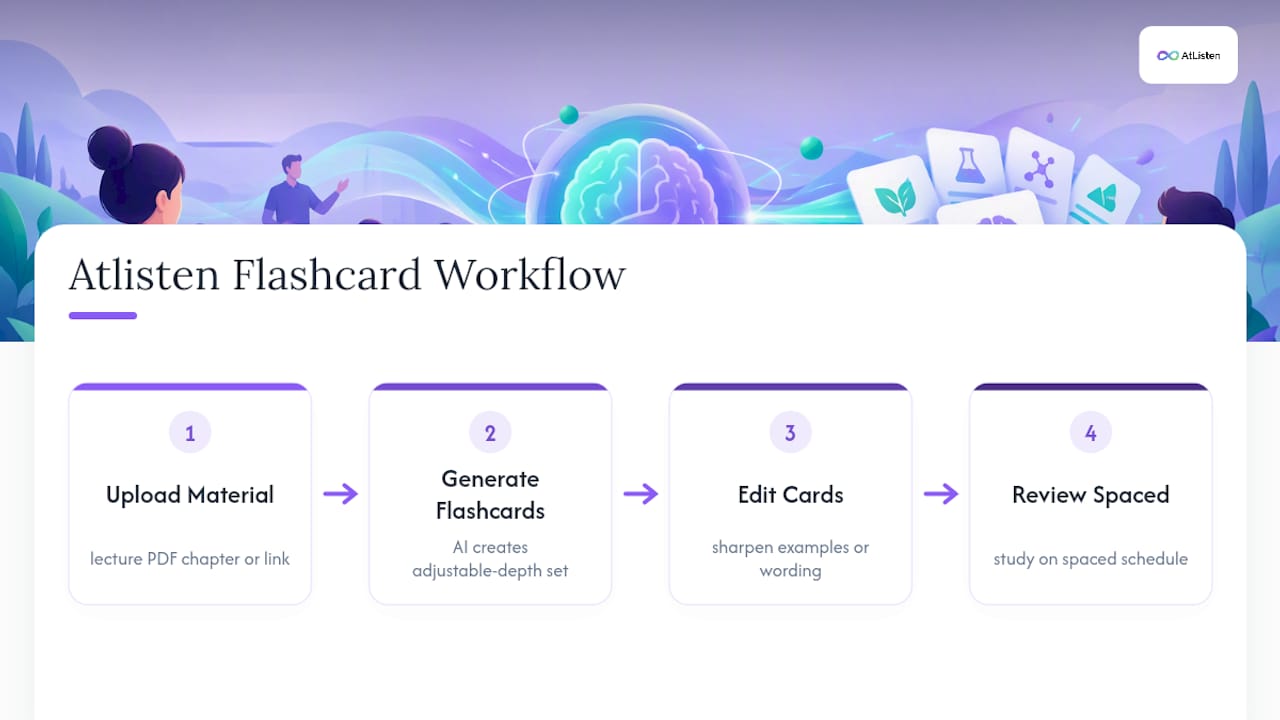
The workflow is simple. Upload your material, let the AI generate a flashcard set with adjustable depth, edit any card that needs a sharper example or a personal rewrite, then start reviewing on a spaced schedule instead of a single cram session.
It works well for turning a semester's worth of lecture recordings into an exam-ready deck, building a discipline-specific term list for a dense course, or putting together a fast review package the night before a quiz.
Try Atlisten: Which Plan Fits Your Study Needs
Atlisten's advantage over a plain flashcard app or a static premade deck is simple: it builds the deck for you, straight from material you already have, so you're not stuck manually typing definitions between classes.

If you're testing the waters, the Free plan lets you convert a lecture or PDF into a flashcard set and try the spaced-schedule review without any cost. If you're managing a full course load or heavy exam prep, Pro at $19.99 per month or Max at $39.99 per month unlock deeper conversion limits and more control over how much detail each flashcard includes. Anyone uploading recorded lectures or personal notes can check how that material is handled on the security page before getting started.
Upload one lecture recording or textbook chapter today, and you'll have a flashcard set ready for your first spaced review session within minutes.
The Real Problem With Flashcard Advice
Most flashcard guides treat the format as the whole solution. Buy a deck, flip through it, done. That's backwards. The card is just a delivery mechanism. The thing that actually builds memory is what happens in the second or two before you flip it, that brief, uncomfortable moment where you're forcing your brain to produce an answer instead of recognizing one.
I'd argue the biggest mistake learners make isn't picking the wrong flashcard set. It's treating every card the same way regardless of how well they know it. A word you've nailed five times in a row doesn't need daily review. A word you keep missing needs to show up again tomorrow, not next week. Static study schedules ignore this completely, and that's exactly why an algorithm that adjusts intervals based on your actual performance outperforms a fixed daily quota.
The other overlooked point: spacing helps most with explicit vocabulary knowledge, the kind you can consciously define and explain. Its effect on more tacit, intuitive language sense is smaller and less consistent. If your goal is fluent, instinctive language use rather than passing a vocabulary quiz, flashcards are one tool among several, not the entire strategy. Pair them with reading and listening in context, and don't expect a deck of cards to do work that immersion does better.
— William
Sources
- Goossens et al., 2012 — spacing effect study (JCP)
- Nakata & Elgort (2021) — Effects of spacing on contextual vocabulary learning
- Frontiers in Psychology (2023) — Mobile-assisted academic vocabulary learning with digital flashcards
- Supplemental materials for user-generated vs premade digital flashcards (2022)
FAQ
What Are Some Good Flashcards to Improve Vocabulary?
The best sets match your specific goal: root-based lists for standardized tests, discipline-specific terms for coursework, or high-frequency word lists for general reading comprehension. Prioritize sets with example sentences and built-in spaced-repetition scheduling over ones that just list bare definitions. Atlisten can also generate a custom set directly from your course material if a generic list doesn't fit your syllabus.
What Is the Easiest Way to Memorize Vocabulary?
Active retrieval on a spaced schedule is the most reliable method researchers have identified for vocabulary retention. Learn a batch of words, test yourself the next day, then space reviews out further as you get each card right, since spacing produced better recall at one and five weeks compared to cramming everything at once.
Do Flashcards Actually Work for Vocabulary Learning?
Yes, particularly when paired with spaced review rather than a single read-through. A 2023 experimental study found students using digital flashcards showed larger vocabulary gains than those using traditional study materials, along with stronger self-regulation habits.
Can You Give Me an Example of 20 Vocabulary Words to Start With?
Rather than one fixed list, start with a set matched to your actual goal, since a random list of 20 words rarely serves an exam or coursework need well. Ready-made libraries organized by root families or academic discipline, checked against your specific test or class, give you a far more useful starting point than a generic word list.