

The fastest way to remember what you study is to pair active recall with spaced repetition. Testing yourself on material, then reviewing it again right before you'd naturally forget it, outperforms rereading and highlighting in study after study. Layer on elaboration, interleaving, mnemonics, and chunking, and you've got a complete, evidence-backed system for turning study time into information that actually sticks on exam day.
TL;DR:
- Active recall and spaced repetition are proven to significantly improve long-term retention compared to rereading or highlighting.
- Demonstrating concepts aloud and interleaving different problem types strengthen understanding and skill application.
- Proper study routines incorporate daily retrieval sessions, difficulty tagging, interleaving, and weekly self-quizzes for effective learning.
- Adequate sleep, exercise, hydration, and stress management critically support memory consolidation and recall ability.
- Tools like AtListen automate the creation of structured study materials, streamlining effective retrieval and spaced learning workflows.
Table of Contents
- The Core Memory Retention Techniques Worth Your Time
- How Do You Build a Study Routine Around These Techniques?
- Why Sleep, Exercise, and Nutrition Affect What You Remember
- The Illusion of Competence: Why Rereading Feels Productive but Isn't
- Applying These Techniques With AtListen
- Why Attention and Fewer Distractions Change What You Actually Retain
- Can Mindfulness and Meditation Actually Improve Memory?
- Techniques for Encoding Information So It Actually Sticks
- My 7-Day Starter Plan for Better Retention
- Try AtListen to Put These Techniques on Autopilot
- Sources
- FAQ
The Core Memory Retention Techniques Worth Your Time
Six techniques carry most of the research weight when it comes to remembering what you study. None of them require special equipment. All of them require more effort than rereading, which is exactly why they work better.
Active recall is the practice of testing yourself instead of passively reviewing notes. Cover your notes and try to write down everything you remember about a topic (a method often called "blurting"), work through practice problems cold, or quiz yourself with flashcards before checking the answer. Studies summarized by The Focused Student show active recall can more than double retention compared to simply reading material again. The mechanism is straightforward: the struggle to retrieve information strengthens the memory trace far more than recognizing it on a page ever could.
Spaced repetition takes that testing effect and adds a schedule. Instead of reviewing a topic five times in one night, you review it once, then again after a day, then after three days, then after a week, expanding the interval each time you recall it successfully. Review too early and the recall feels easy. That ease is actually a warning sign that you're reviewing before you need to.
Elaboration, often taught as the Feynman technique, means explaining a concept out loud in plain language as if teaching a beginner. The moment you stumble is the moment you've found a gap worth closing. NINDS research on spaced skill learning backs the idea that this kind of deeper processing supports more durable skill consolidation.
Interleaving mixes problem types within a single session instead of grinding through one type at a time. Math students who interleave algebra, geometry, and calculus problems get better at recognizing which method a problem calls for. That skill doesn't show up when you drill twenty of the same problem in a row.
Dual coding and mnemonics pair images with words. A memory palace, where you mentally place facts along a familiar route through your house, works because it forces visual and verbal encoding at once. Acronyms and rhymes do the same job on a smaller scale.
Chunking groups scattered facts into fewer, larger units. Seven random digits are hard to hold in working memory. One phone number is easy.
- Turn passive review into a quiz using flashcards or blank-page recall
- Space reviews at expanding intervals instead of cramming them together
- Explain concepts aloud and note exactly where you get stuck
- Mix problem types in the same session instead of blocking by chapter
- Pair unfamiliar terms with a quick mental image
- Group related facts into a single memorable chunk
Pro Tip: If a flashcard feels easy every single time, you're reviewing it too often. Push the interval out further and spend that time on the cards you actually miss.
How Do You Build a Study Routine Around These Techniques?
A technique only works if you actually use it on a schedule. Here's a simple weekly structure that combines daily retrieval with proper spacing.
- Run a 20 to 30 minute active-recall session each day. Pick one topic, close your notes, and write or say everything you remember before checking accuracy.
- Tag each item by difficulty right after recall. Anything you nailed gets pushed out several days. Anything shaky gets reviewed tomorrow.
- Reserve one weekly session for interleaving. Mix three or four topics from different chapters and quiz yourself across all of them in random order.
- Add a timed practice round weekly, especially before exams, to rehearse retrieval under the same pressure you'll feel in the actual test.
- Pick one to three key ideas per chapter to encode deeply, rather than trying to memorize every line of your notes with equal intensity.
You don't need an app to run spaced repetition. A simple box system with index cards sorted into "review tomorrow," "review in three days," and "review next week" works fine. Digital flashcard tools automate the scheduling so you're not manually sorting cards, which matters most when you're juggling several classes at once.
Pro Tip: End every session by writing down the one concept that gave you the most trouble. That single line becomes tomorrow's first quiz question.
Why Sleep, Exercise, and Nutrition Affect What You Remember
Memory isn't built only at your desk. What you do between study sessions determines how much of that work survives.
Sleep is when your brain consolidates the day's learning into long-term storage, and NINDS points to 7 to 9 hours a night as the target for most adults trying to retain new material. Pulling an all-nighter to cram trades away the exact process that would have locked in what you studied.
Exercise matters almost as much. Regular aerobic activity increases blood flow to the hippocampus, the brain region most involved in forming new memories, and is linked to better memory performance according to Harvard Health. A brisk 20 to 30 minute walk before a study session can prime your brain for the work ahead.
- Sleep 7 to 9 hours nightly, especially the night before recall-heavy tests
- Take a short walk or do light cardio before a study block
- Stay hydrated and eat regular meals; dehydration and blood sugar swings hurt focus
- Manage stress through breaks, social contact, and realistic workloads
Mayo Clinic's memory guidance lists physical activity, social interaction, organization, and sleep among seven practical habits shown to support sharper recall over time.
The Illusion of Competence: Why Rereading Feels Productive but Isn't
Rereading your notes feels like progress because the material becomes familiar. Familiarity is not the same thing as retrieval, and that gap is what researchers call the illusion of competence. You recognize the answer on the page, so your brain assumes you'd remember it later, too. You often wouldn't.
Highlighting suffers the same flaw. It marks what looks important without forcing you to recall anything. Cramming the night before adds a second problem: massed practice produces short-term recognition that evaporates within days, while spaced and interleaved retrieval practice builds memories that hold up weeks later.
- Swap rereading for closed-book recall or blank-page summaries
- Swap highlighting for turning each highlighted line into a quiz question
- Swap cramming for short daily sessions spaced across the week
- Swap passive review for teaching the material to someone else, real or imagined
Applying These Techniques With AtListen
Manually building flashcards and practice questions from a semester's worth of lecture recordings and PDFs eats hours you don't have. AtListen converts lectures, textbooks, and notes into structured study materials, summaries, key concepts, practice questions with explanations, and flashcards built for spaced repetition, so the retrieval and spacing workflow described above takes minutes to set up instead of an entire evening.
The depth control feature matters here specifically because encoding effectively means picking the right level of detail for each concept rather than treating every fact as equally important. Instant feedback on practice questions also closes the loop that makes retrieval practice work: you need to know immediately whether your recall was right or wrong, not days later when the correction barely registers.
Data handling and account security details are outlined on AtListen's security page for readers who want to see how their study materials are stored.
Why Attention and Fewer Distractions Change What You Actually Retain
Memory formation starts with attention, and a distracted study session never gets the material into working memory in the first place, let alone long-term storage. Switching between a textbook and a phone notification doesn't just slow you down. It resets the encoding process almost entirely, because each interruption forces your brain to reload context before it can pick up where it left off.
Multitasking during study sessions is one of the most underrated ways students sabotage their own memory retention techniques. Splitting attention between a lecture video and a group chat means neither task gets full processing power, and the material you thought you "reviewed" often never makes it past shallow recognition.
A few practical fixes make a real difference:
- Put your phone in another room, not just face down on the desk
- Study in blocks of 25 to 50 minutes with a short break, rather than open-ended sessions
- Pick one task per session: reading, recall, or problem sets, not all three at once
- Use noise-canceling headphones or a consistent quiet space to reduce environmental pulls
Attention also determines what gets chunked and encoded well versus what gets skimmed. A single focused pass through a chapter, done with genuine attention, often beats three distracted passes. If you find your mind wandering constantly, that's usually a sign the session is too long or the material needs to be broken into smaller pieces rather than a sign you need to push through longer.
Can Mindfulness and Meditation Actually Improve Memory?
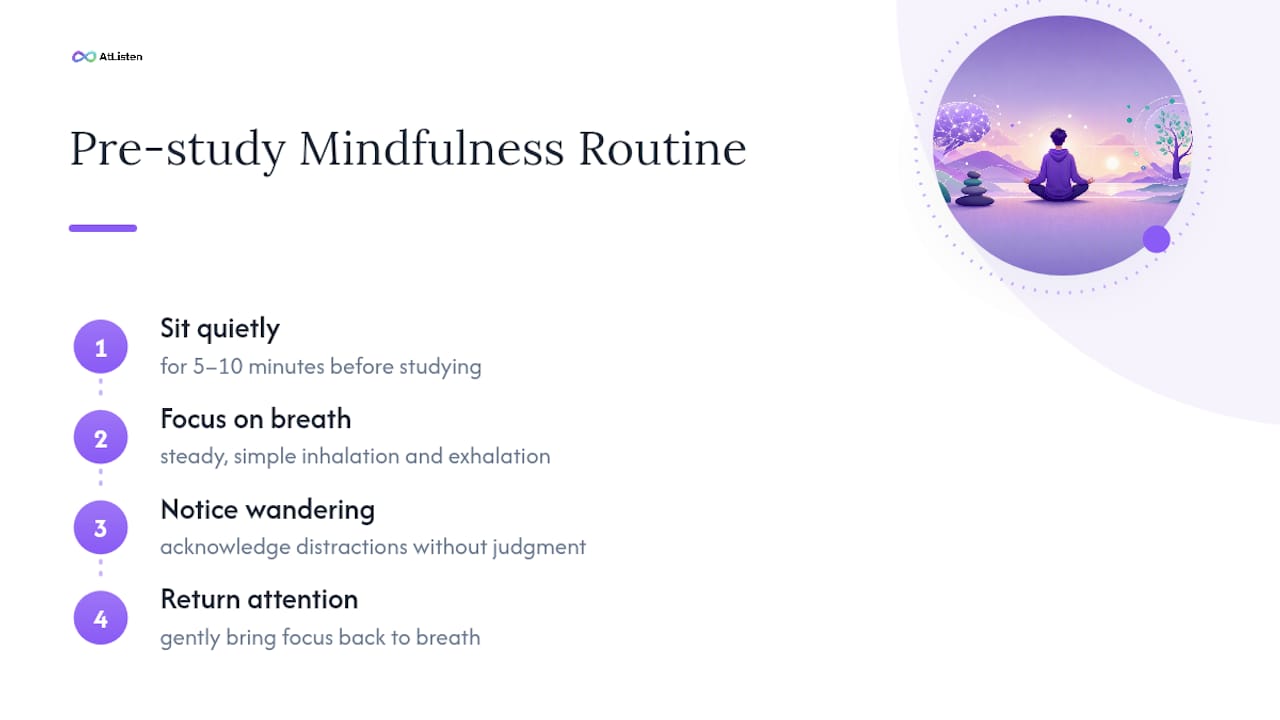
Mindfulness practice trains the same attentional control that memory encoding depends on, which is why it shows up repeatedly in discussions of study performance. A wandering mind can't encode information well, and meditation is essentially attention training. Even five to ten minutes of focused breathing before a study session can settle a racing mind enough to get through the first few minutes of real, uninterrupted attention.
Meditation also appears to help with stress, and chronic stress interferes with the hippocampus, the same brain region exercise supports. Lowering stress before a study block or an exam isn't a soft, feel-good add-on. It's a direct way to protect the brain structure responsible for forming new memories.
A simple pre-study routine looks like this: sit for a few minutes, focus on your breath, and when your mind wanders (it will), just bring it back without judgment. That's the entire skill, and it transfers directly to the kind of sustained focus active recall requires. Students who feel scattered before a session often get more out of five minutes of this than they would from diving straight into another twenty minutes of unfocused rereading.
None of this replaces the core techniques. Mindfulness sets the conditions for retrieval practice and spaced repetition to work better. It doesn't substitute for actually doing them.
Techniques for Encoding Information So It Actually Sticks
Encoding is the step where information first gets processed deeply enough to leave a trace, and how you encode determines how easily you'll retrieve it later. Two techniques stand out for turning shallow exposure into durable understanding.
Elaborative interrogation means asking "why" and "how" questions about facts instead of accepting them at face value. Reading that "spaced practice improves retention" is shallow. Asking yourself why spacing works, and reasoning through the answer, forces you to connect the fact to what you already know. That connection is what makes it retrievable later.
Self-explanation works similarly but applies to problems and processes rather than isolated facts. As you work through a practice problem, explain each step to yourself: why this formula, why this approach, what would happen if a variable changed. Students who narrate their own reasoning while solving problems catch their own errors far more often than students who solve silently and check the answer key at the end.
Both techniques share a common thread with the Feynman technique covered earlier: they force you to generate meaning rather than absorb it. The more mental work you do to connect a new fact to something you already understand, the more durable the memory becomes. Partner resources like AmmarAI's guide on AI-assisted study workflows cover how structured tools can prompt this kind of effortful processing rather than letting students default to passive review.
My 7-Day Starter Plan for Better Retention
Here's the plan I'd run if I were starting from scratch this week. Days 1 through 5: one 25-minute active-recall session per subject, followed by a 15-minute walk. Day 3, add interleaving by mixing two subjects in one session. Every night, review yesterday's toughest three flashcards before bed. Day 7: a timed self-quiz covering the whole week.
Track two numbers only: cards recalled correctly and concepts you missed twice. Adjust intervals from there, and don't judge the first week by how it feels. Judge it by what you can still recall on day seven without looking.
— William
Try AtListen to Put These Techniques on Autopilot
You've got the science: active recall plus spaced repetition beats rereading every time. The gap for most students isn't knowing what to do, it's the hours it takes to actually build flashcards, practice questions, and a review schedule from scratch every week. AtListen closes that gap by converting your lectures, PDFs, and notes directly into the exact study units this article describes.

Upload a recording or a chapter, and a starter workflow gives you:
- Auto-generated summaries and key concepts to guide your first elaboration pass
- Practice questions with instant feedback so you know immediately what needs review
- Flashcards structured for spaced repetition, not just a flat stack to reread
Families and educators who want details on how younger users' data is handled can check the COPPA privacy policy. Start on the AtListen landing page to quickly turn your next lecture into a full study set.
Sources
The PMC review on memory strategies, Mayo Clinic's memory tips, UNC's memorization guide, and NINDS on sleep anchor the claims in this guide.
- Evidence-Based Strategies to Improve Memory and Learning - PMC
- Memory loss: 7 tips to improve your memory - Mayo Clinic
- Aerobic exercise and cognitive fitness - Harvard Health
FAQ
What Is the 7 Second Trick to Improve Memory?
There's no single verified "7 second trick." The closest evidence-backed version is pausing for a few seconds during retrieval practice to force active recall before checking an answer, which strengthens the memory trace more than an instant glance at notes.
What Is the 2 7 30 Rule for Memory?
The 2 7 30 rule suggests reviewing new material after 2 days, then again after 7 days, then again after 30 days, following the same expanding-interval logic behind spaced repetition described earlier in this guide.
What Is the 3 2 1 Memory Technique?
Definitions vary across sources, but one common version has you recall three key facts, two supporting details, and one question you still can't answer, right after finishing a study session.
How Do You Retain 90% of What You Learn?
No single method guarantees a fixed retention percentage, but combining active recall, spaced repetition, and elaboration consistently produces the strongest, most durable retention in cognitive science research, far beyond passive rereading.
Can AtListen Help With Spaced Repetition?
Yes. AtListen converts lectures and notes into flashcards structured for spaced review, along with practice questions that give instant feedback, so you can run the retrieval and spacing routine covered in this article without building materials by hand.