
Instant feedback in studying means finding out whether you were right within seconds of answering, not days later when a graded exam comes back. You get it by quizzing yourself from memory and checking the answer right away, and you make it stronger by asking why a miss happened. This guide shows how to build that loop with flashcards, practice questions and AI, and what to watch out for.
TL;DR
- Instant feedback works when you answer first from memory, then check immediately and mark exactly what you missed.
- Practice questions and flashcards built from your own course materials are the easiest way to get it.
- AI can explain why an answer is wrong, but check its feedback against your textbook or official course materials.
- Feedback that is too immediate can become a crutch. Attempt the answer before you look, and space your sessions.
- AtListen turns lectures, PDFs, videos and notes into practice questions and flashcards with explanations, so the loop starts in minutes.
Table of Contents
- What instant feedback means when you study
- Why mistakes are the useful part
- The feedback loop: answer, check, mark, review
- What good feedback contains
- Getting instant feedback from practice questions and flashcards
- Using instant feedback for exams, dense readings and languages
- Using AI for instant feedback, and checking it
- When instant feedback backfires
- A sample week
- Our perspective: feedback only counts if you act on it
- Start the loop with your own materials
- FAQ
- Sources
What instant feedback means when you study
In a classroom, feedback usually arrives late. You take a test, wait, and get a score after the material has moved on. Instant feedback closes that gap. You attempt something, and you learn right away whether it was correct and, ideally, why.
This is the core idea behind formative assessment. A teaching guide from the University of Illinois Chicago describes formative assessments as giving immediate feedback and chances to self-check, self-monitor and adapt how you learn. The key word is adapt. A score only tells you where you stand. Feedback tells you what to do next.
For a student, that usually looks like one of these:
- Answering a practice question and reading the explanation straight away.
- Flipping a flashcard and marking whether you actually recalled it.
- Explaining a concept out loud, then comparing your explanation with your notes.
- Asking an AI tool to check a written answer and point out what is missing.
None of these require a teacher in the room. They only require that you test yourself before you look at the answer.
Why mistakes are the useful part
Most students avoid wrong answers. Learning researchers treat them as information. Duke's Academic Resource Center notes that mistakes show you where to focus your time and energy on the way to mastery. A wrong answer on a flashcard costs you ten seconds. The same gap discovered on exam day costs you points.
There is a second benefit: calibration. Re-reading a chapter makes it feel familiar, and familiarity feels like knowing. Quizzing yourself breaks that illusion. In one set of experiments, practice with feedback beat lecture for memory and improved metacognitive calibration, meaning students got better at judging what they did and did not know. That judgment decides where you spend the next hour.
The same Duke guidance adds that checking your answers and understanding why you got something wrong provides immediate feedback that builds metacognition. So the habit is not just "check the key." It is "check the key, then name the reason."
The feedback loop: answer, check, mark, review
Instant feedback only helps if it sits inside a loop. Here is the simplest version.
- Hide the source. Close the notes, slides or textbook.
- Answer from memory. Write it, say it, or type it. Guessing counts.
- Check immediately. Compare with your notes, a textbook example or an answer key.
- Mark the error precisely. "Forgot the definition of marginal cost" is useful. "Got it wrong" is not.
- Review the marked items next session. Bring back only what you missed.
This matches what a study guide on active recall describes: hiding source materials, answering from memory, checking right away and marking specific errors such as forgotten definitions or mixed-up terms. Retrieving information from memory also strengthens retention more than passive study, which is why the answer step must come before the check step.
If you want a longer walkthrough of this cycle with AI, we cover it in a four-step study feedback loop, and the retrieval side is explained in our piece on retrieval practice strategies.
What good feedback contains
A green check or a red X is the weakest form of feedback. It tells you the outcome but not the reason. Guidance for educators from the American Society of Health-System Pharmacists says feedback may include the correct response, and that for wrong answers you should be told the answer was incorrect and given the rationale for the correct response.
When you build or choose study material, look for these three parts:
| Part of the feedback | What it does | Example |
|---|---|---|
| Right or wrong | Tells you where you stand | "Incorrect" |
| The correct answer | Shows what you should have said | "Mitosis produces two identical cells" |
| The reason | Fixes the misunderstanding, not just the answer | "You described meiosis, which halves the chromosome number" |
The third row is where most of the learning happens. If your practice questions only give you a key, add the reason yourself in one sentence. That sentence is a small act of retrieval on its own.
Getting instant feedback from practice questions and flashcards
The most practical routine is also the simplest. Duke's guidance says to create practice tests and flashcards from course materials, quiz yourself without looking at notes, then check your answers and review why you missed anything. It also recommends spreading self-quizzing across multiple episodes in daily and weekly sessions rather than one long block.
Flashcards for quick, low-stakes checks
Flashcards give feedback on a single fact in seconds. They suit definitions, formulas, dates and vocabulary. The catch is honesty: only mark a card correct if you produced the answer before flipping. Our guide to effective flashcards covers how to replace cramming with spaced recall, and active recall methods shows how short bursts of five to ten minutes fit into a busy day.
Practice questions for understanding
Flashcards check whether you remember. Practice questions check whether you can use what you remember. For case-based subjects, you can turn your notes into scenario questions, as described in our post on case study practice questions. The explanation under each answer is the feedback, so read it even when you got the question right. Sometimes you land on the right answer for the wrong reason.
Mixing topics
Once single topics feel solid, mix them. Interleaving forces you to decide which idea applies, and the feedback then shows whether you can tell similar concepts apart. See our notes on interleaving practice for a simple 45-minute structure.
Using instant feedback for exams, dense readings and languages
The loop is the same everywhere, but the material changes how you set it up.
Exam preparation. Work backward from the exam format. If the exam has short-answer questions, practice with short-answer questions, not multiple choice. Use feedback to build a list of weak spots, then spend your remaining time there instead of re-reading everything. Short, repeated sessions over several days beat a single night before the test, which is the idea in our seven-day memory retention plan.
Dense course materials. A forty-page chapter is hard to quiz yourself on until you break it apart. Read a section, close the book, write what you remember, and check it against the page. Our method for summarizing textbook chapters puts recall before the summary, so the summary shows what you missed instead of replacing your memory.
Foreign-language vocabulary. Vocabulary suits flashcard feedback because each item has a clear right answer. Test in both directions: from the new word to your language, and from your language to the new word. The second direction is harder and shows more gaps. Mark the words you miss and bring them back in the next session.

Using AI for instant feedback, and checking it
AI has made one kind of feedback far easier: feedback on open-ended answers. Before, you needed a teacher or a study partner to read a paragraph and tell you what was missing. Now a tool can do that in seconds.
The evidence is encouraging but not unconditional. In the experiments mentioned earlier, researchers used GPT-4o to generate personalized explanatory feedback for open-ended questions. Separate work found that GPT-4 classified trainee responses as correct or incorrect and rephrased wrong ones, with performance comparable to human experts.
The limits matter just as much. Research on AI assessing tutors found that models may struggle to tell whether someone actually made an error, sometimes treating uncertainty as a mistake. In practice, that means an AI might mark a hesitant but correct answer as wrong, or accept a confident answer that is slightly off.
So use a simple safeguard: verify AI feedback against your official course materials or textbook. If the AI and your textbook disagree, trust the textbook and ask your instructor. If you want a safe way to start, our six-step guide to studying with AI covers prompts and privacy basics.

When instant feedback backfires
Feedback is not free of trade-offs. Three habits are worth avoiding.
- Peeking too soon. If you look at the answer before you try, you are reading, not retrieving. Make a real attempt, even a bad one.
- Chasing easy wins. It is tempting to quiz only what you already know, because the feedback feels good. Put your time on the items you miss.
- Treating one session as proof. Getting something right right after you saw it says little about next week. Come back after a gap.
Research even suggests feedback changes how practice difficulty plays out. In a study on test feedback, immediate feedback on an initial delayed test reversed the advantage of difficult over easy retrieval practice on later tests. You do not need to memorize that finding. The takeaway is that feedback and difficulty interact, so do not assume that harder practice always wins, and do not assume feedback always helps in the same way.
To avoid dependence on a tool, taper the support. Start with explanations after every question. Later, answer a full set first and read the explanations at the end. Then try a set cold, with no feedback until the whole thing is done, the way an exam works. Our post on turning passive study into active study suggests starting with just one swap this week.
A sample week
Here is a realistic schedule for one course, built around short loops.
| Day | Session | Feedback step |
|---|---|---|
| Monday | 20 minutes: turn the week's lecture into flashcards and questions | Quiz yourself once, mark misses |
| Tuesday | 10 minutes: retry only the misses | Check immediately, write the reason for each error |
| Thursday | 25 minutes: mixed practice questions | Read all explanations after the set |
| Saturday | 20 minutes: cold quiz, no peeking | Compare with notes, list remaining gaps |
| Sunday | 10 minutes: review the gap list | Plan next week's focus |
Notice how little time it takes. The point is not long hours. It is that every session ends with information about what to do next.
Our perspective: feedback only counts if you act on it
We built AtListen around a simple observation: most students do not lack effort, they lack structure. Lectures pile up, PDFs are long, and turning them into something you can quiz yourself on takes longer than studying itself. So the feedback loop never starts.
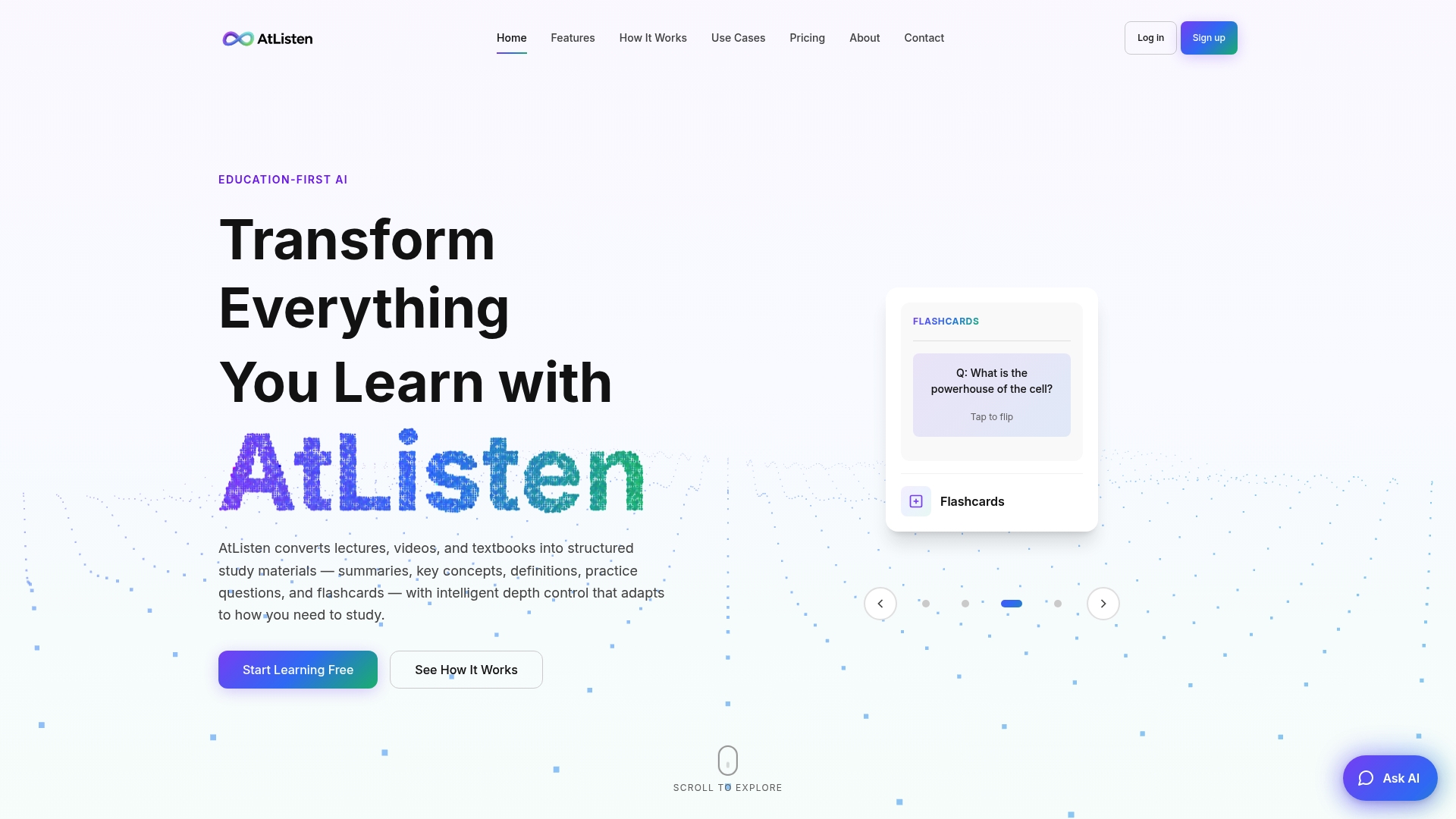
Our approach is to remove that setup cost. You upload a lecture, a video, an audio recording, a PDF or a YouTube link, and you get summaries, key concepts with definitions, practice questions with explanations and flashcards built for spaced repetition. You can control how deep the material goes, so a first pass over a new topic does not look like a final-exam review.
We also think students should be cautious. Instant feedback feels good, and feeling good is not learning. The habit that matters is answering before you look, then writing down why you missed something. A tool can speed up everything around that habit, but it cannot do the retrieving for you. And any AI feedback, ours included, should be checked against your course materials when the stakes are high.
— William
Start the loop with your own materials
If you already have the lecture recordings, slides or textbook chapters, the quickest way to try this is to feed them in and quiz yourself. AtListen has a Free plan at $0 per month, Pro at $19.99 per month and Max at $39.99 per month, and higher tiers add enhanced features and greater usage limits. You can start on the Free plan and see whether the questions and explanations fit how you study.
If privacy is a concern before you upload course content, read the security page first.
FAQ
Is instant feedback always better than delayed feedback?
Not always. Immediate feedback is excellent for catching errors before they stick, but it works best after you have made a real attempt. Research also shows feedback timing can change how different kinds of practice perform, so mix immediate checks with occasional cold quizzes that you review afterward.
What are the best tools for instant feedback studying?
The best tool is whichever one makes you answer before you see the solution. That can be paper flashcards, a self-marking quiz in your course platform, or an AI study tool that generates questions from your own materials and explains each answer. Choose based on whether it uses your course content and gives reasons, not just scores.
Can I trust AI feedback on my answers?
Trust it as a first check, not a final ruling. Studies show AI can give useful explanatory feedback on open-ended answers, but models can misjudge whether you actually made an error. Compare the feedback with your textbook or official course materials, and ask your instructor when they disagree.
How often should I quiz myself?
Spread short sessions across the week instead of one long block. Duke's guidance recommends self-quizzing in multiple episodes across daily and weekly study sessions. Even five to ten minutes a day on the items you recently missed is a good start.
Sources
- Formative Assessments, University of Illinois Chicago
- Retrieval Practice, Duke Academic Resource Center
- Conditions for Effective Learning Without Upfront Instruction, Educational Psychology Review
- Helpful Hints on Session Development, ASHP
- Active Recall Study Guide for Any Subject
- How Can I Get It Right? Using GPT to Rephrase Incorrect Responses, International Journal of AI in Education
- Using Large Language Models to Assess Tutors' Performance, arXiv
- Feedback at Test Can Reverse the Retrieval Effect, Frontiers in Psychology