
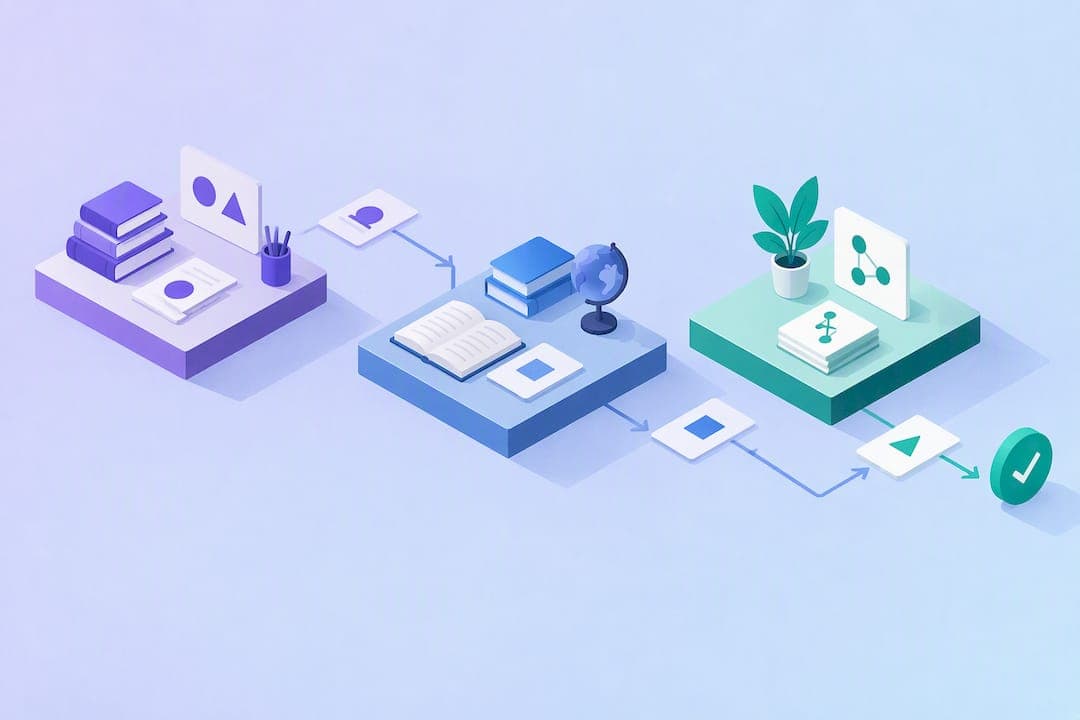
Interleaving practice means alternating between related topics or problem types instead of drilling one type at a time, and it reliably improves how well you remember and transfer material on a delayed test. It works for math, science, and category learning in particular. The catch: it feels harder in the moment, which is exactly why so many students and teachers avoid it.
TL;DR:
- Interleaving practice significantly benefits transfer and long-term memory, especially with visual categories and math problems, but is less effective for simple word lists.
- It requires rotating related skills every five to ten minutes and delaying testing to maximize learning gains on assessments.
- Students tend to perceive interleaving as harder and slower, so a short pilot can demonstrate delayed test score improvements to build understanding.
- Pairing interleaving with active, spaced retrieval quizzes enhances its effectiveness and helps distinguish it from blocked practice.
- Applying interleaving across subjects or categories can extend its benefits but demands deliberate organization and manageable chunks for optimal results.
Table of Contents
- What interleaving practice looks like in a real session
- Why interleaving works: the mechanisms and the strongest evidence
- How to design interleaved sessions step by step
- When interleaving helps and when another approach is better
- Copy-ready checklist and a sample 45-minute study session
- Introducing interleaving to real students
- Turning your materials into interleaved practice sets
- FAQ
- Sources
What interleaving practice looks like in a real session
Blocked practice studies one thing at a time: AAA, then BBB, then CCC. Interleaved practice mixes them: ABCABC. The sequence looks messier on paper, but it forces your brain to keep re-identifying which approach fits which problem, rather than coasting on a pattern you already locked in a minute ago.
A few concrete examples make the pattern clearer:
- Math homework: instead of 10 problems on the area of a prism followed by 10 on the area of a cone, mix prism, cone, and sphere problems throughout the set.
- Language learning: rotate between verb conjugation, vocabulary recall, and listening comprehension in the same 20-minute block instead of finishing one skill before starting the next.
- Art or biology classification: shuffle images from different painters or species so you practice telling them apart, not just recognizing one style in isolation.
Interleaving can happen within a single subject (rotating problem types in algebra) or across subjects (alternating a Spanish review with a chemistry review in the same study hour). As the Loughborough University blog explains, the basic shift from blocked to interleaved practice is simply swapping an AAABBB sequence for an ABCABC one, which also builds in spacing between repetitions of the same type. A simple starting routine: pick three related skills, give each five to eight minutes, and rotate twice before switching to a new set.
Why interleaving works: the mechanisms and the strongest evidence
Three mechanisms explain the effect. Retrieval practice forces you to pull a method or fact out of memory rather than simply rereading it, and that act of retrieval strengthens the memory trace more than passive review does. Desirable difficulty means that struggling a bit during practice, as long as you eventually succeed, produces a stronger memory than practice that feels smooth and easy. Discriminative contrast means that seeing similar-looking problems back to back trains you to notice the features that distinguish one type from another, which is often the actual skill a test demands.
The evidence behind these mechanisms is unusually concrete for an education topic. A classroom experiment with undergraduate physics students replaced blocked homework with interleaved homework and found much larger median gains on surprise tests, with large improvements on two separate criterial tests after eight weeks, even though students rated the interleaved homework as harder. In math, Taylor and Rohrer's classic study found that interleaving lowered scores during practice itself but produced higher scores on a test given one day later, because students got better at selecting the correct procedure rather than just executing a memorized one.
A meta-analysis of interleaved learning found a moderate overall effect (Hedges' g of about 0.42), but the benefit depends heavily on material type. It was strongest for visual-category tasks like identifying painting styles and for some types of math problems, weaker and inconsistent for expository text, and actually negative for simple word lists. That moderator pattern matters: interleaving is not a universal fix, and pairing it with the wrong material can backfire.

How to design interleaved sessions step by step
Turning the research into a usable session takes a few deliberate choices, not just random shuffling.
- Pick two or three related skills or topics that students commonly confuse with each other, since discriminative contrast only helps when the categories are actually similar.
- Break each skill into short blocks of five to ten problems or five to eight minutes, then rotate through them instead of finishing one before starting the next.
- Add a short delay before testing, ideally a day or more, since the benefit of interleaving shows up on delayed tests far more than on same-day quizzes.
- Pair interleaving with low-stakes retrieval quizzes, such as a two-minute recall check at the start of the next class, to combine spacing with active retrieval.
- Use a cross-course review block once a week where students mix review questions from two different classes, which extends interleaving beyond a single subject.
- Ask a quick metacognitive question after each rotation, such as "which method did you use and why," to make the discrimination step explicit rather than automatic.
Start small: one interleaved homework set per week is enough to see whether the format suits your course before converting an entire curriculum.
Pro Tip: Tell students in advance that interleaved practice will feel harder and slower than blocked drills, and that this is the expected trade-off for better long-term retention, not a sign the material is too difficult.
When interleaving helps and when another approach is better
Interleaving earns its keep when categories are easy to confuse, when the goal is transfer to new problems rather than rote repetition, and when the skill involves choosing among several possible methods, as in mixed math problem sets. Blocking tends to win in the opposite situations.
- Favor interleaving for confusable categories, transfer-focused learning, and open problem solving where the student must first identify which method applies.
- Favor blocking when the goal is rule discovery, when students are complete novices with no base knowledge to anchor retrieval, or when the skill is a single, non-confusable procedure.
- Run a quick test by giving half your class a blocked homework set and half an interleaved one, then comparing delayed quiz scores a week later rather than trusting same-day impressions.
Copy-ready checklist and a sample 45-minute study session
Plan any interleaving session around one rule: rotate related topics in short bursts, then test the result days later instead of immediately.
- 0 to 5 minutes: quick retrieval quiz on last week's material, no notes allowed.
- 5 to 20 minutes: rotate through three related problem types, five minutes each, in ABCABC order.
- 20 to 35 minutes: repeat the rotation with harder variants of the same three types.
- 35 to 45 minutes: mixed review set pulling one problem from each type at random, then a one-line note on which method was used for each.
| Step | Time | Focus |
|---|---|---|
| Retrieval warm-up | 0 to 5 minutes | Prior material, no notes |
| First rotation | 5 to 20 minutes | Three skills, ABCABC order |
| Harder rotation | 20 to 35 minutes | Same skills, tougher variants |
| Mixed review | 35 to 45 minutes | Random order plus method notes |
Log scores from a delayed quiz a few days later rather than the in-session quiz, since that delayed number is the one that actually reflects learning.
Introducing interleaving to real students

The first thing students notice about interleaving is that it feels worse. They make more errors, work slower, and often ask to go back to blocked drills because blocked practice feels like it is "working." A short pilot, two weeks, one unit, with a delayed quiz at the end, settles the argument faster than any explanation of desirable difficulty.
Run the pilot quietly, compare delayed scores against a prior blocked unit, and share the numbers with students afterward. That comparison, not the theory, is what changes minds.
— William
Turning your materials into interleaved practice sets
Building a proper interleaved rotation takes raw material: practice questions across several related topics, flashcards you can shuffle, and quizzes timed for delayed review. That's the part AtListen was built to speed up. We convert lectures, textbooks, PDFs, and even YouTube videos into structured practice questions, key concepts, and flashcards, so you can pull three related topics into one rotation instead of building each set by hand.

- Generate mixed practice fast: upload material from two or three related units and get practice questions and flashcards ready to interleave in minutes.
- Flashcards built for spaced review: our smart flashcards are designed for spaced repetition, which pairs naturally with an interleaved schedule.
- Depth control: adjust how detailed the generated questions are, depending on whether you want quick retrieval checks or harder transfer problems.
Educators working with materials from younger students can check our security practices and our COPPA-focused privacy policy before rolling a tool out to a classroom. Start with the Free plan, or move to Pro at $19.99 per month or Max at $39.99 per month for higher usage limits.
FAQ
What is interleaving practice?
Interleaving practice means alternating between related topics, skills, or problem types during study instead of completing one type in a full block before moving to the next. It trades a smoother, easier practice session for better performance on tests given days or weeks later.
Can you give me some examples of interleaving?
Common examples include mixing math problems on different geometric shapes in one homework set, rotating between vocabulary, grammar, and listening practice in a language lesson, or shuffling images of different painting styles so you practice telling them apart. The common thread is alternating similar categories instead of finishing one before starting another.
What is the interleaved practice technique?
The technique replaces a blocked AAABBB sequence with a mixed ABCABC sequence, so related items are spaced apart and repeatedly contrasted against each other. Research summarized in a meta-analysis of interleaved learning found this produces a moderate average benefit that varies by material type.
What is the difference between interleaved practice and variable practice?
Interleaved practice specifically alternates between distinct categories or problem types in a mixed sequence, while variable practice more broadly refers to varying conditions, contexts, or difficulty within practice of a single skill. Interleaving is one way to introduce variability, but variable practice can also include changing settings or formats without mixing separate topic categories.