

The fastest way to make lecture notes useful is to stop rereading them and start answering questions from them. You can write those questions by hand, but the slow part is reading, selecting and drafting, which is exactly the part AtListen takes off your plate: upload your notes, a PDF, a recording or a YouTube link, and it builds practice questions with explanations, key concepts and flashcards in minutes. Below is the full routine, so you know what a good quiz looks like and how to use it.
TL;DR
- Questions beat rereading: recalling answers from memory strengthens learning, according to Carnegie Mellon's Eberly Center.
- Mix short-answer questions (recall) with multiple-choice (recognition), and always check feedback.
- Build the quiz from your own course materials, and verify the answer key against slides or the textbook.
- Take the quiz in short, repeated sessions, not one long cram.
- AtListen turns notes, lectures and PDFs into a question set so you spend your time answering, not drafting.
Table of Contents
- Why a quiz works better than rereading
- Turn notes into questions step by step
- Studying with limited time
- Language learners: quiz your vocabulary
- Professionals and certification exams
- Build your quiz with AtListen
- Our perspective
- FAQ
- Sources
Why a quiz works better than rereading
Rereading feels productive because the material looks familiar. Familiarity is not the same as being able to produce the answer on exam day. Retrieval practice, which means recalling information from memory through quizzes, flashcards or practice problems, can strengthen memory, understanding and application, as Carnegie Mellon's Eberly Center explains.
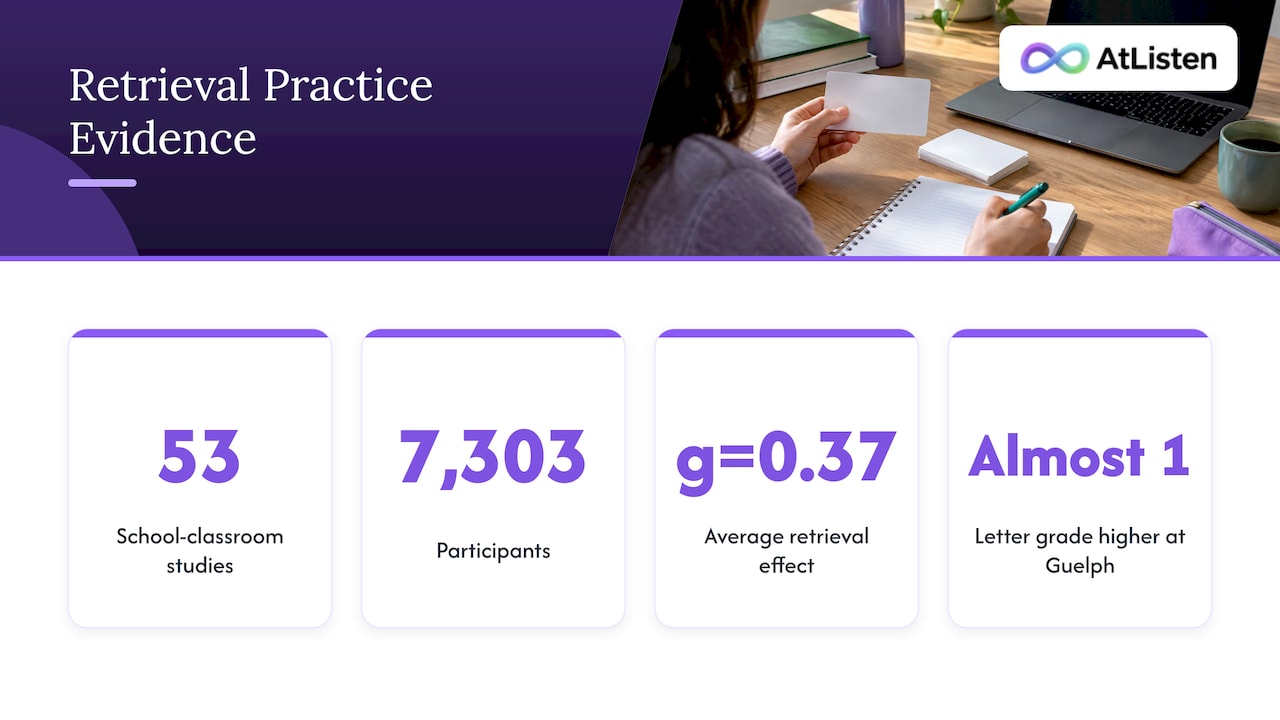
The evidence is broad. A 2026 meta-analysis in Educational Psychology Review covering 53 school-classroom studies and 7,303 participants found an average effect of g = 0.37 for retrieval practice. The authors also found that results vary with things like question format and when feedback arrives, so the details of how you quiz yourself matter. The rest of this article covers those details.
A university example makes it concrete. At the University of Guelph, students in Make & Take quiz sections reviewed their notes, wrote two questions with correct answers, and then answered questions the following week. Those sections earned final-exam grades almost a full letter grade higher than comparison sections.
If you want the longer case for swapping passive study for active study, our guide on making passive study active walks through one change you can make this week.
Turn notes into questions step by step
1. Clean up the notes first
Questions are only as good as the material under them. Scattered bullets, half sentences and missed slides produce vague questions. Fill the gaps from the slides or textbook before you start. If your notes come from a recording, a transcript turned into study-ready notes gives you a clean base in under 15 minutes.
With AtListen you can skip this cleanup: it accepts lectures, videos, audio recordings, PDFs, textbooks, notes, web articles and YouTube URLs, and structures them into summaries, key concepts with definitions and key facts that the questions are built from.
2. Find the testable units
Go through the notes and mark what an exam could ask about:
- Definitions and terms
- Cause-and-effect relationships
- Steps in a process or procedure
- Comparisons between two ideas
- Formulas, dates and named examples
The University of New Hampshire's study-guide handout suggests turning study-guide topics into questions and practicing answering them. Every heading in your notes is a candidate question.
3. Write the question, then the answer
Write the answer at the same time as the question, in your own words, from the notes. A question without a recorded answer is hard to grade later. Keep each question to one idea. "Explain how X causes Y" is better than "Discuss X."
This is where drafting by hand costs the most time. AtListen generates practice questions with explanations, so every answer comes with the reasoning behind it, and you can set the depth of the material to match how far into the course you are.
4. Choose the question type on purpose
Short-answer questions test recall. Multiple-choice questions test recognition. Carnegie Mellon advises matching the format to your learning goal, and cites a study in which short-answer testing after history lectures beat both restudying and multiple-choice testing on a test a month later.
That does not make multiple-choice useless. A 2014 classroom study by McDermott and colleagues found that both multiple-choice and short-answer quizzes with correct-answer feedback improved later exam performance in seventh-grade science and high-school history. The quiz format also did not need to match the exam format for the benefit to appear.
A practical mix:
| Goal | Best question type | Example |
|---|---|---|
| Memorize terms | Short answer or flashcard | "Define opportunity cost." |
| Spot the right idea among similar ones | Multiple choice | Four plausible causes of the event |
| Apply a concept | Scenario question | "A firm raises prices by 10%. What happens to demand, and why?" |
| Explain a process | Open response | "Walk through the steps of glycolysis." |
For the difference between the two modes, see our piece on retrieval versus recognition. For case-based courses, case study practice questions show how to turn course notes into applied scenarios.
5. Check the answer key
Any question set, whether you wrote it or a tool generated it, needs a quick accuracy check. The AUA AI Hub advises comparing questions and answers against lecture slides, settling disagreements with the textbook, and asking your instructor when the slides themselves may be wrong. Exams are written from course materials, so those materials outrank any unsupported answer.
A two-minute pass is enough: skim each answer, find the matching line in your notes, and flag anything you cannot locate.
6. Take the quiz properly
The order matters more than the tool:
- Close your notes and answer from memory, one question at a time.
- Commit to an answer before seeing the feedback.
- Check the answer and read the explanation, especially for the ones you missed.
- Mark misses and put them back into the next round.
The AUA AI Hub recommends exactly this pattern: one question at a time, answer first, then feedback, using both self-generated answers and multiple choice.
Studying with limited time
Short and often beats long and rare. Eberly Center guidance says to retrieve before rereading, check feedback, and practice regularly over time instead of in a single session. The 2026 meta-analysis above also found positive average effects for spacing (g = 0.20) and interleaving (g = 0.40), which means spreading sessions out and mixing topics both help.
A week before an exam, a workable pattern looks like this:
- Day 1: Quiz on the newest lecture, 15 minutes.
- Day 2: Re-quiz the misses plus one older lecture, 15 minutes.
- Day 4: Mixed quiz across two or three topics.
- Day 6: Full practice test, timed.
For 5 to 10 minute sessions that fit between classes, see our active recall methods. To mix topics within one session, the interleaving practice guide gives a 45 minute format. To fit all of this into your calendar, a study schedule keeps the sessions from slipping.
Flashcards are the lightest version of the same idea. AtListen creates flashcards optimized for spaced repetition, and our guide to effective flashcards explains how to replace cramming with spaced recall.
Language learners: quiz your vocabulary
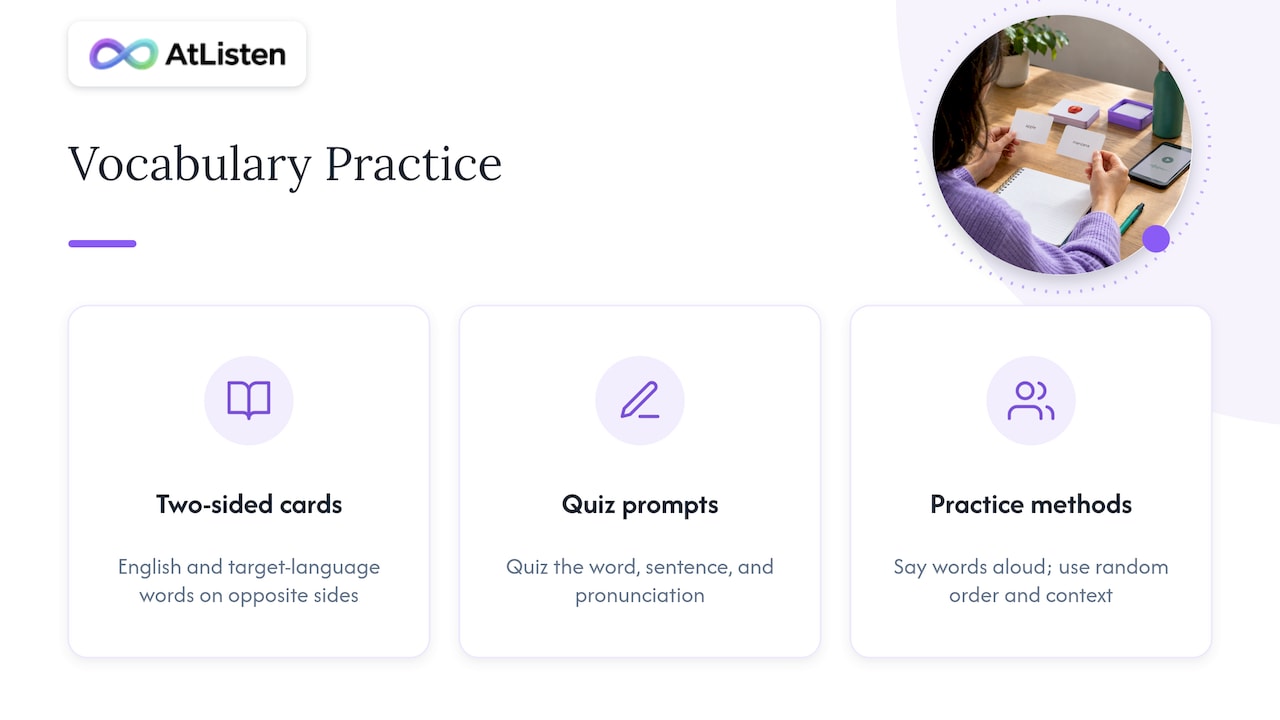
If your notes are word lists from class, turn them into two-sided cards with the English word on one side and the target-language word on the other, plus a sentence using the new word. The Peace Corps' language-learning manual also recommends saying words aloud, practicing in random order as well as the original sequence, and learning vocabulary in context and in related sets.
So a good vocabulary quiz asks for the word, the sentence and the pronunciation, not just the translation. You can turn lectures into vocabulary flashcards and use ready-made flashcard templates for language learners as a starting point.
Professionals and certification exams
The same routine applies to course packs, training slides and exam guides. Upload the material, quiz by section, and track which domains keep producing misses. Short daily sessions work well alongside a job because each one is a handful of questions, not a block of study time.
Build your quiz with AtListen
AtListen converts lectures, videos, recordings, PDFs and notes into summaries, key concepts, practice questions with explanations, spaced-repetition flashcards and personalized study plans, with instant feedback and adjustable depth. There is a Free plan at $0 per month, Pro at $19.99 per month and Max at $39.99 per month; higher tiers give enhanced features and greater usage limits. You can start on atlisten.com.
Our perspective
Most students do not lack effort, they lack a quiz. A page of notes is a record of what the lecturer said, and a question set is a test of what you can say. The gap between the two is where grades are decided.
We built AtListen around that gap. The slow part of active study is not answering questions, it is producing good ones from dense material when you are tired and the exam is close. So the platform structures whatever you bring, from a lecture recording to a textbook chapter, into questions, explanations and flashcards, and lets you set how deep it goes. You spend the evening answering, not formatting.
Whatever you use, keep the habit: answer first, check feedback, repeat across days.
William
FAQ
Can I make a quiz from lecture notes for free?
Yes. You can write questions by hand from your headings and definitions, or start on AtListen's Free plan, which costs $0 per month. Higher tiers add features and usage limits if you study heavily.
Should I use multiple-choice or short-answer questions?
Use both. Short-answer questions test recall, and multiple-choice tests recognition. Research on classroom quizzing found that both formats with feedback improved later exam results, so the mix can follow your goal.
How many questions should I make per lecture?
There is no fixed number. A sensible target is one question for each key idea in the lecture, often five to ten. The University of Guelph's Make & Take approach asked students for just two good questions per class.
How do I know the answers are right?
Check each answer against your slides, then the textbook, and ask your instructor if the two disagree. Exams come from course materials, so they decide what counts as correct.
Sources
- Retrieval Practice for Improved Learning, Eberly Center, Carnegie Mellon University
- A Meta-Analysis of the Effectiveness and Boundary Conditions of Retrieval Practice, Educational Psychology Review (2026)
- "Make & Take" Quizzes, University of Guelph Office of Teaching and Learning
- Create Your Own Study Guide, University of New Hampshire
- Both Multiple-Choice and Short-Answer Quizzes Enhance Later Exam Performance (McDermott et al., 2014)
- AI and Your Learning, AUA AI Hub
- On-going Language Learning Manual, Peace Corps