
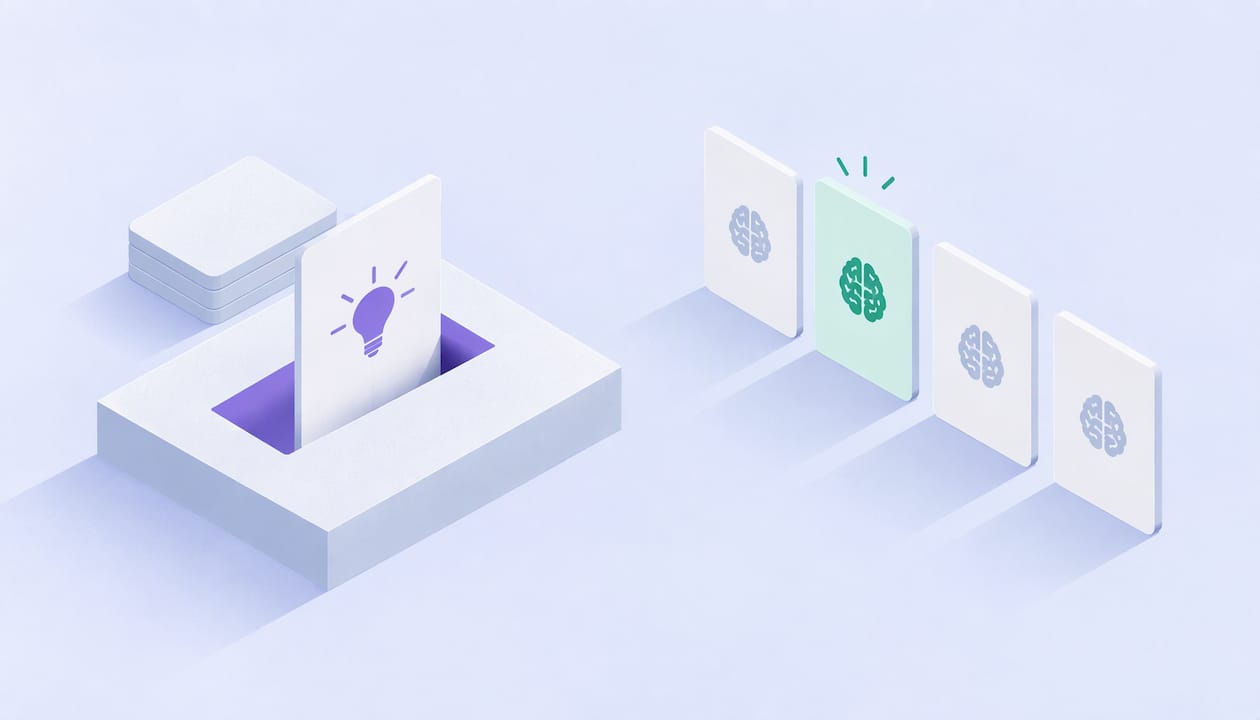
Recognition means seeing something and knowing you have met it before. Retrieval, in the sense students care about, means pulling an answer out of memory with little or no help. Recognition feels easier, so rereading and highlighting feel productive. Retrieval is harder, and it is the one that builds memory that lasts. The best study plan uses recognition to get started and spends most of its time on retrieval. AtListen turns your lectures, PDFs and videos into questions and flashcards that make you retrieve, then shows you the answer right away.
TL;DR
- Recognition is picking the right answer from what you see (multiple choice). Recall is producing it yourself (an essay or a blank flashcard). Psychologists treat both as ways of retrieving a memory.
- Recognition is easier because the options give you cues. That ease is also why rereading creates a false sense of knowing.
- Research on the testing effect shows that trying to recall material improves long-term retention more than restudying it.
- Use recognition-style questions to check you have met an idea, then switch to recall questions and flashcards, with feedback after every attempt.
- AtListen converts your own materials into summaries, practice questions with explanations and spaced-repetition flashcards in minutes, so the questions never have to be written by hand.
Table of Contents
- What retrieval, recall and recognition actually mean
- Examples: the same fact, three ways
- Why recognition feels easier
- The trap: when recognition feels like learning
- What the research says about recall practice
- Feedback closes the loop
- How to turn your materials into recall questions
- A worked example: one lecture, two ways to study
- Recall for languages, high school exams and certifications
- A simple rule for mixing both
- Where AtListen fits
- Our perspective
- FAQ
- Sources
What retrieval, recall and recognition actually mean
The terms overlap, and that causes most of the confusion in this keyword. In psychology, retrieval is the general act of getting information out of long-term memory and back into conscious awareness. A General Psychology textbook from UCF lists three ways it happens:
- Recall: accessing information without cues. An essay question or a blank flashcard is a recall task.
- Recognition: identifying information you learned earlier once you see it again. A multiple-choice question is a recognition task.
- Relearning: learning something a second time faster than the first. The same textbook gives the example of a person relearning Spanish after thirteen years.
So when someone asks "retrieval vs recognition," they usually mean recall versus recognition, and they are often asking which kind of question to study with. The short answer is that both retrieve, but they ask very different amounts of your memory.
A quick note for anyone who landed here from a design or usability search: "recognition rather than recall" is also a user-interface rule, which says menus and labels should be visible so people do not have to remember commands. The same mental difference sits underneath it, but this article is about studying.
Examples: the same fact, three ways
The Baylor University cognition lab manual shows the difference with a movie question:
- Free recall: "Which actor played Jack Sparrow?" You have no help at all.
- Cued recall: the same question plus a hint, such as "he also played Edward Scissorhands, Willy Wonka and the Mad Hatter." A cue narrows the search.
- Recognition: you see George Clooney, Tom Cruise, Johnny Depp and Brad Pitt and pick one.
Now translate that to a biology course:
| Format | Example question | What your memory has to do |
|---|---|---|
| Recognition | Which organelle produces most of a cell's ATP? A) Golgi B) Mitochondria C) Ribosome D) Lysosome | Judge which option looks right |
| Cued recall | The organelle that produces most of a cell's ATP begins with "mito." What is it? | Generate the answer from a partial cue |
| Free recall | Where does a cell get most of its ATP, and how? | Generate the answer and the explanation from nothing |
The same fact sits behind all three, but the work in your head is very different. And the same pattern applies to vocabulary. Seeing "la biblioteca" and picking "library" from four choices is recognition. Seeing "library" and writing the Spanish word is recall, and it is the one you need when you are actually speaking.
Why recognition feels easier
There are two common explanations, and both are useful for students.
The first is the two-step view. The PS200 Principles of Psychology pressbook cites research (Haist, Shimamura and Squire, 1992) saying recall involves generating an answer and then judging whether it is correct, while recognition only involves choosing which listed item seems most correct. Recognition skips the hard first step.
The second is about cues. Raluca Budiu of Nielsen Norman Group explains in a 2024 article on recognition and recall that the difference is the number of cues: when several options are in front of you, each one activates related memories and raises the activation of the right answer. That is why multiple-choice questions are easier than open-ended ones.
The same article points out that real-life remembering often blends the two. You recall a small fragment of what you are after, which narrows the choices, and then you scan and recognize the target. Studying works the same way. A partial memory plus a good cue can get you to the answer, and the goal of practice is to make that partial memory stronger.
The trap: when recognition feels like learning
Here is the problem for students. Rereading a chapter or reviewing highlighted notes is almost pure recognition. Everything looks familiar, so you feel fluent and confident. But familiarity is not the same as being able to produce the answer on an exam page with nothing in front of you.
Research has measured this. In a 2009 study, Karpicke, Butler and Roediger surveyed 177 college students and found that 84% reported rereading as a study strategy, and 55% called it their number-one strategy. Only 11% said they practiced retrieval, and just 1% named recall their top strategy. The authors suggest students prefer rereading because of "illusions of competence": it feels easy and confident, so students judge their own learning poorly.

If you want to go deeper on that feeling, our piece on illusions of competence explains why studying can feel like learning when it is not.
What the research says about recall practice
The benefit of trying to recall is known as the testing effect. MIT's Teaching + Learning Lab summarizes robust research that retrieval practice improves long-term retention and helps knowledge transfer to new contexts. It also helps students see what they do and do not know, which tells them where to focus next.
A few specific results are worth knowing:
- In the classic Karpicke and Roediger (2006) experiments, students who were repeatedly tested recalled 64% of word lists a week later, versus 57% for students who repeatedly studied. Items that were recalled and then kept in the testing rotation were remembered far better (44%) than items dropped from further testing (21%).
- A 2014 meta-analysis by Rowland comparing testing with restudying found that initial recall tests produced larger testing benefits than recognition tests. Effortful retrieval is what does the work.
This does not mean recognition questions are useless. They are a fine first check that you have met a term and can tell it apart from lookalikes. They just should not be where your study time ends.
Feedback closes the loop
Retrieval alone is half the job. If you recall something wrongly and never find out, you may strengthen the mistake. A review of classroom research by Littrell-Baez reports that Agarwal and colleagues (2012) found a 14% increase in later chapter exam scores when feedback came right after a retrieval-practice quiz. The same paper says feedback should include the correct answers for all practice questions.
That means the ideal cycle is: attempt, check, and fix. If you want a practical routine for catching errors quickly, see our guide to instant feedback studying.
How to turn your materials into recall questions
The hard part for most students is not believing in retrieval practice. It is building the questions from a 60-page chapter or a two-hour lecture when you are already behind. Study skills guides describe the manual method well, and it works.
The Foundations of Learning pressbook suggests making concise questions from lecture slides, notes or a textbook, answering them without looking at your notes, checking and retrying the ones you got wrong, and color-coding your progress. The SQ3R method from Lane Community College adds that you can turn titles, headings and subheadings into what, why, how, when, who and where questions, rewrite end-of-chapter questions in your own words, and recite an answer in your own words at the end of each section.
Here is the step-by-step routine, with where each step tends to go wrong:
- Break the material into chunks. One lecture or one chapter section at a time. Where it goes wrong: trying to quiz yourself on an entire unit at once, which produces vague questions. AtListen reads your upload and structures it into summaries, key concepts with definitions and key facts, so the chunks are already there.
- Write questions that demand an answer, not a glance. Use "explain," "why" and "what happens if" over "which of these." Where it goes wrong: writing questions that quote the textbook sentence, so you can answer by pattern matching. AtListen generates practice questions with explanations from your material, and its depth control lets you choose how detailed they get.
- Answer from memory first. Cover the notes, say or write the answer, and only then look. Where it goes wrong: peeking after two seconds, which turns recall back into recognition. AtListen also takes live voice input, so you can answer out loud.
- Check immediately and mark what you missed. Where it goes wrong: skipping the check because it takes time. AtListen gives instant feedback on your answers.
- Repeat the misses on a schedule. The UNH guide to successive relearning describes testing each item, scoring it, restudying if wrong, and relearning the same items across two or more sessions. Where it goes wrong: reviewing everything equally, or forgetting to come back at all. AtListen's flashcards are optimized for spaced repetition, and it can build a personalized study plan around your exam date.
The point of the routine is not to add work. It is to move your hours from the comfortable activity (rereading) to the one that pays off.
A worked example: one lecture, two ways to study
Say you have a 50-minute psychology lecture on memory and an exam in ten days.
The recognition-heavy way. You reread your notes the night before, highlight the key terms, and skim the slides. Everything looks familiar. You feel ready. On the exam, you are asked to explain the difference between recall and recognition with an example, and you realize you can recognize the words but cannot write the explanation.
The retrieval-heavy way. After the lecture, you upload the recording and slides to AtListen. In minutes you have a summary, key concepts with definitions, and practice questions with explanations. You start with a few multiple-choice questions to check that the terms are clear, then move to open questions such as "Explain why recognition is easier than recall." You answer aloud, read the feedback, and send the missed items to flashcards. Two days later, and again on day six, you go through the missed cards. The week before the exam you are mostly fixing the last few gaps, not meeting the material for the first time.
The second student spends about the same total time. The difference is that nearly all of it went to attempts, not to looking.

Recall for languages, high school exams and certifications
The same logic applies across your situations, with small adjustments.
- Foreign language students. Do both directions. Recognizing a word when you read it is the easy direction. Producing it when you speak or write is the recall direction, and it needs the most practice. Spaced flashcards with the target language on the answer side are the simplest test.
- High schoolers with limited time. Short bursts work. Our guide to active recall sessions with 5 to 10 minute bursts shows how to fit this around a full class schedule.
- College students with dense readings. Convert each reading into questions before the lecture it belongs to, then use the lecture to correct your answers. Our guide to effective flashcards covers how to replace cramming with spaced recall.
- Professionals preparing for exams or certifications. Your time is the constraint, so spacing matters more. See our 30-day plan comparing cramming with spaced study.
To check what you actually know rather than what feels familiar, metacognitive monitoring gives you a simple way to rate your confidence and compare it with your results.
A simple rule for mixing both
Use this ratio as a starting point, and adjust it to your course:
| Stage | Mostly use | Why |
|---|---|---|
| First pass on new material | Recognition and cued recall | You are still building the first traces, and cues help |
| Mid-course review | Cued recall and short free recall | Cues fade as the answer gets stronger |
| Final weeks before the exam | Free recall, mixed topics | It matches what the exam demands |
For the last stage, mixing topics in a session is worth trying. We cover that in our interleaving practice guide. If your exam includes higher-order questions such as analyzing or applying, our guide to Bloom's taxonomy for studying shows how to climb from simple recall to application.
Where AtListen fits
The free plan lets you try the full flow on a lecture or chapter before you decide anything. Paid plans raise the limits and unlock more features: Pro is $19.99 per month and Max is $39.99 per month, and the Free plan is $0 per month. You can upload lectures, videos, audio recordings, PDFs, textbooks, notes, web articles and YouTube URLs, and get a study package built from them.
If you have a chapter or a lecture recording due for an exam, start with AtListen's free plan and turn it into questions you can answer from memory today.
Our perspective
Most students we talk to about studying do not lack effort. They lack a way to turn what they have into practice. Writing good questions from a dense chapter takes nearly as long as reading it, so people skip that step and go back to rereading, which feels safe.
We built AtListen around that gap. You upload the lecture, the PDF or the YouTube link, and you get structured summaries, key concepts, practice questions with explanations, and flashcards designed for spaced repetition. Depth control lets you decide how detailed you want the material, and instant feedback tells you where you stand while the question is still fresh.
Our view is simple: the time you save on preparing material should go to retrieving it. Recognition is a fine way to start, and recall is where the learning is built. Our tool is meant to get you there faster.
William
FAQ
What is the difference between recall and retrieval?
Retrieval is the umbrella term for getting information out of long-term memory. Recall is one way of doing it, where you produce the information without cues. Recognition and relearning are the other two ways, according to a General Psychology textbook.
Is recognition always easier than recall?
Usually, yes, because the options in front of you act as cues. Research summarized by the PS200 pressbook also notes that recall and recognition scores are correlated, so people who do well at one tend to do well at the other. Practicing recall tends to raise both.
Are multiple-choice questions bad for studying?
No. They are good for checking that you can tell similar ideas apart and for a first pass on new terms. For long-term memory, Rowland's meta-analysis found that recall tests gave larger benefits than recognition tests, so add open-ended questions and flashcards as you go.
How do I make study questions from a textbook?
Turn each heading into a question, write a few questions per section, answer them without your notes, and retry the ones you missed. This is the approach described in the SQ3R guide. AtListen can generate practice questions with explanations from an uploaded textbook or PDF, so you can skip the writing.
How often should I repeat questions I got wrong?
Space them across at least two sessions, restudying after each miss, as the successive relearning guide describes. A schedule that fits your exam date is easier than guessing. Our memory retention guide shows a 7-day version.
Sources
- Retrieval – General Psychology (UCF)
- Lab 9. Recall, Recognition, and Encoding Specificity (Baylor University)
- Memories as Types and Stages, Principles of Psychology
- Memory Recognition and Recall in User Interfaces (Nielsen Norman Group)
- Karpicke, Butler and Roediger (2009), Purdue Learning Lab
- Help Students Retain, Organize and Integrate Knowledge (MIT Teaching + Learning Lab)
- Karpicke and Roediger (2007), Purdue Learning Lab
- Rowland (2014), testing versus restudy meta-analysis
- Using Retrieval Practice and Metacognitive Skills (Littrell-Baez)
- Study Strategies, Foundations of Learning
- SQ3R: A Great Reading and Studying Technique (Lane Community College)
- Successive Relearning guide (University of New Hampshire)