

Digital flashcards paired with spaced repetition and honest active recall are one of the fastest ways to build and retain vocabulary. Start now: make a moderate number of contextual cards today and review them daily using an adaptive scheduler. Copyable templates, daily routines, and tool criteria follow below.
TL;DR:
- Spaced repetition models that adapt to your performance improve long-term vocabulary retention more effectively than fixed schedules or cramming.
- Production-based flashcards, such as sentence gaps and image-label cards, strengthen active recall and transfer better to real speaking or writing.
- Limiting new cards to a moderate daily amount and focusing on consistent review sessions prevents burnout and builds durable knowledge over months.
- Choosing a flashcard app with features like performance-adaptive scheduling, audio support, and export options is crucial for long-term, flexible learning.
- Flashcards alone cannot achieve fluency; they must be paired with speaking and listening practice to turn vocabulary into active language skills.
Table of Contents
- Why Spaced Repetition and Active Recall Actually Build Vocabulary
- How Do You Design a Flashcard That Actually Works?
- How Many Flashcards Should You Review Each Day?
- What Features Matter Most in a Flashcard App?
- Can Flashcards Alone Make You Fluent?
- Turning Your Own Course Materials Into Flashcards Automatically
- What Realistic Expectations Look Like With Flashcards
- Try Atlisten and See How Much Time You Save
- Key Research and Guides on Spaced Repetition
- Sources
- FAQ
Why Spaced Repetition and Active Recall Actually Build Vocabulary
Your memory forgets on a predictable curve. Hermann Ebbinghaus mapped this more than a century ago: without review, new information fades fast, and it fades faster the longer you wait to revisit it. Spacing reviews at increasing intervals interrupts that decay right before you'd lose the word, which is why spaced schedules beat cramming for long-term retention according to research on spaced repetition and vocabulary retention.
Two classic systems built this into practice. The Leitner method sorts physical or digital cards into boxes. Get a card right, it moves to a box with a longer interval. Get it wrong, it drops back to daily review. It's simple, and it's why the Leitner system still shows up inside most flashcard apps. Pimsleur's approach fixes the gaps in advance, expanding them on a set schedule regardless of individual performance, which works for audio courses but doesn't adapt to what you personally struggle with.
Modern apps go further. Half-life regression models each card's individual decay rate using your actual answer history. In a large-scale test, this approach cut prediction error significantly and lifted daily engagement compared to older scheduling methods, according to Duolingo's research on trainable spaced repetition.
- Recognition (seeing a word and knowing it) is the easiest skill flashcards build.
- Production (recalling a word from scratch) is harder and closer to real speaking.
- Cards that force production strengthen the memory trace more than cards you just glance at.
Pro Tip: If a card feels too easy, it's testing recognition, not recall. Rewrite it so you have to produce the answer, not just recognize it.
How Do You Design a Flashcard That Actually Works?
Most flashcard failures trace back to bad card design, not bad memory. A card crammed with three meanings and a paragraph of notes teaches nothing. A card with one clear task, reviewed honestly, teaches a lot. Here are four templates you can copy right now.
- Single-word vocabulary card. Front: the target word plus a prompt type ("translate," "define," "use in a sentence"). Back: the meaning, a pronunciation guide, one sample sentence, a common collocation, and a mnemonic if the word is tricky. This is your workhorse for building raw vocabulary.
- Sentence gap card (production). Front: a sentence with the target word blanked out, plus a cue word or image. Back: the complete sentence and a short note on why that word fits there. This format forces retrieval instead of recognition, and it transfers better to real speaking, per research on retrieval and contextualized practice.
- Listening comprehension card. Front: an audio clip of a sentence or short phrase. Back: the full transcript and translation. Useful for training your ear separately from your reading.
- Image and label card. Front: a photo of an object, action, or scene. Back: the word or full description. Skips your native language entirely, which is valuable for concrete nouns.
A few rules apply across every template. Put one idea per card, not three vocabulary meanings stacked together. Always include context, since a bare word pair teaches you almost nothing about how to actually use it. Rate difficulty honestly when the app asks. And weight your deck toward production cards once you've got the basics down, since recognition alone plateaus fast.
How Many Flashcards Should You Review Each Day?
A moderate number of new cards daily, paired with two short review sessions, is sustainable for most learners and beats sporadic marathon sessions according to practical vocabulary-building guidance. Consistency compounds. Consistent daily learning adds a large number of words to a learner's review rotation over several months, with far less burnout than someone attempting 50 a day for two weeks and quitting.
If you're chasing a bigger goal, like 3,000 to 5,000 word families for genuine fluency, don't scale up new cards. Scale up your review cadence instead and let the scheduler stretch intervals for cards you know well. Once your backlog balloons past a comfortable review size, a few tactics help:
- Freeze new card intake completely until the backlog shrinks.
- Prioritize cards marked "still learning" over ones already in long intervals.
- Run a focused 30 to 60 minute review blitz using pure active recall, no peeking at answers early.
- Reassess your honesty setting. Marking cards "easy" when they're only "familiar" wrecks the scheduler's accuracy and buries you in false confidence later.
What Features Matter Most in a Flashcard App?
Not every flashcard tool is built for the same job, and picking the wrong one wastes weeks of effort. Before committing to a workflow, check for a handful of core capabilities.
- A scheduler that adapts intervals based on your actual performance, not a fixed calendar.
- Mobile sync so a session on your commute updates the same deck you study at your desk.
- Audio or text-to-speech support, since pronunciation-paired cards speed up recall compared to text-only formats.
- Import and export in common formats like CSV or Anki-compatible files.
- Basic review statistics so you can see which cards are actually sticking.
Lightweight, session-based tools work fine for quick practice or a single trip's worth of phrases. Full spaced-repetition systems earn their keep for long-term goals like exam prep or fluency, where thousands of cards need tracking over months. One detail gets overlooked constantly: whether you can actually export your own deck. Tools that lock your cards inside their platform cost you everything if you switch apps later, which is worth checking before you invest months building a deck.
Can Flashcards Alone Make You Fluent?
No, and treating them like they can is the single biggest mistake learners make. Flashcards build the raw vocabulary; speaking and listening practice turn that vocabulary into fluency. The fix is simple: pair every review session with a small production task.
After a card graduates to a longer interval, use that word out loud or in a sentence within 24 to 48 hours. Try shadowing (listening to native audio and repeating it in real time) using words that happen to be due for review that day. Set a tiny goal: one spontaneous use per new word, logged somewhere so you can track it.

Pro Tip: Keep a running note of every word you use unprompted in conversation or writing. That log tells you more about real progress than any review streak number ever will.
Turning Your Own Course Materials Into Flashcards Automatically
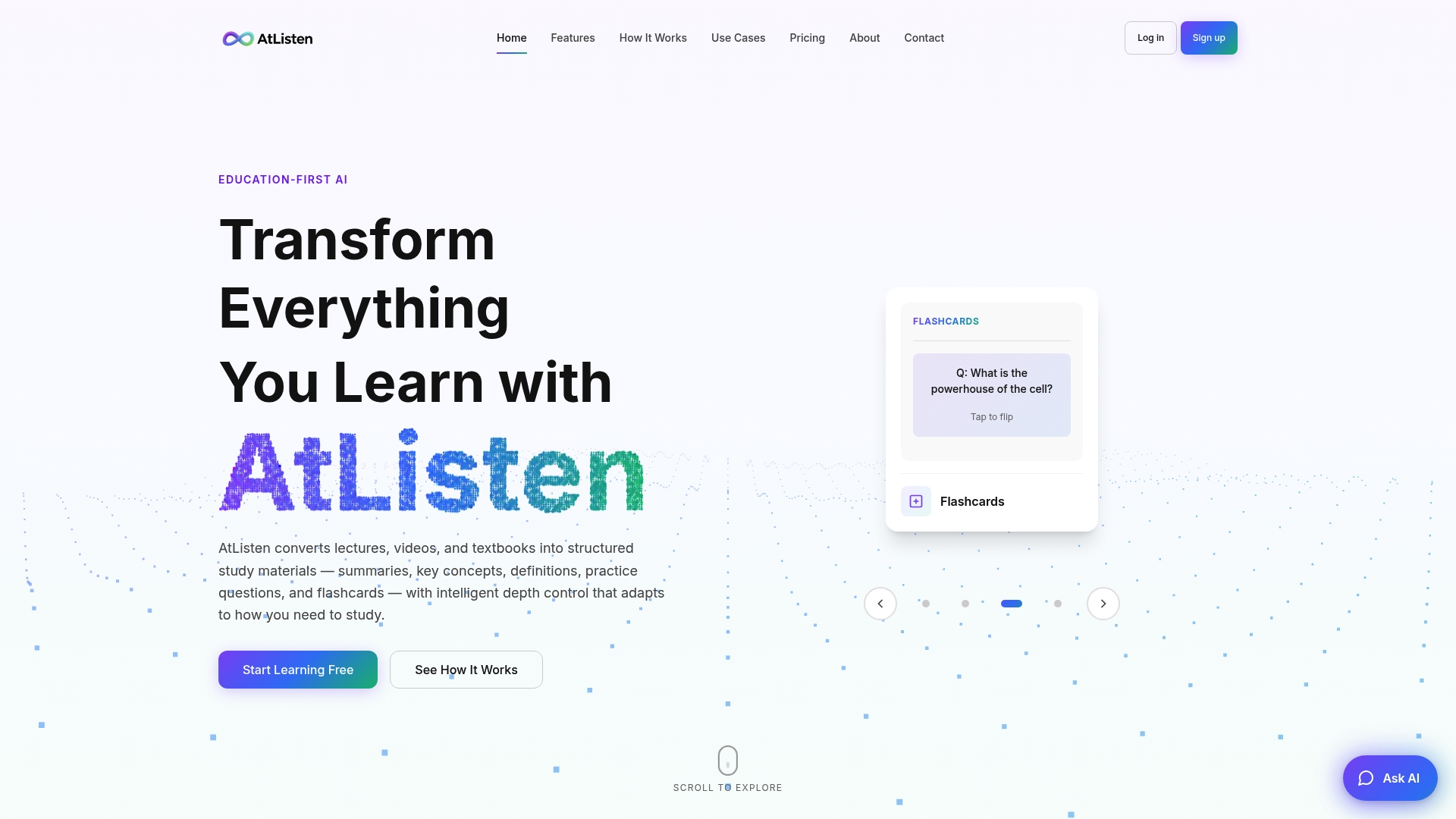
Building good cards by hand takes time most learners don't have, especially when the source material is a two-hour lecture or a dense textbook chapter. Atlisten handles that conversion automatically. Upload a lecture recording, a video, a PDF, or your own notes, and it generates structured study material, including smart flashcards, summaries, and practice questions built directly from that content.
The workflow is straightforward: upload your material, generate a set of contextual cards drawn from what you actually studied, then review with an adaptive schedule and instant feedback on each answer. This fits best for learners with a lot of source material already in hand—a textbook chapter, a recorded class, a set of notes—who want context-rich cards without spending an evening formatting them by hand.

What Realistic Expectations Look Like With Flashcards
Flashcards are excellent at retention and mediocre at fluency on their own. That's not a flaw, it's just what the tool is for. Combine review with real input and production, and rate cards honestly. Marking something "known" because you recognize it once is how decks quietly stop working. When progress stalls, rotate card formats and lean harder into production before adding more new words.
— William
Try Atlisten and See How Much Time You Save
Atlisten is the shortcut for learners who'd rather study than format cards for an hour first. Instead of manually building a deck from your lecture notes or textbook chapter, you upload the material and get a structured set back, summaries, key terms, practice questions, and flashcards built for spaced review, in minutes rather than an evening.
Take one lecture recording or textbook chapter you already have and run it through Atlisten. Compare the time it takes against building that same deck card by card, and judge for yourself whether the shortcut earns its place in your routine. The platform provides a free tier to test the workflow before committing to paid options, and offers the ability to export your study materials. Visit Atlisten to convert your first document into a study set, or check how the platform handles your material on the security page if data privacy is part of your decision.
Key Research and Guides on Spaced Repetition
- A Trainable Spaced Repetition Model for Language Learning, on half-life regression and adaptive scheduling.
- Spaced Repetition for Language Learning, a science-based overview of retention and active recall.
- Repetition and vocabulary retention research, on why repetition drives real recall.
Sources
- A Trainable Spaced Repetition Model for Language Learning
- Spaced Repetition for Language Learning: The Science of Never Forgetting | Science Based Learning
- Flash Cards — English Vocabulary Practice | LexFizz
FAQ
Are Flashcards Good for Language Learning?
Yes. Flashcards used with spaced repetition and active recall produce significantly stronger long-term vocabulary retention than passive review or massed cramming, though they work best paired with speaking and listening practice.
How Does the FBI Learn Languages Quickly?
Intensive government language programs typically combine daily vocabulary drilling, including spaced flashcard-style review, with heavy immersion, structured grammar study, and constant speaking practice rather than relying on any single method.
What Is the Best Way to Create Flashcards for Language Learning?
Put one idea per card, include a full example sentence for context, and favor production formats like sentence gaps over simple word pairs. Tools like Atlisten can generate contextual cards automatically from your own course materials if building them by hand is the bottleneck.
Can Duolingo Do Flashcards?
Duolingo isn't built as a traditional flashcard app, but its underlying review engine uses an adaptive spaced repetition model, half-life regression, to decide when to resurface vocabulary you've already learned.
How Many New Flashcards Should I Add Per Day?
A steady daily pace of new cards, supported by brief review sessions, is sustainable for most learners and more effective than irregular high-volume sessions over time.