

Metacognitive monitoring is the habit of judging your own thinking while you learn: noticing what you understand, what you only recognize, and what you will probably forget. It matters because studying decisions follow those judgments. If the judgments are wrong, you spend time on material you already know and skip the material that will cost you points. Below you will find what the term means, why your sense of "I've got this" is often off, and the specific habits that make it more accurate.
TL;DR
- Monitoring is evaluating your own knowledge or performance. Control is what you do about it, such as deciding what to study next and for how long.
- Rereading and recognition create a false feeling of knowing. Trying to recall the answer from memory gives you a far more honest signal.
- Judgments are more accurate after a delay, and only when you test yourself first. Waiting alone does not help.
- Concrete goals, practice questions with feedback, and spaced flashcards turn monitoring into a routine you can repeat for any course.
- Interventions that train monitoring show small but real gains on average, so a simple, repeated system beats a one-off trick.
Table of Contents
- What metacognitive monitoring means
- Monitoring vs. control
- Why your feeling of knowing is often wrong
- Habits that make monitoring more accurate
- A worked example: one hour with a dense chapter
- Turning lectures and vocabulary into monitoring tools
- Our perspective
- What the research says about limits
- Build the habit into your study week
- Try it on your next lecture
- FAQ
- Sources
What metacognitive monitoring means
Metacognition is thinking about your own thinking. One academic overview of pharmacy education breaks it into three parts: knowledge (what you know about tasks, strategies and yourself), monitoring, and control. Monitoring refers to evaluating the process of learning or your current state of knowledge.
A paper in Developmental Psychology gives a handy everyday example. Monitoring is recognizing that some topics are less familiar than others, and that unfamiliar ones will take more time and effort. That is the whole idea in one sentence: an honest internal gauge of how well you know something.
Monitoring shows up in many small moments:
- Pausing mid-chapter and realizing you cannot say what the last page was about.
- Looking at a practice problem and judging that you could solve it, before you try.
- Finishing an exam question and rating how sure you are of your answer.
- Deciding at 9 p.m. that the biochemistry unit is shakier than the statistics unit.
The MIT Teaching + Learning Lab describes metacognition as using knowledge of the task, of strategies and of yourself to plan your learning, monitor progress toward a goal, and then evaluate the outcome. Monitoring is the middle step, the one that connects your plan to your results.
Monitoring vs. control
People often mix up the two main metacognitive functions. Fiedler, Ackerman and Scarampi (2019) describe it as useful to distinguish monitoring and control as the two major functions, and they call guiding people toward effective regulation of effort the ultimate goal of the field.
| Monitoring | Control | |
|---|---|---|
| Question it answers | How well do I know this? | What should I do about it? |
| Direction | Reads your mental state | Changes your behavior |
| Student example | Realizing you can't explain glycolysis without notes | Moving glycolysis to the top of tomorrow's session |
| Typical failure | Feeling confident because the page looks familiar | Studying favorite topics because they feel good |
The Son and Schwartz chapter frames control as using your judgments to alter behavior. The pharmacy education article gives examples of control: deciding when to study, which strategies to use, and how to study differently for the next exam.
The two depend on each other. Even perfect control cannot rescue a student whose monitoring is off, because the controller is steering by a bad map. Metcalfe's work on study choices argues that people try to drop what is already well learned and then move from easier to harder material, and that this only works when the judgments are accurate and the right choices are carried out.
Why your feeling of knowing is often wrong
Most students monitor by feel. The research says feel is a shaky instrument.
Recognition feels like recall
Stanton, Sebesta and Dunlosky note that students often rate their confidence on their ability to recognize concepts rather than recall them. Reading your notes and thinking "yes, I know that" is recognition. An exam asks for recall. The two can be far apart.
Familiarity and fluency are cues, not proof
Fiedler and colleagues report that metacognitive judgments draw on heuristic cues such as fluency, familiarity, accessibility and pronounceability. A smooth lecture, a neatly highlighted page or a term you have seen ten times all produce fluency. None of them guarantees you can retrieve the idea tomorrow.
Two ways to be inaccurate
The LSE evidence-based teaching guide separates two kinds of accuracy:
- Relative accuracy (resolution): can you tell which topics you learned well and which you learned less well?
- Absolute accuracy (calibration): does the size of your confidence match the size of your score?
You can rank your topics correctly and still be overconfident across the board. Fiedler and colleagues stress measuring both resolution and calibration to understand where monitoring biases come from. For a student, the practical version is simple: after a quiz, compare what you predicted with what you got, topic by topic.
Easy material hides the problem
The LSE guide also notes that students are not likely to use metacognition on easy assignments and exams. That is a useful warning. If your early quizzes feel effortless, you may not have built the checking habit you will need when the material gets dense.
Habits that make monitoring more accurate
Test yourself before you judge yourself
The strongest single move is to attempt retrieval first and rate your knowledge second. Stanton and colleagues point out that self-testing with flashcards and practice questions gives you chances to monitor understanding and find gaps. The MIT Teaching + Learning Lab cites work showing that judgments of learning made after a delayed retrieval attempt lead to more accurate monitoring.
If you want the deeper case for this habit, our guide to retrieval practice strategies covers it in detail.
Wait, generate, validate
Hausman, Myers and Rhodes (2021) propose a three-step framework for assessing your understanding. Here is how a student can use it:
- Wait. Let some time pass after studying instead of judging right away.
- Generate. Write the explanation, answer the question or solve the problem from memory.
- Validate. Check your output against the source, a key or feedback.
The authors say strategies like this can give students a more objective measure of what they learned from lectures, how well they understand course concepts, and how ready they are for tests, and that they lead to better study decisions.
Delay judgments, but give them something to stand on
A tempting shortcut is to delay and then simply "feel" again. Serra and Metcalfe explain that delay alone does not improve the accuracy of comprehension judgments. Delayed judgments need diagnostic cues, and summarizing or generating keywords provides them. Keyword generation takes less time than writing a full summary, which makes it a good quick check after a reading.
The same chapter reports that term-specific judgments are more accurate than broad ones, especially when you must try to retrieve the answer and get feedback on whether it was right. So instead of asking "Do I understand chapter 6?", ask "Can I define each of these eight terms without looking?"
Ask yourself monitoring questions
The MIT page cites Schraw (1998) for regulatory checklists with prompts such as: Do I have a clear understanding of what I am doing? Does the task make sense? Am I reaching my goals? Do I need to change my plan? Put these on a sticky note and answer them at the end of every session. If you teach, lesson reflection prompts show how the same kind of questions can end in a concrete next-step plan.
Set concrete goals
The LSE guide notes that students who set concrete goals and evaluate their progress toward them are more effective than those who do not. "Study genetics" is not a goal you can monitor. "Answer 15 practice questions on Mendelian inheritance and get at least 12 right" is. If your week feels crowded, our exam study plan templates give you a structure for turning goals into days.
Use the gap to decide what comes next
Monitoring only pays off when it changes what you do. After each self-test, sort items into three piles: solid, shaky and missing. Drop the solid pile to a longer review interval, give the shaky pile another round soon, and go back to the source for the missing pile. This mirrors the strategy Metcalfe describes of dropping what is learned and working progressively toward harder material. Spacing those reviews is the subject of our 30 day cram vs. spaced study plan.

A worked example: one hour with a dense chapter
Say you have a 40-page cell biology chapter and an exam in ten days. Here is a monitoring-first hour:
- Minutes 0 to 5: write one concrete goal, for example "explain how the three types of membrane transport differ."
- Minutes 5 to 30: read and take notes, pausing at each heading to ask whether you could explain the last section aloud.
- Minutes 30 to 35: close the book and list ten keywords you remember.
- Minutes 35 to 50: answer practice questions on those terms from memory, writing a confidence rating from 1 to 5 beside each answer before you check.
- Minutes 50 to 60: compare confidence with results, mark shaky items, and schedule them for tomorrow and again in three days.
The confidence rating is the monitoring step and the schedule is the control step. After a few sessions you will see patterns, such as always overrating definitions you have read many times. That pattern is the information most students never collect.
Turning lectures and vocabulary into monitoring tools
Monitoring needs something to check yourself against. A recording or a 60-page PDF is hard to test against, because it offers no questions. The raw material has to become questions, definitions and flashcards first.
For lectures, that means converting the content into key concepts, definitions and practice questions, then answering them without looking. For foreign language vocabulary, flashcards give you a clean signal: you either retrieved the word or you did not, and the cards you miss are your control decisions. Our guide to effective flashcards explains how to build and space them. Fast feedback helps too, since you catch a wrong belief before it hardens, as we describe in instant feedback studying.
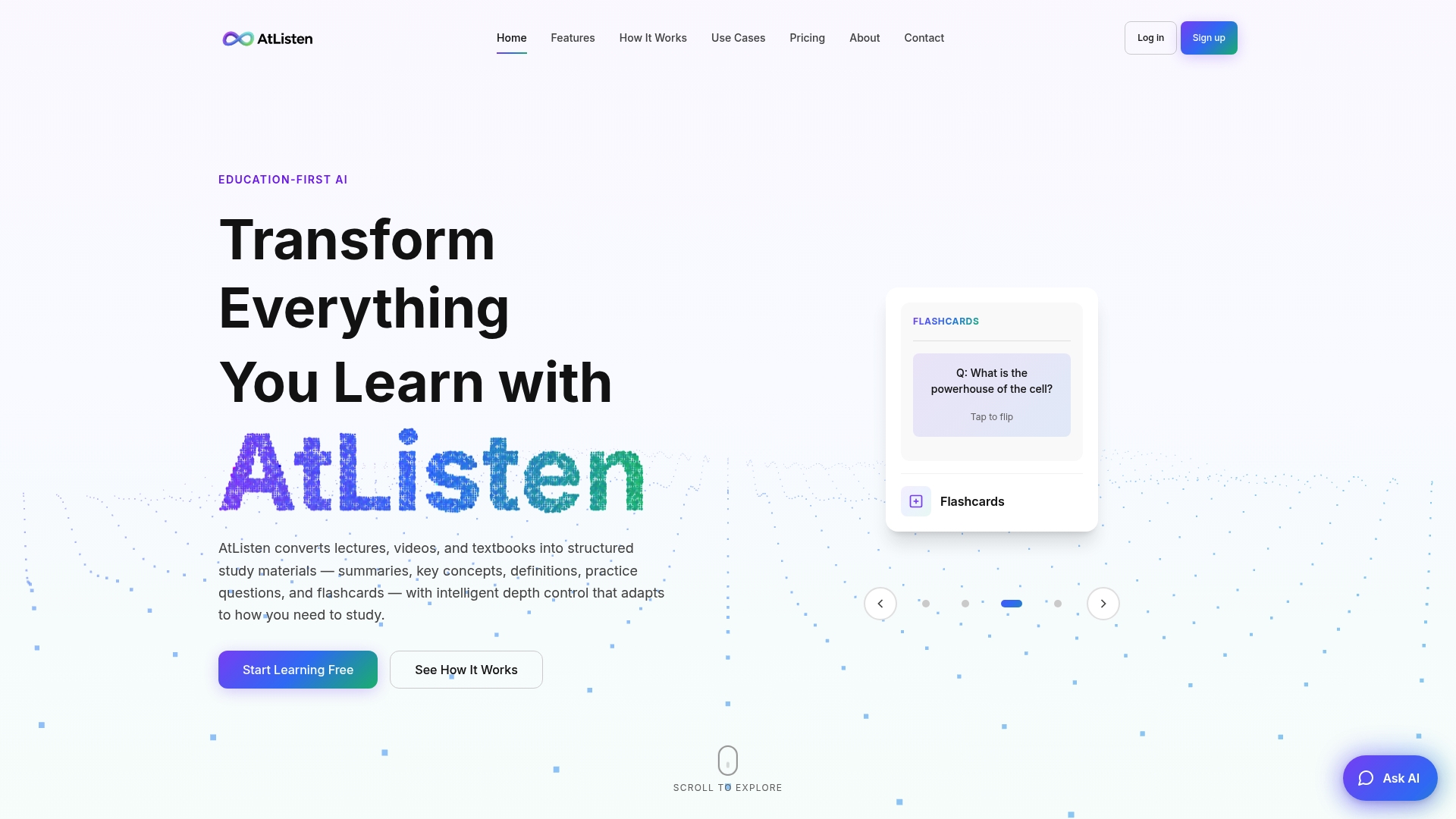
We built AtListen around this loop. You can upload lectures, videos, audio recordings, PDFs, textbooks, notes, web articles or YouTube links, and it generates summaries, key concepts with definitions, key facts, practice questions with explanations and flashcards designed for spaced repetition. You can adjust the depth, so a first pass can stay light and a later pass can go deeper.
Our perspective
Most students do not lack effort. They lack a trustworthy signal about where their effort should go. Rereading feels productive, and that feeling is exactly what makes it hard to spot the gaps.
We designed AtListen to put the signal in front of you. When a lecture or chapter becomes questions, definitions and flashcards, you can try to retrieve first and judge second. Explanations on practice questions and instant feedback are meant to close the loop right away, so a wrong belief gets corrected while it is still fresh.
Depth control matters here too. A student overwhelmed by a dense unit does not need everything at once. Starting with the key concepts, then moving to finer detail as the gaps show, keeps monitoring manageable instead of discouraging. Our goal is to make the habit of checking yourself easy enough that you do it every session.
William
What the research says about limits
Monitoring is trainable, but the gains are modest on average and depend on the method. A 2024 meta-analysis of 35 studies found that interventions together had a small positive effect on monitoring accuracy (g = 0.25). Interventions aimed at the whole task, at metacognitive knowledge and at external standards improved accuracy. Those that manipulated the timing of judgments reduced it, and secondary school students benefited least.
The lesson for high schoolers is practical: build in external standards, such as answer keys and explained solutions, rather than relying on self-judgment alone. A guided, feedback-rich routine supplies the standard that unaided judgment lacks.
Other findings point the same direction. In a randomized experiment with 103 undergraduates, students trained in metacognitive retrieval practice scored higher on final exam items that had not been quizzed before, and the accuracy of their monitoring of yet-to-be-learned material had the strongest indirect effect. A meta-analysis by Prinz, Golke and Wittwer found a medium effect (g = 0.46) on relative comprehension accuracy for interventions that push readers to build a mental model of the text, with setting a comprehension-test expectancy particularly effective.
Age matters as well. The Developmental Psychology paper reports that young children vastly overestimate their performance, while adults' estimates track their actual performance closely, though adults sometimes underestimate. Overconfidence shrinks with experience, and deliberate practice helps it along.

Build the habit into your study week
A workable weekly rhythm looks like this:
- Day of the lecture: turn the material into questions and flashcards while it is fresh.
- Next day: do a closed-book check and rate your confidence before seeing answers.
- Every few days: review only the shaky and missing piles, with longer gaps for solid items.
- End of week: compare predictions with results and write one sentence on what to change.
If pressure is building, our study overwhelm guide helps you shrink the plan. If you prep for AP exams, the 8-week AP study plan fits 45 to 60 minutes a day around this routine. For a calendar that adapts to your load, see how to create a study schedule with AI.
Try it on your next lecture
AtListen turns the material you already have into the study set you need to check yourself: summaries, key concepts, practice questions with explanations and spaced flashcards. The Free plan costs $0 per month, Pro is $19.99 per month and Max is $39.99 per month, with higher tiers offering enhanced features and greater usage limits. Start with the free plan at AtListen and run your first closed-book check tonight.
FAQ
What does metacognitive monitoring mean in simple terms?
It means keeping track of how well you are learning while you learn. You notice what you understand, what is unfamiliar and how confident you are in an answer. Researchers define it as evaluating your own knowledge, proficiency or performance.
How is monitoring different from metacognitive control?
Monitoring is the judgment and control is the action that follows. Realizing a topic is weak is monitoring. Giving it more time, switching strategies or rescheduling it is control. Good studying needs both, in that order.
How can I tell if I really understand something?
Try to produce the answer from memory instead of rereading. Write an explanation, define the terms or solve a problem, then check it against a trusted source. Research suggests judgments made after a delay and a retrieval attempt are more accurate than judgments made right after studying.
Does monitoring work for high school students?
Yes, but it works better with support. A meta-analysis found that secondary school students gained the least from monitoring interventions, which is a reason to use external standards such as answer keys, explanations and instant feedback. Concrete goals and regular practice questions give younger learners something solid to measure against.
Sources
- Measuring Metacognitive Knowledge, Monitoring, and Control in the Pharmacy Classroom
- Developmental Psychology manuscript on metacognitive monitoring and control
- Son and Schwartz, The relation between metacognitive monitoring and control
- Fiedler, Ackerman and Scarampi, Metacognition: Monitoring and Controlling One's Own Knowledge
- MIT Teaching + Learning Lab, Metacognition
- LSE guide: Encouraging Students to Monitor and Control their Learning
- Stanton, Sebesta and Dunlosky, Fostering Metacognition to Support Student Learning
- Hausman, Myers and Rhodes, Improving Metacognition in the Classroom
- Metcalfe, Metacognitive Judgments and Control of Study
- Serra and Metcalfe, chapter on metacomprehension
- Janssen and Lazonder, Meta-analysis of Interventions for Monitoring Accuracy
- Cogliano, Bernacki and Kardash, A Metacognitive Retrieval Practice Intervention (ERIC)
- Prinz, Golke and Wittwer, Situation-Model-Approach Interventions meta-analysis
- Lesson reflection prompts that produce an I will plan