
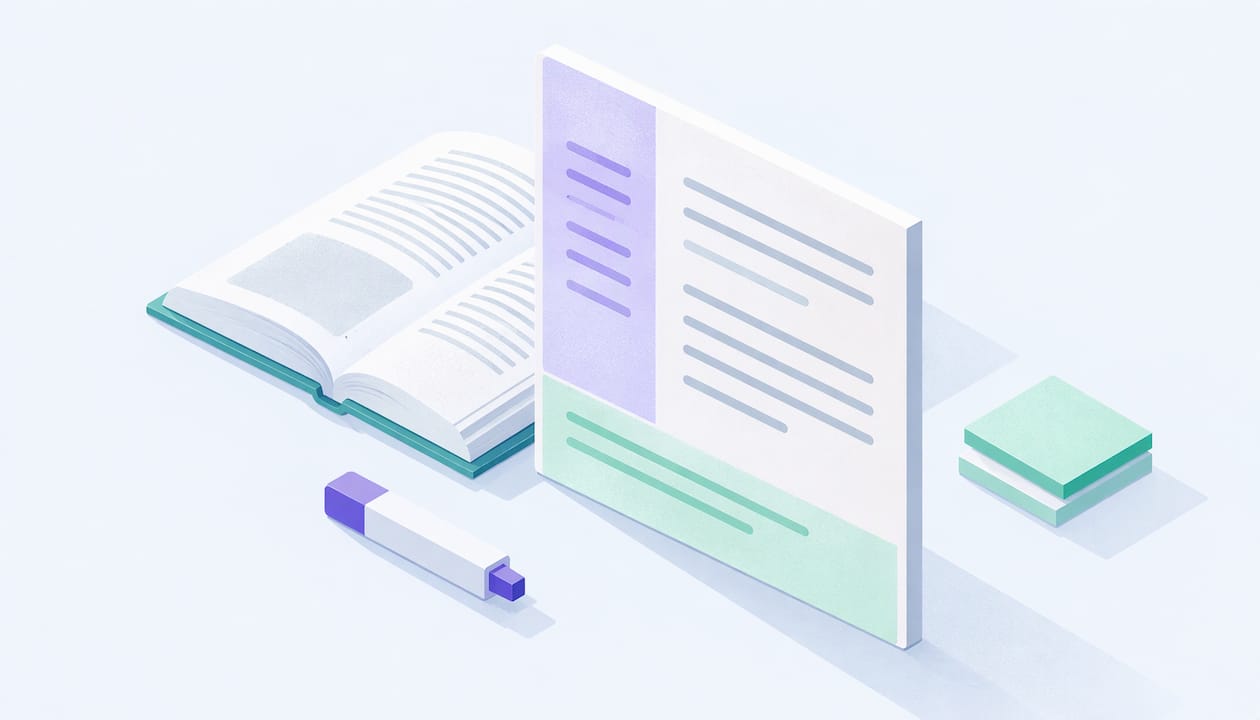
To take Cornell notes from a textbook, skim the chapter first, then divide your page into a wide notes column on the right, a narrow cue column on the left and a summary strip at the bottom. Read one section at a time, write the main ideas on the right, then turn them into questions and key terms on the left. Finish each page with a short summary in your own words. This guide walks through each step, shows what a finished page looks like, and covers what to do when you have an hour instead of a week.
TL;DR
- Skim the headings, intro and summary for a minute or two before you write anything, so your notes follow the chapter's structure.
- Take notes on the right, one section at a time. Write the cue column and the bottom summary afterward, not while you read.
- Use the cue column as a quiz: cover the right side and answer out loud.
- Short on time? Choose a lighter reading level, such as skimming only the sections covered in class, and keep reading in 5 to 10 page chunks.
- Review within 24 hours, then shrink your notes each time until a single word cues a whole idea.
Table of Contents
- Why Cornell notes suit textbook reading
- Step 1: Skim the chapter before you take notes
- Step 2: Set up the page
- Step 3: Take notes one section at a time
- Step 4: Fill in the cue column and summary
- What a finished textbook page looks like
- Review so the notes stay with you
- Cornell notes or a chapter outline?
- When you do not have time for full notes
- If reading is harder for you than for classmates
- Using Cornell notes for vocabulary in another language
- Our perspective
- Turn a chapter into a study set in minutes
- FAQ
- Sources
Why Cornell notes suit textbook reading
The Cornell system was developed by Cornell education professor Walter Pauk, who described it in his book How to Study in College, according to Cornell's Learning Strategies Center. It was built for lectures, but the page layout fits reading just as well. A textbook already gives you headings and a hierarchy of ideas. Cornell notes give you a place to compress those ideas and a place to test yourself on them.
The layout has three parts, as the OISE Academic Skills Hub describes it: a notes section on the right for important information from the reading, a cue column on the left for keywords, questions or concepts, and a summary section at the bottom for a concise recap. A Cornellians feature puts it simply: two unequal columns with a summary across the bottom.

The difference between this and highlighting is the work it forces. Western Washington University's study skills booklet says that actively processing information, by recalling, analyzing, summarizing and paraphrasing, increases comprehension and retention. Cornell notes build all four into one page.
One practical point: the Cornell Learning Strategies Center states that research shows handwriting beats laptop typing for notes, and that the physical act of writing can help you remember. If you can, take your textbook notes on paper. A loose-leaf notebook lets you rearrange pages later and spread them out when you review.
Step 1: Skim the chapter before you take notes
If you start writing on page one, you will copy too much because you do not yet know what matters. A short survey fixes that.
The UNC Learning Center describes skimming as focusing on a text's main ideas and deliberately skipping details. It suggests looking at introductions, chapter summaries, the first and last sentences of paragraphs, bold words and text features. Cornell's own Learning Strategies Center describes the survey step of the SQ3R method as glancing over the headings, then reading the final summary paragraph, and says it should take no more than a minute or two.
If you want a more structured pass, Bucks County Community College suggests reading the introduction, then skimming each page for about 5 seconds, noticing headings, illustrations and tables, and finishing with the chapter summary.
A simple skimming routine:
- Read the chapter title, introduction and end-of-chapter summary.
- Flip through every page, reading only headings, bold terms and captions.
- Read the end-of-chapter questions. They tell you what the authors expect you to know.
- Write the chapter title and date at the top of your first Cornell page.
Step 2: Set up the page
Rule your paper before you read. The layout in most guides, including Stanford's Center for Teaching and Learning, looks like this:
- Right side (wide): your notes while you read.
- Left margin (narrow): key concepts and questions, added afterward.
- Bottom strip: a brief summary of the page.
For textbooks, start a new page whenever you start a new major heading. That keeps each page to one cluster of ideas, which makes the bottom summary easy to write and the cue column easy to use. Put the heading and the textbook page numbers at the top of the page so you can find the source again.
Step 3: Take notes one section at a time
The Bucks County guide advises developing Cornell notes as you complete each section: main ideas in the margin and important details, such as explanations, examples and applications, on the right. It also recommends summarizing what you have read after each section or unit.
In practice:
- Read one section, from one heading to the next.
- Close your eyes or look away for a moment and ask what the main point was.
- Write that point on the right, then the two or three supporting details that make it make sense.
- Leave the cue column blank for now.
Two habits keep the right column readable. Skip a line between ideas, and use abbreviations and short phrases instead of full sentences, a tip from The Learning Toolbox style guides that applies to textbook notes just as well. Write definitions in full, though, since you will need the exact wording later.
As a pace guide, the UNC Learning Center recommends tackling no more than 5 to 10 pages at a time and spreading reading across the day and week rather than cramming it into long sessions. Cornell's P2R system uses the same rhythm: after about ten pages, pause to summarize in your own words, recite key information under each heading with the book closed, or write exam-style questions and answer them.
Step 4: Fill in the cue column and summary
This is the step most people skip, and it is where the method pays off.
Walter Pauk's advice, as quoted in the Cornellians article, is to keep the cue column empty while you take notes. Then, when you review and recite what you have written, draw questions from the ideas and put them in the cue column. Writing questions helps clarify meanings, reveal relationships, establish continuity and strengthen memory.
Stanford's approach is a little different: after reading, distill your notes into key concepts of one to three words in the left margin, and use the bottom margin to state the relationship between the page's key concepts. You can mix both. Use short key terms for vocabulary-heavy sections and full questions for processes and arguments.
Good cue-column entries
- A term: "Mitosis, 4 phases"
- A why question: "Why does inflation reduce the value of fixed-rate debt?"
- A compare question: "How do mitosis and meiosis differ?"
- A prediction: "What would an exam ask about the Treaty of Versailles?"
The summary strip should be two or three sentences you could say without looking. If you cannot write it, you have found a section to reread, which is useful information.
What a finished textbook page looks like
Here is an illustration, a made-up page from an introductory biology chapter on cell division:
| Cue column (left) | Notes (right) |
|---|---|
| What is mitosis? | Cell division producing 2 genetically identical daughter cells. Used for growth and repair. |
| 4 phases, in order? | Prophase, metaphase, anaphase, telophase. Chromosomes condense, line up, separate, then two nuclei form. |
| Why does it matter? | Keeps chromosome number constant across body cells. |
| Mitosis vs. meiosis | Meiosis: 2 divisions, 4 cells, half the chromosomes. Gametes only. |
Summary (bottom strip): Mitosis copies a cell into two identical cells through four phases, which keeps chromosome number stable. Meiosis differs because it halves the number to make gametes.
Notice what is missing: no full paragraphs, no copied sentences, and nothing the book says twice.
Review so the notes stay with you
Princeton's McGraw Center states that students forget 50% of what they learn if they do not review within 24 hours. It recommends reviewing within that window, filling in blanks, annotating key terms in the left margin and writing a summary of each page at the bottom.
Two review routines come straight from university guides:
- The cover-up quiz. The WWU booklet says to cover the right side and try to recall the related information out loud, check what you got right, and repeat until the material is familiar.
- The margin-only read-aloud. Stanford suggests arranging your sheets so only the left margins show, summarizing the reading out loud using only those cues, then spreading the sheets out and checking yourself. Highlight any concept you missed and give it extra time.
Bucks County adds a useful long-term habit: keep reducing the size of your notes each time you review, until one word or phrase is enough to cue the detail. If you want to go deeper on the recall side, our guide to active recall sessions in 5 to 10 minute bursts shows how to schedule them, and question and answer notes covers writing the questions well.
Cornell notes or a chapter outline?
The two are not rivals. An outline captures the chapter's structure; Cornell notes capture and test its content. Many students do both: outline during the survey, Cornell notes during reading.
For the outline, ThoughtCo suggests reading the first and last paragraphs of the chapter, listing every heading and subheading, then noting the first and last sentences of paragraphs and skimming for bold terms. The SJSU Writing Center recommends setting up an outline while previewing, with the chapter name, headings with main points, and subheadings for concepts and definitions.
If you want clean outlines, the Excelsior OWL lists four rules: parallelism, coordination, subordination and division. Each heading level should be the same kind of item, the same rank, more general than the level below it, and split into at least two parts.
After reading, UNC recommends making an outline or concept map from memory first, then using the book to fill what you could not recall. A Cornell page does exactly this job when you cover the notes and rebuild them. For a recall-first approach to whole chapters, see our 7 step method to summarize textbook chapters.
When you do not have time for full notes
Full Cornell notes on every chapter is not realistic in a heavy week. Trent University's Academic Skills guide estimates that one course can mean 25 to 50 pages of reading per week, or about 2 to 4 hours, and five courses can reach 10 to 20 hours. So match your effort to the stakes.
The CWU Learning Commons offers five reading intensity levels:
| Level | What you do | Where Cornell fits |
|---|---|---|
| 1 | Skim only sections covered in class | Write cue questions from headings only |
| 2 | Fully read those sections | Notes on right, short summary |
| 3 | Skim the whole chapter | One summary strip for the chapter |
| 4 | Fully read the chapter | Notes on the key sections |
| 5 | Take notes on the entire chapter | Full Cornell pages |
The table's third column is our suggestion for pairing the levels with the page layout, not part of the handout.
For a true time crunch, the SJSU handout recommends the THIEVES method: Title, Headings, Introduction, each paragraph's first sentence, Visuals, end-of-chapter Questions and Summary. Use it to find the gist, then write a single Cornell page with the headings as your cue column and one sentence per heading on the right.
If your class is short on time and long on reading, spacing helps more than a single marathon. Our 30 day plan comparing cramming with spaced study lays out how to spread review.
If reading is harder for you than for classmates
Some readers find dense textbook pages slower going, and a structured page with a clear job for each section can reduce the load. Short phrases on the right, one idea per line and a quiz column on the left all help. If that sounds familiar, these study strategies for dyslexic students are worth pairing with the Cornell layout.
Using Cornell notes for vocabulary in another language
When the textbook is in a language you are still learning, the page layout adapts easily. Put the target-language sentence or term on the right, with a short definition in the language you know best. Use the cue column for the word's translation, a clue or a question like "What does this verb mean in context?". Cover the right side and test yourself, as in the cover-up quiz above. Group words by chapter heading so the context stays attached.
The summary strip becomes a sentence or two written in the target language using the new words. Later, turn the cue column into flashcards. Our guide on turning lectures into vocabulary flashcards walks through that step, and effective flashcards with spaced recall explains how to review them.
Our perspective
We built AtListen around one observation: students rarely struggle because they lack material. They struggle because the material is dense, the time is short, and reading passively feels like studying when it is not.
Cornell notes are a good answer to that problem because they force the steps that matter: finding the main idea, turning it into a question, and recalling it later. The weak point is the effort of setting it all up for every chapter of every course. That is where we think a tool should help, not replace the thinking.
AtListen takes textbooks, PDFs, lecture recordings, notes, web articles and YouTube links and turns them into summaries, key concepts with definitions, practice questions with explanations and flashcards designed for spaced repetition. Depth control lets you choose how detailed the output is, which maps neatly onto the skim-versus-full-notes choice above. Instant feedback on practice questions gives you the cover-up quiz without having to write the questions first.
Our suggestion: take your own Cornell notes on the chapters that matter most, and let a structured study package handle the rest. You get the active recall benefits without spending your whole evening formatting.
William
Turn a chapter into a study set in minutes
If you want a head start on the cue column, you can upload a textbook chapter, PDF or notes to AtListen and get key concepts, definitions, practice questions and flashcards back in minutes. Use them as your starting questions, then add your own in the margin.

The Free plan costs $0 per month. Pro is $19.99 per month and Max is $39.99 per month, with higher tiers enabling enhanced features and greater usage limits. See the plans on AtListen and start with a chapter you have to read this week.
FAQ
How long should Cornell notes from a textbook take?
Plan for the survey to take a minute or two, then write notes in chunks of 5 to 10 pages. The cue column and summary add a few minutes per page, but they are the part that makes the notes useful at review time. If you are short on time, take notes only on sections covered in class.
Should I take Cornell notes while reading or after?
Do both in sequence. Write the main ideas on the right as you finish each section. Add the cue column and summary afterward, ideally within 24 hours, when you can recite the material and draw questions from it.
Can I use Cornell notes with a digital textbook?
Yes, the layout works on paper or a screen. Cornell's Learning Strategies Center says research favors handwriting for notes, so paper is a good default if your tablet or notebook allows it. If you type, keep the same three zones in a table or a split document.
What is the difference between Cornell notes and a chapter outline?
An outline maps the chapter's structure of headings and subheadings. Cornell notes record the key content and add questions and a summary to test yourself. Many students outline while skimming and then take Cornell notes while reading.
Sources
- Skimming, UNC Learning Center
- Reading Textbooks Effectively, UNC Learning Center
- Textbook Reading Systems, Cornell Learning Strategies Center
- The Cornell Note Taking System, Cornell Learning Strategies Center
- Reading College Texts, Bucks County Community College
- How to Take Notes of Readings, OISE Academic Skills Hub
- The Cornell Method of Taking Notes, Stanford Center for Teaching and Learning
- Take Note: Popular Study Method, Cornellians
- Listen Actively & Take Great Notes, Princeton McGraw Center
- Study Skills Booklet, Western Washington University
- How to Create Quick Chapter Outlines, ThoughtCo
- Creating an Outline, Excelsior OWL
- Reading a Textbook, SJSU Writing Center
- Color-Coding Textbook Reading, CWU Learning Commons
- Reading Textbooks, Trent University Academic Skills