

Elaborative interrogation is a study strategy where, instead of accepting a fact as given, you ask yourself why it is true or how it connects to what you already know, then answer the question in your own words. It works best on the handful of ideas in a lecture or chapter that really matter, and it works far better when you have a quick way to check your answers. Turning a pile of lecture recordings, PDFs and slides into clear key concepts to question is where AtListen fits in: you upload the material, and the concepts, definitions and practice questions are ready in minutes.
TL;DR
- Elaborative interrogation means asking "why" and "how" about a fact, then explaining the answer yourself, as Duke's Academic Resource Center describes it.
- In one biology course study, students prompted with "Why is this true?" scored 76% on a final test versus 69% for students who read the chapter twice, as Roediger (2012) reports.
- It needs some background knowledge and a check against your materials, because weak explanations can hurt learning.
- Use it on key concepts, not on every line, and pair it with retrieval practice such as flashcards for dates and vocabulary.
Table of Contents
- What elaborative interrogation is
- Why asking "why" helps you remember
- Elaborative interrogation examples you can copy
- How to use elaborative interrogation on a real course
- Using it with lecture notes
- Vocabulary, dates and other arbitrary facts
- High school and professional exam prep
- Elaborative interrogation or self-explanation?
- Where AtListen fits
- Our perspective
- FAQ
- Sources
What elaborative interrogation is
The name sounds technical, the idea is not. You take a statement from your notes, turn it into a question beginning with why or how, and try to answer it. Duke's Academic Resource Center gives a simple example: the heading "Important principles of chemistry" becomes "Why are these chemistry principles important?" (Duke ARC).
Rutgers' learning centers describe it as a specific kind of elaboration, which just means adding detail and connections to what you are learning. Their sample prompts are: How does this work? Why does this happen? What causes this? What is the result? (Rutgers).
The technique goes back to a 1987 study by Pressley and colleagues. A 2018 review by Weinstein, Madan and Sumeracki lists it as the elaboration technique with relatively strong evidence behind it: students ask "how" and "why" questions about concepts, then try to answer them from their materials or, eventually, from memory (Weinstein et al., 2018).
Why asking "why" helps you remember
Passive rereading lets facts slide by. A why question forces you to do three things at once.
According to Karpicke and O'Day (2024), a "why" prompt makes you retrieve what you already know and generate an explanation. It may also help you notice similarities among concepts, and it very likely makes each fact more distinctive in memory, because your explanation is unique to that fact (Karpicke & O'Day, 2024). In plain terms, you attach the new fact to things you already understand, and that gives you more routes back to it on exam day.
Dunlosky and colleagues (2013) add that many studies phrased the prompt as "Why would this fact be true of this [X] and not some other [X]?" That wording pushes you to compare similar things, which helps when an exam asks you to tell related ideas apart (Dunlosky et al., 2013).
What the numbers look like
In the classic study, undergraduates explained sentences such as "The hungry man got into the car" by answering why that man did that. They scored about 72% on a cued-recall test, against about 37% for groups who were given explanations or simply read (Dunlosky et al., 2013).
A more course-like result: in a biology lab section, students who were intermittently asked "Why is this true?" about facts such as saliva mixing with food to start digestion scored 76% on a final true/false test, versus 69% for students who read the chapter twice (Roediger, 2012).
The technique is also cheap to learn. Dunlosky's review notes that brief instructions plus three or four practice facts were enough in studies, and that the time cost was modest, around 15 seconds per fact in some experiments (Dunlosky et al., 2013).
Elaborative interrogation examples you can copy
The pattern is the same in every subject: take a claim, then ask why it holds and how it works.
| Subject | Statement in your notes | Elaborative question |
|---|---|---|
| Biology | Saliva must mix with food to start digestion | Why does digestion start in the mouth rather than the stomach? |
| Chemistry | Important principles of chemistry | Why are these principles important, and what would break without them? |
| History | The U.S. entered World War II after the attack on Pearl Harbor | Why did the attack lead to a declaration of war, and what did it change? |
| Psychology | Spaced practice beats cramming | Why would spreading study sessions out help memory more than one long session? |
| Economics | Prices rise when demand outpaces supply | Why does this happen for gasoline and not for, say, software downloads? |
| Nursing or health sciences | A drug is given with food | Why does food change how this drug is absorbed, and which patients does that matter for? |
Notice the last phrase in several rows. Adding "and not some other" or "for this case but not that one" is the comparison format that most of the research used.
A worked example
Say your lecture slide reads: "Myelin speeds up nerve signals."
- Question: Why does myelin speed up a signal?
- First answer, from memory: Myelin is an insulating coat around the axon, so the electrical signal does not leak out and can travel faster.
- Follow-up: How does the signal move along a myelinated axon compared with a bare one?
- Check: Compare your answers with your textbook or lecture. If you wrote that the signal "jumps" between gaps, did the source say the same thing?
The last step is the one most students skip, and it matters most.
How to use elaborative interrogation on a real course
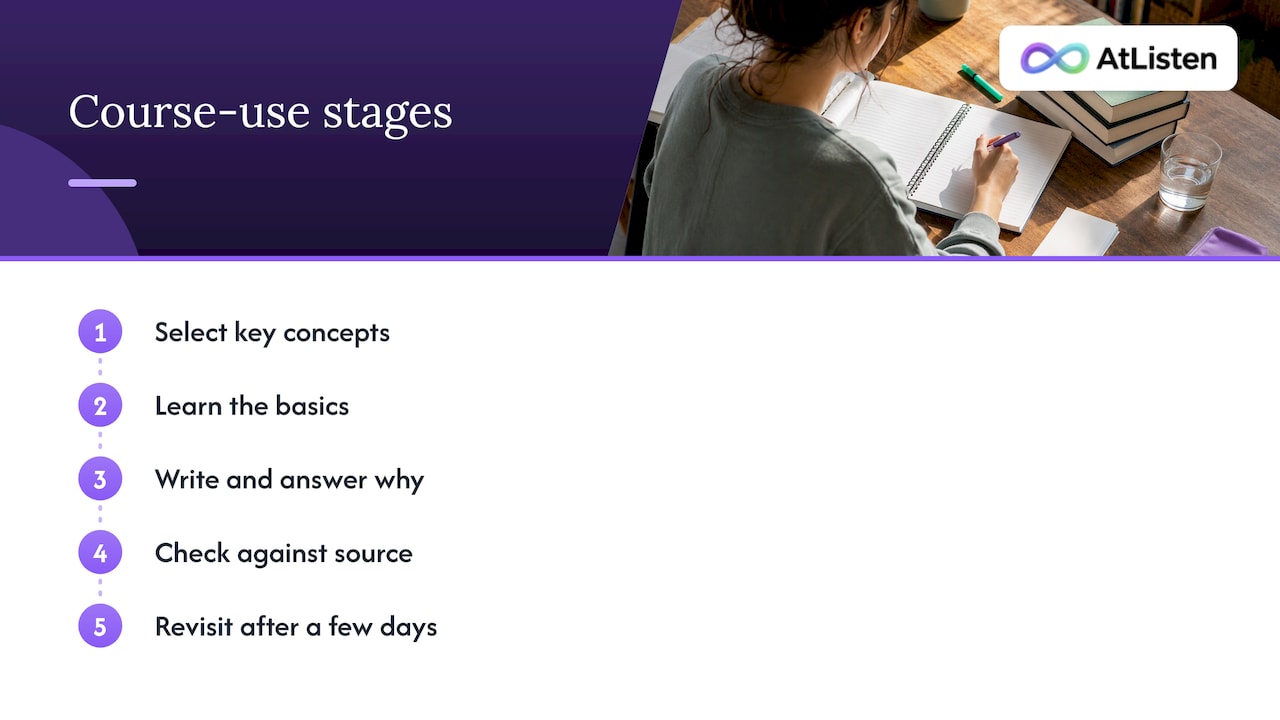
1. Pick the ideas that carry the most weight
You do not need to question every sentence. The research is clear that it works best on specific concepts and segments of text rather than extensive material (UW-La Crosse CATL). Dunlosky's review also warns that effects can fade or even reverse when a prompt shows up only once every page or two of a long text (Dunlosky et al., 2013). So choose the concepts, then question each one thoroughly.
If you are facing a 90-minute lecture recording or a 40-page PDF, finding those concepts is the first job. AtListen turns uploaded lectures, videos, audio recordings, PDFs, notes and YouTube links into summaries, key concepts with definitions and key facts, so the list of what to question is already on your screen. Our guide to identifying key concepts covers the same skill by hand.
2. Learn the basics before you question
Elaboration links new information to what you already know, so you need something to link to. The UW-La Crosse guide says plainly that students need background knowledge to produce good explanations (UW-La Crosse CATL). Dunlosky's review likewise notes that benefits may be smaller for learners with low domain knowledge.
Practically: read or listen to the material once, get a clear summary, and only then start asking why. If a topic is brand new, begin with the definitions and one example, then question.
3. Write the question, then answer from memory
Write a specific question. "Why does this work?" is vague. "Why does a larger sample size narrow a confidence interval?" is a question you can answer and check. Then write your answer without looking. Writing exposes gaps that thinking quietly hides.
4. Check against your source
This is the safeguard. Weinstein and colleagues stress that students should check their answers against their materials or their teacher, because poor generated content can hurt learning (Weinstein et al., 2018).
The evidence for why is sobering. In a 2016 study of 198 undergraduates learning about posterior probability, about 37% of answers were missing, circular or wrong and another 51% were inadequate. Answer quality tracked test scores, and the question group did worse than a read-twice group (Clinton, Alibali & Nathan, 2016). The lesson is not to skip the technique. It is to make sure the answers you rehearse are correct.
Keeping your sources in one place makes checking fast. If you save readings and notes in a personal library, AI answers linked to sources let you see where a claim came from. With AtListen, the key concepts, definitions and practice questions with explanations generated from your own material give you a reference to compare your answer against.
5. Add a second pass a few days later
Studies have found benefits after delays of one to two weeks and longer, though Dunlosky notes the delayed tests were often preceded by shorter ones, which may have inflated results. Treat that as a reason to revisit rather than a guarantee. Return to your questions after a few days and answer them again without peeking. That is retrieval practice, and our guide to active recall sessions shows how to fit it into short bursts.
Using it with lecture notes
Lecture material is where the technique earns its keep. A study of underprepared college students at Toronto Metropolitan University trained them to generate and answer their own questions from a lecture. On a one-week retention test, the self-questioners did somewhat better than students who summarized and significantly better than students who only reviewed their notes (Toronto Metropolitan University study, 1992).
A routine that fits a normal week:
- Within a day of the lecture, mark the two or three ideas that the professor spent the most time on.
- Write one why question and one how question for each.
- Answer from memory, then check against your slides, textbook or generated summary.
- Fix any answer that was wrong or circular, and rewrite it in a sentence you could say aloud to a classmate.
If you want to organize the answers, drawing links between them in a concept map shows how the explanations connect.
Vocabulary, dates and other arbitrary facts
Some facts have no reason behind them. The French word for "apple" is not French because of any logic you can explain, and a treaty date is just a date. Roediger cautions that for students learning new vocabulary in a foreign language course, retrieval practice or distributed practice work better than elaborative interrogation (Roediger, 2012).
So split your material in two:
- Things with reasons (mechanisms, causes, processes, arguments): ask why and how.
- Things you must simply know (vocabulary, dates, formulas, names): use flashcards and spaced repetition.
AtListen generates flashcards built for spaced repetition from the same upload, so language learners and anyone facing a certification exam can handle both kinds of facts in one place. Our guide to effective flashcards explains how to build and review them, and the piece on retrieval versus recognition explains why testing yourself beats rereading.
For grammar and usage, why questions do work: "Why does this verb take the subjunctive here?" has a real answer.
High school and professional exam prep
With limited time, the technique scales down well. For a high school exam in a week, take the topics most likely to be tested, write three or four why questions per topic, and answer them in order of difficulty. For professional certifications, where material is dense and procedural, use it on principles and rules (why this control exists, why this step comes before that one) and leave the memorization of lists to flashcards.
One caution on the clock: the technique slows you down compared with skimming. Roediger notes that elaborative interrogation and self-explanation slow reading but improve comprehension and learning (Roediger, 2012). That is why choosing fewer, better targets matters.
Elaborative interrogation or self-explanation?
The two are close cousins. Self-explanation means explaining how new information relates to what you know, or how you solved each step of a problem. In a 1998 study of 55 university students learning cardiovascular-system facts, self-explanation beat elaborative interrogation on cued recall and recognition (O'Reilly et al., 1998). A practical takeaway: when you finish a why answer, keep going by explaining how it connects to the previous topic. Question, answer, connect.
Where AtListen fits
Elaborative interrogation is a habit, and the hard parts are finding the right concepts, having a reliable reference, and keeping up with volume. AtListen takes your lectures, videos, audio, PDFs, textbooks, notes, web articles and YouTube URLs and builds a study package: summaries, key concepts with definitions, key facts, practice questions with explanations and flashcards, with depth control so you decide how detailed it gets. You then use the output as the raw material for your own why and how questions, and as the answer key you check against.
The Free plan costs $0 per month. Pro is $19.99 per month and Max is $39.99 per month, with higher tiers offering enhanced features and greater usage limits. You can see the plans at atlisten.com.
If you want a full routine for working with AI on your notes, our six-step guide to studying with AI walks through it.
Our perspective
Most students do not fail because they study too little. They fail to turn hours of input into something they can use. Elaborative interrogation is one of the clearest ways to turn input into understanding, because you stop being a spectator and start explaining.
The catch is practical. You cannot ask good questions about material you have not organized, and you cannot trust your answers unless you can check them quickly. That is the gap we built AtListen to close: a lecture or textbook chapter becomes structured concepts, definitions, practice questions with explanations and flashcards in minutes, so your time goes into the thinking.
Our advice is to take the key concepts, ask why and how before you look at the explanation, then compare. Do it for a few ideas per session, and let flashcards carry the facts that have no reason behind them.
William
FAQ
What is an example of an elaborative interrogation question?
Take the fact "Saliva must mix with food to start digestion" and ask, "Why is this true?" Then answer in your own words and check the answer against your textbook. Good questions are specific, like "Why does this happen here and not in that other case?"
Does elaborative interrogation work for everyone?
It helps most when you already have some background in the topic. Dunlosky and colleagues rate its utility as moderate, with the strongest effects on factual memory after short delays (Dunlosky et al., 2013). If a topic is new, start with a summary and definitions, then question.
How is it different from rereading or summarizing?
Rereading repeats the text, and summarizing compresses it. Elaborative interrogation asks you to produce an explanation, which connects the fact to what you know. In the biology course study, prompted students scored 76% against 69% for readers (Roediger, 2012).
How many questions should I ask per study session?
Focus on the two or three most important ideas of each lecture or chapter and question each one fully. Spreading single prompts thinly across long texts can dilute the effect, according to Dunlosky's review. Use flashcards for vocabulary and dates.
Sources
- Elaborative Interrogation, Duke Academic Resource Center
- Teaching the science of learning, Weinstein, Madan & Sumeracki (2018)
- Evidence-Based Study Strategies, Rutgers Learning Centers
- Elements of Effective Learning, Karpicke & O'Day (2024)
- Improving Students' Learning With Effective Learning Techniques, Dunlosky et al. (2013)
- Inexpensive techniques to improve education, Roediger (2012)
- Elaborative interrogation, UW-La Crosse CATL Teaching Improvement Guide
- Learning About Posterior Probability, Clinton, Alibali & Nathan (2016)
- Comparison of Self-Questioning, Summarizing, and Notetaking-Review (Toronto Metropolitan University)
- A Comparison of Self-Explanation and Elaborative Interrogation, O'Reilly et al. (1998)
- Ask Your Saved Research with AI