

Progressive summarization is a way of condensing notes in stages instead of all at once. You save a source, then return to it later and mark the best parts, then the best of those, and only the most valuable notes get a summary in your own words. For students, it works best when the final layer feeds something that tests your memory: practice questions and spaced flashcards. That is how we use it at AtListen, where uploaded lectures, PDFs and videos become summaries, key concepts, practice questions and flashcards you can review in layers.
This guide explains the method, walks through each layer with a textbook and lecture example, and shows how to turn the result into exam preparation.
TL;DR
- Progressive summarization compresses a note in small passes over time, and each pass spends effort only on material that has proven useful.
- The five layers run from the untouched source (Layer 0) to captured passages, bolded passages, highlighted best-of-the-best, an executive summary in your own words, and finally a remix into new work.
- Do not apply every layer to every note. Forte's own guideline is to calibrate effort to a note's value.
- Research on study strategies favors pairing summaries with self-testing and spacing, so finish each layered note by turning it into questions or flashcards.
- For exams and vocabulary, summarize from memory first, then layer the result.
Table of Contents
- What progressive summarization is
- The five layers, with a textbook example
- Do not apply every layer to every note
- Summaries do not replace recall
- From layered notes to flashcards and practice questions
- Using it for language vocabulary
- Progressive summarization versus other note methods
- Perspective
- Try the layers on your own material
- FAQ
- Sources
What progressive summarization is
Tiago Forte, the productivity author behind the Building a Second Brain system, introduced the method in 2017. He describes it as opportunistic compression: summarizing in small spurts spread across time, and doing only as much as the information deserves.
The problem it addresses is a tradeoff every student knows. A short note is easy to scan but loses context. A full note keeps the details but takes too long to reread. Forte frames the design question as how to make what you are reading right now easy for your future self to find and use, while keeping every earlier layer as a safety net in case you compressed the wrong thing.
That safety net matters for students. You rarely know on the first pass which part of a chapter the exam will emphasize. Layering lets you postpone that decision until you have more information, such as the professor's review session or a practice test.
The five layers, with a textbook example
Say you are working through a chapter on cellular respiration. Here is how the layers apply, following Forte's definitions.
Layer 0: the original. The full chapter, PDF or lecture transcript, kept untouched. You never edit it. It is the reference you can always return to.
Layer 1: capture. Copy into your notes the passages that feel insightful, interesting or useful. For the chapter, that might be the definition of glycolysis, the diagram caption on the electron transport chain, and a worked ATP count. Do not summarize yet. Just capture.
Layer 2: bold. On a later pass, bold only the best parts of what you captured. Forte's book describes this layer as a way to grasp a note in under a minute rather than five to ten minutes for the original article. In our example you might bold the sentence stating where each stage happens and the net ATP yield.
Layer 3: highlight. When you review the note again, highlight the best of the bolded passages. This is the layer for the handful of facts you most need: for instance, the inputs and outputs of each stage.
Layer 4: executive summary. At the top of the note, restate the key points in your own words. Do this only for notes you keep returning to. This is where understanding happens, because you must reorganize the material rather than just mark it.
Layer 5: remix. Turn a tiny fraction of your sources into something new: a study guide, an essay outline, a presentation, a teaching explanation for a classmate.

How much to compress
Forte gave rough funnel proportions in a follow-up post. About half of captured notes reach Layer 2 (a quarter of everything consumed), 20% of the original reaches Layer 3, 5% reaches Layer 4, and under 1% reaches Layer 5. Treat these as a picture of the shape, not a quota. Most material should stop early, and that is the design working as intended.
Do not apply every layer to every note
The most common mistake is over-processing. Forte's first guideline is that there is no preferred level of summarization: more is not better, and a small share of your notes holds most of the value. His second guideline is to choose what to mark by resonance, a quick gut scan for what is surprising, meaningful or useful, rather than a long list of criteria. His fourth is to keep notes glanceable, since every extra highlight dilutes the rest.
For a student with a full course load, this translates into a triage routine:
- Capture broadly at Layer 1 for every lecture and reading.
- Bold (Layer 2) only when a topic shows up on a syllabus, problem set or quiz.
- Highlight (Layer 3) only in the two weeks before an exam, for topics you still miss.
- Write an executive summary (Layer 4) only for the concepts that connect many others, such as the central theory of a unit.
A weekly pass keeps this manageable. Our 30-minute weekly review routine shows how to schedule the layering so it does not pile up the night before a test.
Summaries do not replace recall
Here is the part most guides skip. Marking and condensing notes organizes information, but an exam asks you to produce it from memory. The research on study strategies points to a clear way to combine the two.
In a review of study techniques in Scientific American, undergraduates remembered 35% of tested word pairs a week later versus 4% of untested ones. An analysis of 254 studies covering more than 14,000 participants found spaced study produced 47% recall versus 37% for massed study. The same review notes that highlighting can be useful when the marked information is turned into flashcards or self-tests.
That is exactly where progressive summarization fits. Layers 2 and 3 tell you what matters. Self-testing is how you learn it.
The broader research on summarizing agrees. The widely cited 2013 review by Dunlosky and colleagues found that summarizing helps free recall and essay-style measures more than recognition measures, that its benefit depends on how skilled the learner is at summarizing, and that in a high-stakes test study a self-questioning group outperformed a summarization group. The takeaway is practical: summarize, then question yourself.
Review matters too. A 2018 review in Psychological Bulletin cites a meta-analysis in which note-taking without review had a small effect (d = 0.22) while note-taking with review had a large one (d = 0.75). Layering is a built-in review schedule, because every layer is a reason to reopen the note.

A recall-first variation
If you tend to read and highlight without remembering much, flip the order. Read a section, close it, and write down what you remember. Then apply Layers 2 to 4 to those memory-derived notes, comparing against the source to fill gaps. You get the navigability of layered notes plus the benefit of retrieval. Our 7-step recall-first method for textbook chapters walks through this approach chapter by chapter.
From layered notes to flashcards and practice questions
Once a note reaches Layer 3 or 4, convert it into testable pieces:
- Highlighted facts become cards. Each highlighted definition or fact becomes a front-and-back card. Write the question side so it forces you to produce the answer, not recognize it.
- Your executive summary becomes a prompt. Cover it and try to rewrite it from memory a few days later.
- Bolded comparisons become practice questions. "How does X differ from Y?" is a better exam rehearsal than rereading the sentence that states it.
Spacing matters as much as the cards themselves. Vanderbilt's English Language Center suggests the first self-quiz should come 10 to 20% of the way through your retention window, with later sessions spaced further apart: one-day gaps for a test in 7 days, 11-day gaps for 35 days, 21-day gaps for 70 days. Our guides to effective flashcards and a 30-day cram versus spaced study plan put those intervals on a calendar.
The same logic keeps any note collection useful over time: revisit selectively and keep only what earns its place. A set of templates for reviewing notes shows how structured records stay usable after the meeting or class is over.
Using it for language vocabulary
If you are learning a language, summarizing helps most after you have read something, not during. The Learning Design Alliance notes that summarization is more effective after or between readings than during first reading for learners with low prior knowledge, and that it doubles as retrieval practice because you must pull ideas from memory.
For vocabulary specifically, a 2020 study of 66 advanced EFL learners found that writing a summary using target words after reading was an effective vocabulary technique, though retelling the passage aloud worked better for long-term retention. A practical routine: capture unfamiliar words at Layer 1, bold the ones you meet twice, then write a three-sentence summary of the passage using as many as you can. Next, say it aloud without looking, and put the words into spaced flashcards.
Progressive summarization versus other note methods
Progressive summarization is a processing technique, not a capture method. It starts after you already have notes. That means it pairs with, rather than competes with, a capture format.
For exam-tested material, cue-question formats such as Cornell notes give you built-in self-quizzing, and layering can sit on top for the notes you keep long term. Our Cornell notes for textbooks guide shows how to set up the cue column. If you want to understand the difference between condensing and rewording, see summarizing versus paraphrasing.
| Situation | Capture | Layering depth | Finish with |
|---|---|---|---|
| Weekly lecture | Lecture notes or transcript | Layer 1, Layer 2 on exam topics | Practice questions |
| Dense textbook chapter | Passages after a recall attempt | Layers 2 to 4 | Flashcards |
| Language reading | Unfamiliar words and phrases | Layers 1 to 2, short summary | Spaced vocabulary cards |
| Certification study | Official guide sections | Layers 2 to 4 for weak domains | Timed question sets |
Perspective
Most students we talk to do not have a note-taking problem. They have a volume problem: hours of recordings, long PDFs and chapters piling up faster than anyone can process them.
Progressive summarization is a good answer to that, because it says you do not have to compress everything now. We built AtListen around the same idea. You upload a lecture, video, audio recording, PDF or textbook chapter, and you get structured study material in minutes: summaries, key concepts with definitions, key facts, practice questions with explanations, and flashcards designed for spaced repetition.
The depth control is the layering principle in practice. A short overview when you are triaging, a fuller breakdown when a topic proves important. Then the material turns into questions, which is where the research says memory is built. The point of every layer is the next time you sit down and try to answer.
William
Try the layers on your own material
If you want the capture and conversion done for you, AtListen takes lectures, YouTube links, PDFs, notes and web articles and produces the summaries, key concepts, practice questions and flashcards described above, with depth you can adjust. You can start on the Free plan at $0 per month. Pro is $19.99 per month and Max is $39.99 per month, with higher tiers offering greater usage limits. See the options at AtListen.
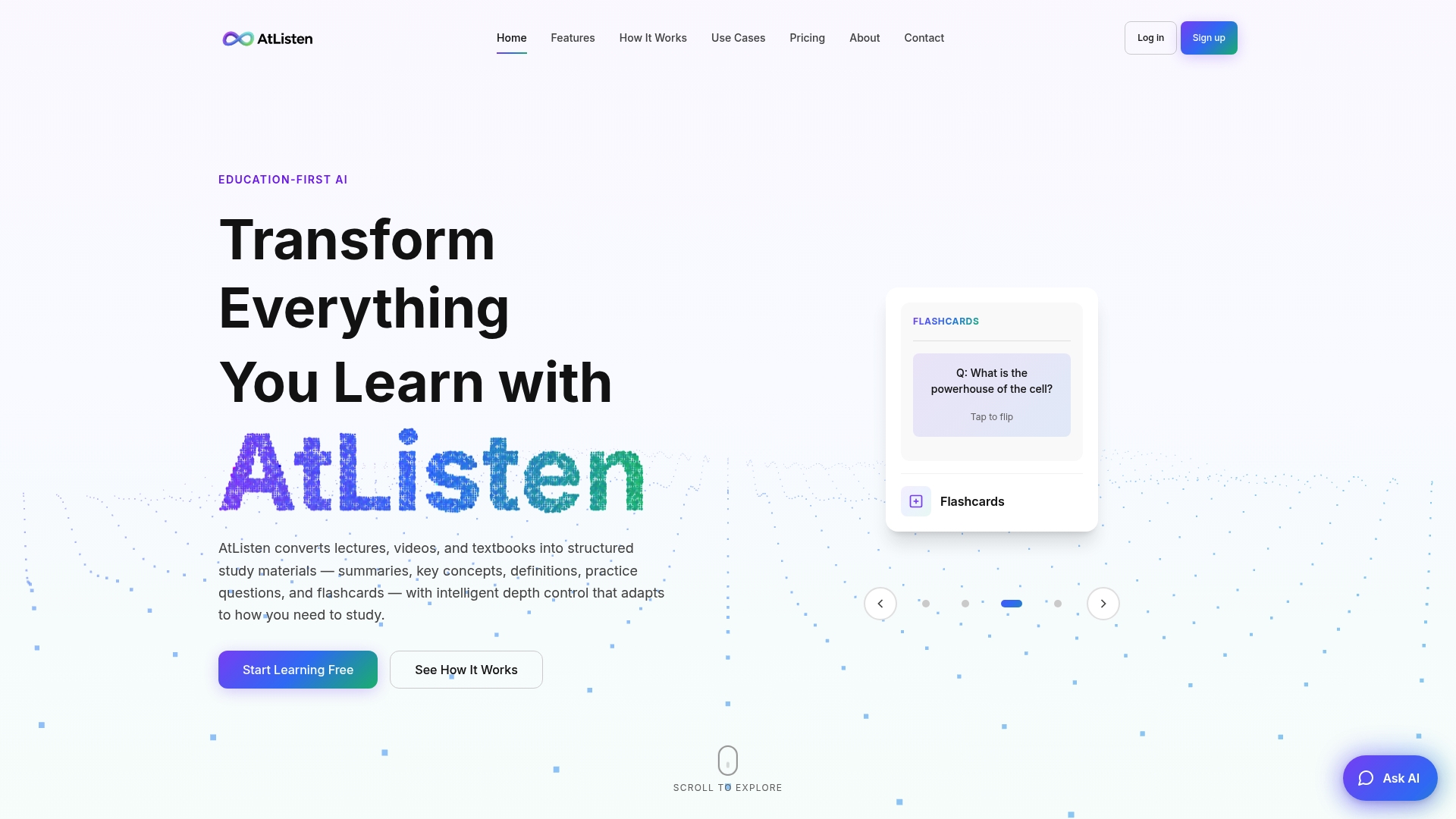
A good first test: upload one lecture or chapter, read the summary as your Layer 2 pass, then work through the practice questions before looking at anything again. If you work from PDFs, our guide to summarizing a PDF with page citations shows the workflow.
FAQ
Is progressive summarization good for studying for exams?
Yes, as a way to decide what matters and to build a reference you can scan quickly. Because exams test recall, finish each layered note with self-testing: flashcards, practice questions, or rewriting your summary from memory. Research on study strategies consistently favors that combination.
How many layers do I need?
Usually two or three. Capture and bold most things, highlight what you still need before an exam, and write an executive summary only for core concepts. Forte's own guidance is that applying every layer to every note is the biggest mistake.
How is it different from ordinary highlighting?
Ordinary highlighting happens once, often during a first read. Progressive summarization spreads the marking across several later passes, so each decision is made with more context, and it keeps the original text intact. It also ends with a restatement in your own words, which is where understanding is tested.
Can I use it for language learning?
Yes. Capture unfamiliar words, bold the repeated ones, write a short summary using them after reading, and move them into spaced flashcards. Summary writing after reading has been shown to support vocabulary learning, and speaking the summary aloud may help retention further.
Sources
- Progressive Summarization: A Practical Technique for Designing Discoverable Notes (Forte Labs)
- Progressive Summarization (Every)
- Progressive Summarization III: Guidelines and Principles (Forte Labs)
- Building a Second Brain excerpt
- What Works, What Doesn't (Scientific American)
- Improving Students' Learning With Effective Learning Techniques (Dunlosky et al., 2013)
- Five Popular Study Strategies: Their Pitfalls and Optimal Implementations (Miyatsu et al., 2018)
- Academic Vocabulary Guide: Spacing (Vanderbilt English Language Center)
- Summarization and Synthesis (Learning Design Wiki)
- Examining the effects of oral reproduction on vocabulary learning (Cogent Education, 2020)