
The best open book exam strategy is to study as if the book were closed, then build a reference set so organized that you rarely need it. Open-book tests reward understanding and speed, not lookup. If you turn your lectures and readings into short, structured study material before the exam, you spend test time thinking instead of searching. That is the job AtListen does: it converts lectures, PDFs, videos and notes into summaries, key concepts and practice questions.
TL;DR
- Open-book exams ask you to compare, analyze and apply, so memorizing nothing is the most common way to fail them.
- Be selective: a short, indexed reference set beats a pile of everything.
- Practice with questions under timed conditions, using only the materials you will have on exam day.
- Plan a five-day schedule with sleep and breaks instead of cramming.
- Confirm with your instructor what is allowed, especially AI tools.
Table of Contents
- What an open book exam actually tests
- Build a reference set you can search in seconds
- Study the way the exam will test you
- A five-day open book exam plan
- During the exam
- Check the rules on AI and other materials
- Where AtListen fits
- Perspective
- FAQ
- Sources
What an open book exam actually tests
Cornell's Learning Strategies Center says an open-book exam lets you use reference materials but still requires real understanding. Because it targets higher levels of thinking, expect questions that ask you to compare, analyze, evaluate or synthesize rather than recall a fact.
That changes how you study. A definition you can look up is worth little. Knowing which idea applies to a messy scenario, and why, is worth a lot.
UNC's Learning Center names the trap: the "open-book, easy exam" fallacy. Students assume they can skip studying because the notes are on the desk. The result is slower work during the test and thinner answers, because instructors use these exams to ask harder questions. Treat your notes as cues for memory, not a replacement for it.
Build a reference set you can search in seconds
Cornell advises being selective, because too much material is hard to search. Its suggestions: organize by theme and topic, summarize key information, show connections between ideas, create an index of key topics, bookmark chapters, and list formulas and definitions in one place.
Condense first, then index
Georgetown Law's outlining handout warns that an outline can grow too long to use and recommends an "attack" outline: a shortened version with only the distilled material, such as key cases and the tests to apply. You can use the same idea in any subject. A full set of notes is your archive. The attack sheet is what you actually work from.
A workable structure:
- One page of formulas, definitions or rules, grouped by topic.
- One page per major unit with the core concepts and how they connect.
- A table of contents listing where everything lives.
- Textbook pages flagged only where a detail is hard to compress.
The heavy part is the condensing. AtListen takes uploaded lectures, audio recordings, PDFs, textbooks, notes and YouTube URLs and produces summaries, key concepts with definitions and key facts, with depth control so you can choose how detailed each one is. That gives you a first draft of your attack sheet in minutes, which you then check against your syllabus and shape to your course.
Print and lay out your materials
Princeton's McGraw Center recommends printing notes, slides, formula sheets and practice exams so you are not clicking through tabs, and spreading them within arm's reach, "like an airplane cockpit." It also suggests sticky notes to label books and tag pages by topic or lecture number, plus a table of contents for your materials.

If your exam is on a screen, rules may restrict what you can open. Find out in advance, and see the section on AI and permitted materials below.
Notes only help if you can find things
Princeton chemistry students interviewed in a department article on note-taking describe organization as the most important piece of note taking. They also recommend connecting ideas, rephrasing and questioning them, then synthesizing notes into study guides. If your notes are messy, a method like Cornell notes for textbooks gives each page a cue column and a summary you can scan quickly.
Study the way the exam will test you
Since the questions are about application, your practice should be too. Yale Law Women's study guide describes outlining as a learning tool in itself: synthesizing class notes, readings and the syllabus is where much of the learning happens, and the outline then doubles as your reference.
Ohio State's math department adds a habit that works well beyond math: rework review problems and imagine the questions you would ask if you were the teacher.
Turn material into practice questions
Write or generate questions at the level the exam will use. Ask "why," "compare," and "what would happen if," not just "what is." Our guide to Bloom's taxonomy for studying shows how to move from recall questions to analysis and evaluation. For case-based subjects, you can turn course notes into case study practice questions.
AtListen generates practice questions with explanations from your own uploaded material, plus instant feedback, so you find gaps in understanding while there is still time to fix them.
Know the learning objectives
Instructors write exam questions from course goals. Pull those goals from your syllabus and slides, and check that every one has a spot in your reference set and at least one practice question. Here is how to extract learning objectives from any course material.
Keep key ideas in memory
You will work faster if core definitions and frameworks are already in your head. Flashcards on a spaced schedule are the simple way to do it; see this spaced repetition schedule with intervals and a timetable. Language learners can do the same with vocabulary, since a dictionary in the exam room does not help you write fluently under time pressure: turn lectures into vocabulary flashcards.
A five-day open book exam plan
Princeton's Principedia recommends a realistic schedule with specific goals for each session, a five-day plan that includes sleep, meals and downtime, and warns that cramming raises stress and lowers scores. Here is one way to apply it.
| Day | Focus | Output |
|---|---|---|
| 5 days out | Gather syllabus, slides, readings; list objectives | Topic list |
| 4 days out | Condense each unit into summaries and key concepts | Draft attack sheet |
| 3 days out | Practice questions without looking at notes | List of weak topics |
| 2 days out | Timed practice exam using only allowed materials | Revised sheet and index |
| 1 day out | Light review of flashcards, set up space and tech | Ready materials, early bedtime |
OSU's math department also advises going to bed early the night before. For editable versions of this schedule, see our exam study plan templates and five-day plan, or turn a syllabus into a weekly schedule if you have more than a week. High schoolers with an AP exam coming can use the 8-week AP study plan.
Test your setup under real conditions
Georgetown's handout advises testing your outline with a practice exam to reveal unclear sections, missing information and access problems, and suggests color-coding concepts so the outline is easy to scan. Do this at least once, with a timer. Mark every moment you hunted for something and fix the index.
During the exam
- Read every question first and budget time. UNC warns that hunting for the "right" answer in your notes eats the time you need to synthesize a complete response.
- Answer from memory first, then use your materials to confirm details, formulas or citations.
- Start with what you know. Return to harder items with your index.
- Show your reasoning. Because the test is about application, explain why a concept fits.
For remote or take-home exams, UNC recommends choosing a quiet space, testing your laptop, internet and required software before the window opens, and picking a time of day that matches your focus if you have a choice.
Check the rules on AI and other materials
Before you plan anything, ask your instructor what is allowed: open notes, open books, a written outline, or a limited number of note cards. UNC also notes that its Honor Code still applies on remote exams.
AI rules vary by course. Georgia Tech's CSE6040 exam, which is open-internet, prohibits tools like ChatGPT, Claude and Copilot while allowing standard search engines and documentation. An EDUCAUSE Review account of a graduate open-book final reports that AI was allowed for studying beforehand but not during the exam. Harvard's graduate school of education states that, unless the instructor says otherwise, submitting AI-generated work as your own breaches academic integrity, and that any permitted use should be documented.
The safe pattern: use AI before the exam to build summaries, flashcards and practice questions, and use only what your instructor permits during it. For a look at how institutions are handling exam integrity, read this piece on generative AI in proctoring college examinations.

Where AtListen fits
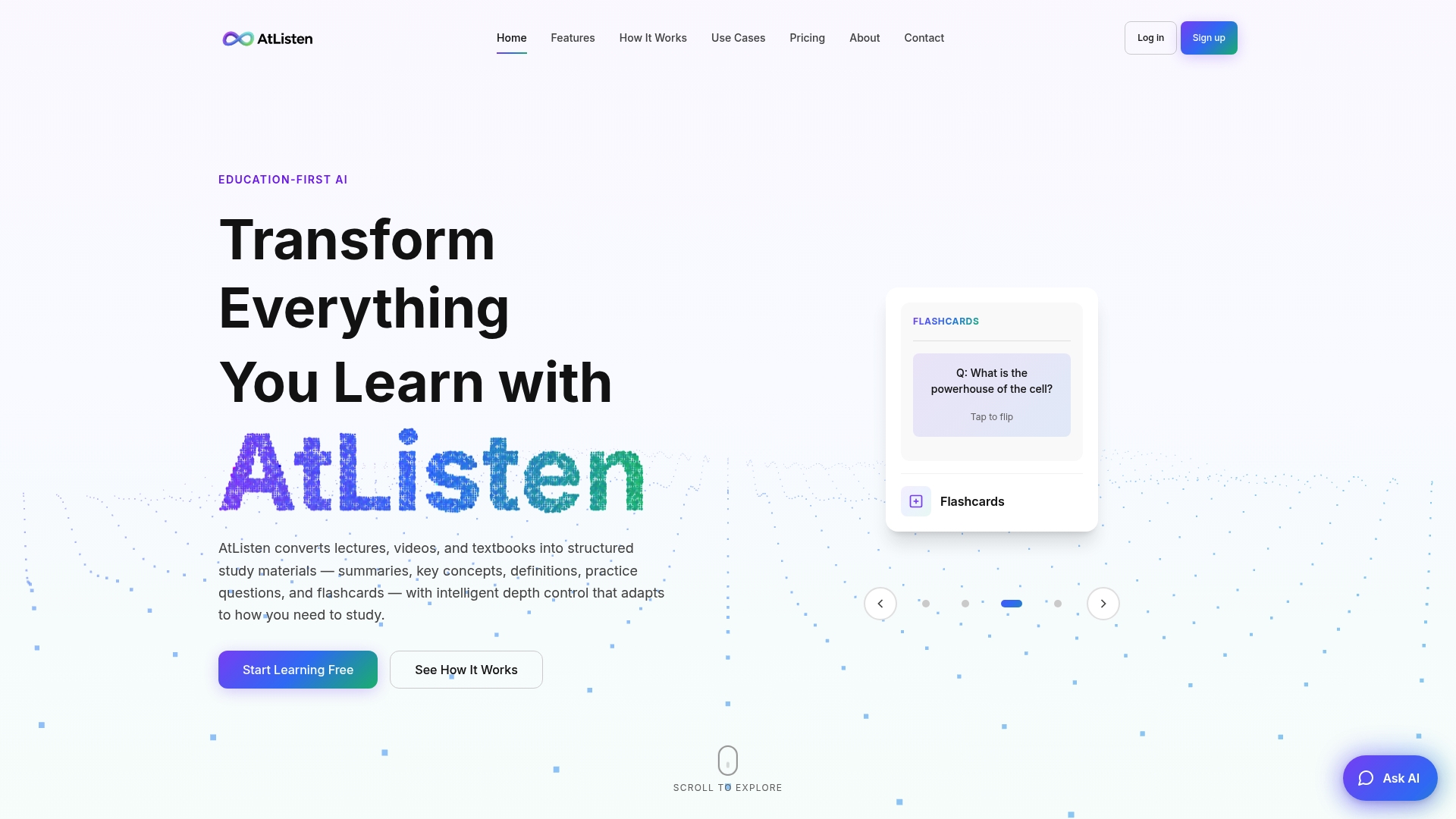
The slow part of open-book prep is converting hours of lectures and hundreds of pages into something you can use. Upload your material to AtListen and you get structured summaries, key concepts with definitions, practice questions with explanations and flashcards built for spaced repetition, in minutes. There is a Free plan at $0 per month, Pro at $19.99 per month and Max at $39.99 per month, all at atlisten.com.
Start with one unit, build your attack sheet from it, and run a timed practice session before you do the rest.
Perspective
Students tell us the same thing about open-book exams: they felt safe because the book was there, then lost the first twenty minutes looking for answers. We think the fix is to move the work earlier. Passive rereading does not prepare you for questions that ask you to analyze and compare.
Our approach is to turn your own material into active formats: a summary at the depth you choose, key concepts with definitions, practice questions that give instant feedback, and flashcards on a spaced schedule. When those exist before exam week, your reference set shrinks to what matters and your understanding does the heavy lifting.
That is why we built AtListen to accept lectures, recordings, PDFs, textbooks, notes and YouTube links, and to return a study package in minutes. You bring the course, and the time you save goes into practice, which is what open-book exams reward.
William
FAQ
What is the best way to study for an open book test?
Study as though you cannot use your notes, then condense them into a short, indexed reference set. Practice with application questions under timed conditions. The goal is to use your materials to confirm details, not to learn the content during the exam.
Can you use ChatGPT in an open book exam?
Only if your instructor says so. Many courses, such as Georgia Tech's CSE6040, ban AI tools during the exam, while allowing them for preparation. Ask early and follow the written policy.
What is allowed in an open book exam?
It depends on the course: open notes, textbooks, a written outline, or a few note cards. Confirm with your instructor or teaching assistant before you build your materials, and remember that honor codes still apply on remote exams.
How long should I prepare for an open book exam?
Give it as much time as a closed-book exam. A five-day schedule with specific session goals, sleep and breaks is a solid minimum, and a longer syllabus-based weekly plan is better if you have the time.
Sources
- Open-Book Exams, Cornell Learning Strategies Center
- Take-Home Exams, UNC Learning Center
- Advice for Approaching Open Book Exams, Princeton McGraw Center
- Outlining for Exams, Georgetown Law
- Take Great Notes, Princeton Chemistry
- YLW Guide to Study Strategies, Yale Law Women
- How to Study Math in College, Ohio State Mathematics
- Preparing for Exams, Princeton Principedia
- Exam Rules and Policies, Georgia Tech CSE6040
- Artificial Intelligence: Lessons Learned from a Graduate-Level Final Exam, EDUCAUSE Review
- HGSE AI Policy, Harvard Office of the Registrar