

The simplest AP exam study plan that works is an 8-week rhythm: daily short practice sessions, weekly topic reviews mapped to the Course and Exam Description, and two full-length timed exams before test day. Start now by picking your exam date, splitting the CED units across eight weekly blocks, and locking in 45 to 60 minutes of focused study most days. If you're past week 8, compress to four and let self-scored FRQs and error logs decide what you review.
TL;DR:
- An eight-week study plan with daily short sessions and two full-length practice exams offers the most reliable preparation for content-heavy AP exams.
- For late starters, focusing on high-weight units and taking weekly practice exams can still yield gains within four weeks, but full coverage becomes impossible.
- Effective study sessions include quick recall on previous material, focused work on specific questions, and self-testing, with shorter, spaced intervals outperforming long cramming.
- Using free resources like AP Classroom, past FRQs, and Khan Academy helps build a focused, cost-effective prep, while practice exams should be analyzed by category to target weak areas.
- Consistent habits, active recall, and turning practice results into concrete adjustments significantly impact final scores more than long hours or extra materials.
Table of Contents
- How Long Should an AP Exam Study Plan Really Be?
- The Week-by-Week AP Study Schedule Template
- What Should a Single Study Session Look Like?
- How Do You Use Practice Exams to Actually Improve?
- Which Study Resources Are Worth Your Time?
- How Do You Balance Studying for Multiple AP Exams?
- The Final Two Weeks: What to Do (and Stop Doing)
- How Should You Take Notes During AP Review?
- How Do You Stay Motivated Without Burning Out?
- Why Active Recall and Spaced Repetition Beat Rereading
- What Reliably Moves AP Scores
- Let AtListen Turn Your Study Plan Into Study Materials
- Sources
- FAQ
How Long Should an AP Exam Study Plan Really Be?
Eight to twelve weeks is the sweet spot for most AP courses, especially content-heavy ones like AP US History, AP Biology, or AP World History. That window gives you enough time to move through every unit in the CED once, then circle back to your weakest ones before the exam. Math-heavy APs like Calculus or Statistics can sometimes get away with six weeks if you've kept up with class all year, since the skills build on each other and daily coursework already functions as review.
If you're starting later than that, the plan changes. You don't get to "cover everything" anymore, so you triage: run a diagnostic practice exam immediately, rank units by how many points you're losing, and spend nearly all remaining time on practice exams and FRQs rather than rereading notes.
Use this quick filter to pick your track:
- 8 weeks: Default choice for content-dense subjects or if your grade in the class has been inconsistent.
- 6 weeks: Math and science APs where you've stayed current and mainly need timing practice.
- 4 weeks: Started late, or juggling multiple APs and need a stripped-down version.
The Week-by-Week AP Study Schedule Template
Here's a shell you can copy for any AP subject. Coaching resources that build study schedules for busy students generally follow this same logic: front-load content, then pivot hard to practice exams.
- Weeks 1 through 4 (content review): Work through the CED unit by unit, roughly one to two units per week depending on their weight on the exam. Each day, do 20 to 30 minutes of AP Classroom topic questions tied to that unit, plus a short recall drill on yesterday's material. Start an error log now, not later. Every missed question gets one line: what you missed, why, and the unit it belongs to.
- Week 5 (first checkpoint): Take your first full-length practice exam under timed conditions. This is a diagnostic, not a grade. Score it against the official rubric and sort every miss into your error log by category.
- Weeks 6 through 7 (targeted repair): Spend most sessions on the two or three units where you lost the most points. Mix in FRQ practice daily instead of saving it for the end.
- Week 8 (second checkpoint and taper): Take a second full-length practice exam in late April, ideally two to three weeks before your real test. Compare unit-by-unit scores to week 5 and spend the final stretch tightening whatever's still shaky.
Compressed 4-week version: Skip full unit-by-unit review. Identify the two or three highest-weight units from the CED, drill those hard, and take a practice exam every week instead of every four. You'll trade depth for speed, but a focused four weeks beats a scattered eight.
What Should a Single Study Session Look Like?
A good session has three parts: a five-minute recall warmup on yesterday's material, a focused practice block, and a quick self-test before you close your notes. That structure matters more than the total hours you log.
- Warmup (5 minutes): Answer two or three questions from memory before opening any notes.
- Focused block (25 to 60 minutes): Work AP Classroom topic questions, flashcards, or FRQ prompts on one unit.
- Self-test (5 to 10 minutes): Close everything and write down what you remember, cold.
Research on distributed practice backs shorter, spaced sessions over long marathons. Two 30-minute sessions on separate days beat one 60-minute cram, even though the total time is the same. If you're juggling two or three subjects, interleave them: 25 minutes of Biology, then 25 minutes of Calculus, rather than three hours of Biology straight through. It feels less efficient in the moment. It sticks better a week later.
Pro Tip: Use 25 to 30 minute Pomodoro blocks for memorization-heavy work like vocabulary or dates, and 45 to 60 minute focused blocks for FRQ writing or multi-step problem sets. Switching formats keeps your brain from checking out around the 40 minute mark.
How Do You Use Practice Exams to Actually Improve?
A practice exam is only useful if you treat the score as a diagnosis, not a verdict. Khan Academy's guidance on AP prep frames practice tests this way for a reason: the number tells you almost nothing on its own. What matters is which units and question types keep costing you points.
Run your first full-length practice exam around week 5, timed exactly like the real thing, and your second in late April, two to three weeks out. Score both against the official College Board rubrics, then compare unit-by-unit results between the two.
- Grade FRQs yourself using the official scoring guidelines, not a gut feeling.
- Log every miss by cause: content gap, timing pressure, or a careless misread.
- Turn the top three recurring causes into your next two weeks of targeted practice.
This is how a single practice exam becomes a plan instead of just a number.
Which Study Resources Are Worth Your Time?
Start with what's free and official before adding anything else. AP Classroom gives you topic questions, progress checks, and AP Daily videos organized by unit, all built directly from the CED your teacher is already following. College Board also posts past FRQs with scoring guidelines on each course's exam page, which is the closest thing to a preview of what you'll actually face.
- AP Classroom: Topic questions and progress checks for diagnostic practice by unit.
- College Board past FRQs: Real prompts with official scoring guidelines for self-grading.
- Khan Academy: Free subject-specific practice plans that pair well with AP Classroom drills.
- AtListen: Turns your class notes, lecture recordings, and textbook chapters into summaries, flashcards, and practice prompts, which speeds up building week-by-week materials instead of retyping notes by hand.
How Do You Balance Studying for Multiple AP Exams?
Start by counting your real weekly hours. Subtract school, sleep, sports, and anything nonnegotiable, and whatever's left is your actual study budget. Most students overestimate this number badly.
Once you know your budget, prioritize by three factors: how much you'd gain from the credit, how close the exam date is, and how big your current gap to your target score is. An exam three weeks out with a shaky FRQ score beats an exam in ten weeks where you're already solid.
- Two APs: Split roughly 60/40 based on which exam is sooner or weaker, not evenly down the middle.
- Four APs: Rotate subjects daily rather than trying to touch all four every session. Aim for 45 to 60 minutes per subject, three or four times a week each.
- Any load: Reassign hours weekly based on your last practice score, not your original plan.
The Final Two Weeks: What to Do (and Stop Doing)
The last two weeks aren't for learning new content. They're for tightening what you already know and making sure nothing derails you on test day.
- Stop new material now. Shift entirely to timed FRQs, pacing drills, and reviewing your error log.
- Days 14 to 8: One timed FRQ set per day, plus 20 minutes reviewing your two weakest units from the error log.
- Days 7 to 2: Lighter timed practice, heavier review of flashcards and past mistakes. Confirm your exam start time and location.
- The day before: No new practice. Skim your error log once, pack your bag, and confirm your approved calculator and materials.
- Exam day: Eat something real, arrive early, and trust the pacing you already practiced. Sleep matters more at this point than one more review session.
How Should You Take Notes During AP Review?
Rewriting your notebook word for word feels productive and teaches you almost nothing. The methods that actually hold up during review are the ones that force retrieval instead of copying.
Cornell notes split your page into cues, notes, and a summary, which gives you a built in self-quiz every time you revisit a page. The Feynman technique asks you to explain a concept in plain language as if teaching a younger student. The moment you stumble is exactly the gap you need to fix. Concept mapping works especially well for subjects like AP Biology or AP Environmental Science, where ideas connect across units rather than sitting in isolation.
Whatever method you use, review notes within 24 to 48 hours of taking them, then again a week later. That gap is what separates review from rereading. If you're staring at pages of lecture notes with no clear structure, a tool like AtListen can convert them into organized summaries and flashcards automatically, which saves the reformatting step so you can spend that time actually recalling the material instead of retyping it.
Students planning ahead for competitive college tracks sometimes layer AP strategy on top of longer-term goals. If that's you, early academic planning resources are worth a look alongside your exam prep.
How Do You Stay Motivated Without Burning Out?
Motivation dips are normal around week 4 or 5, right when the material stops feeling new and the exam still feels far away. That's usually when students either quit the plan or overcorrect with a marathon cram session that backfires.
Small, visible progress beats vague willpower. Track your error log shrinking week over week. Watching a list of "content gaps" drop from fifteen to six is more motivating than any pep talk, because it's proof, not encouragement.
Stress usually spikes from uncertainty, not workload. Students who know exactly what they're doing each day tend to feel calmer than students doing more hours with no structure. That's the real argument for a written week-by-week plan: it turns an abstract fear into a checklist.
A few practical guardrails: keep one full day off per week, even during week 7. Protect sleep over squeezing in one more session. Study with a friend taking the same exam for accountability, but keep sessions short so it doesn't turn into a hangout. And if a subject feels genuinely stuck after real effort, that's a signal to ask your teacher for help, not a sign you should study harder alone.
Why Active Recall and Spaced Repetition Beat Rereading
Rereading a chapter feels like studying. It mostly isn't. Active recall, testing yourself instead of reviewing passively, is what actually builds long-term memory, and spaced repetition is what keeps it from fading before test day.
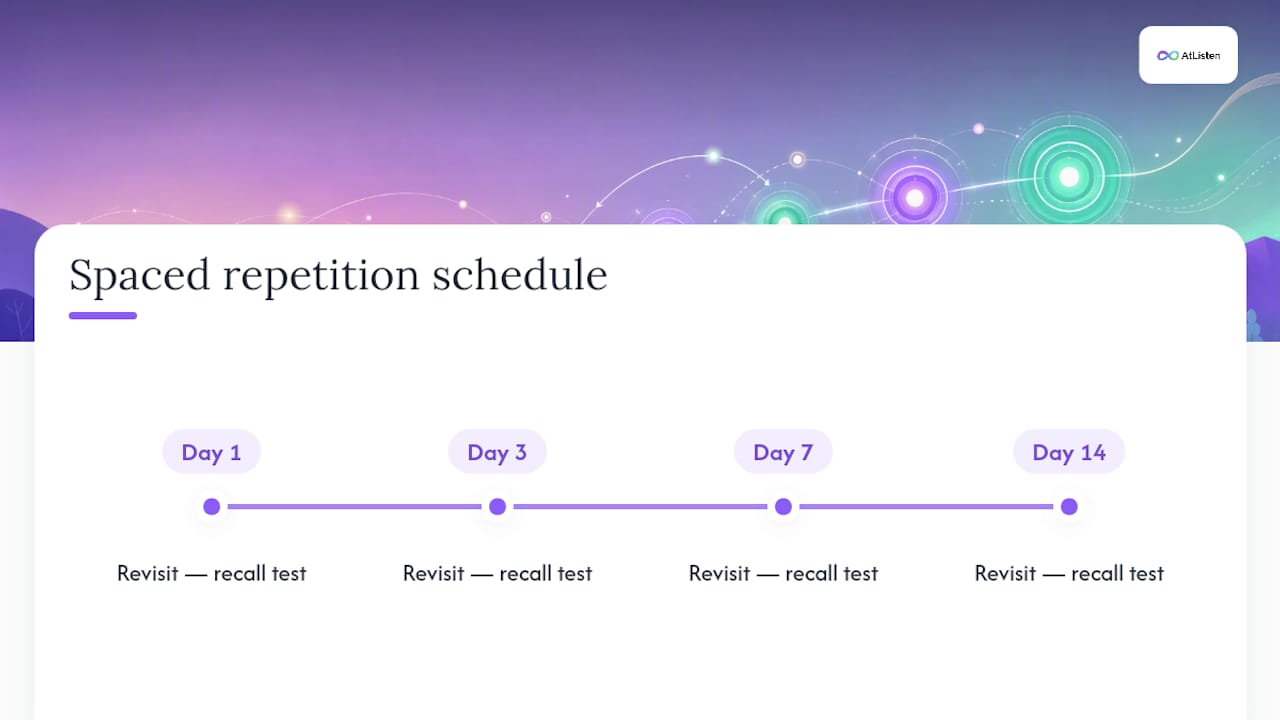
Build this into your plan two ways. First, end every session with a blank-page recall test: close your notes and write down everything you remember about that day's topic. Second, revisit material on a growing schedule, day 1, day 3, day 7, day 14, rather than studying a unit once and moving on forever.
Flashcards are the easiest way to run spaced repetition without tracking it manually, especially if the deck is built from your actual error log rather than generic terms. AtListen can generate flashcards directly from your notes or lecture recordings and space them automatically, which turns your error log into a review deck without extra setup work.
What Reliably Moves AP Scores
Consistency beats intensity almost every time. A student doing 30 focused minutes daily for eight weeks will usually outperform one doing three-hour weekend cram sessions, even with the same total hours. The unglamorous habits, daily recall warmups, honest self-scoring, an error log you actually update, do more for a score than any single resource or trick.
The biggest gap I see isn't access to materials. Every student now has AP Classroom and Khan Academy for free. The gap is turning practice results into a plan instead of just a grade.
— William
Let AtListen Turn Your Study Plan Into Study Materials
Building the plan is the easy part. Actually producing eight weeks of unit summaries, flashcards, and FRQ-style practice from scratch is what eats up the time most students don't have. Atlisten closes that gap by converting your lecture notes, class recordings, and textbook chapters into structured study material in minutes instead of hours.
Inside this exact plan, that looks like three specific things: turning a week's worth of lecture notes into a clean unit summary for your review sessions, generating FRQ-style practice prompts from your textbook readings so you're not limited to the College Board's released set, and converting your error log into spaced-repetition flashcards that update as your weak spots change. The platform is built with student privacy in mind, with details available on its security page and its COPPA policy for younger users.
If you've got your 8-week shell mapped out and CED units assigned to each week, the next move is simple: upload your first unit's notes to Atlisten and see your first summary and flashcard set before your next study session.
Sources
- Free Resources to Prepare for AP Exams - College Board Blog
- Five Tips for Studying for AP Exams - Khan Academy Blog
- AP exam dates - AP Students (College Board)
FAQ
What Is the Best Way to Study for an AP Exam?
The most effective approach combines daily active recall practice with two timed full-length practice exams, using AP Classroom topic questions and past FRQs as your core materials. An 8-week structure works for most students, with a 4-week compressed version available if you're starting late.
Is a 70% a 5 on the AP Exam?
Scoring cutoffs vary by subject and by year since the College Board sets them based on that year's overall performance, so there's no fixed percentage that guarantees a 5 across every exam. Some exams have historically converted scores in the 65 to 75% raw range, into a 5, but you should treat your practice exam raw scores as directional, not exact predictors.
What Is the Hardest AP Class?
There's no single official answer, since difficulty depends on the student's strengths, but AP Physics C, AP Chemistry, and AP US History are frequently cited as among the most demanding due to either their math intensity or sheer content volume.
Is Taking Seven AP Classes Enough for Harvard?
Highly selective colleges look at rigor relative to what your school offers rather than a fixed AP count, so seven can be plenty if it represents your school's most challenging track. What matters more than the number is how well you perform in those courses and on the exams themselves, which is exactly what a structured AP exam study plan is meant to protect.