
Pick your dedicated length from your NBME baseline score, adjusting study time based on your diagnostic results rather than calendar dates. Every version of that timeline should run on the same engine: timed QBank blocks, daily spaced-repetition in Anki, and First Aid used as a review anchor, not as a first read. Before you build anything else, take a baseline NBME under real timing this week.
TL;DR:
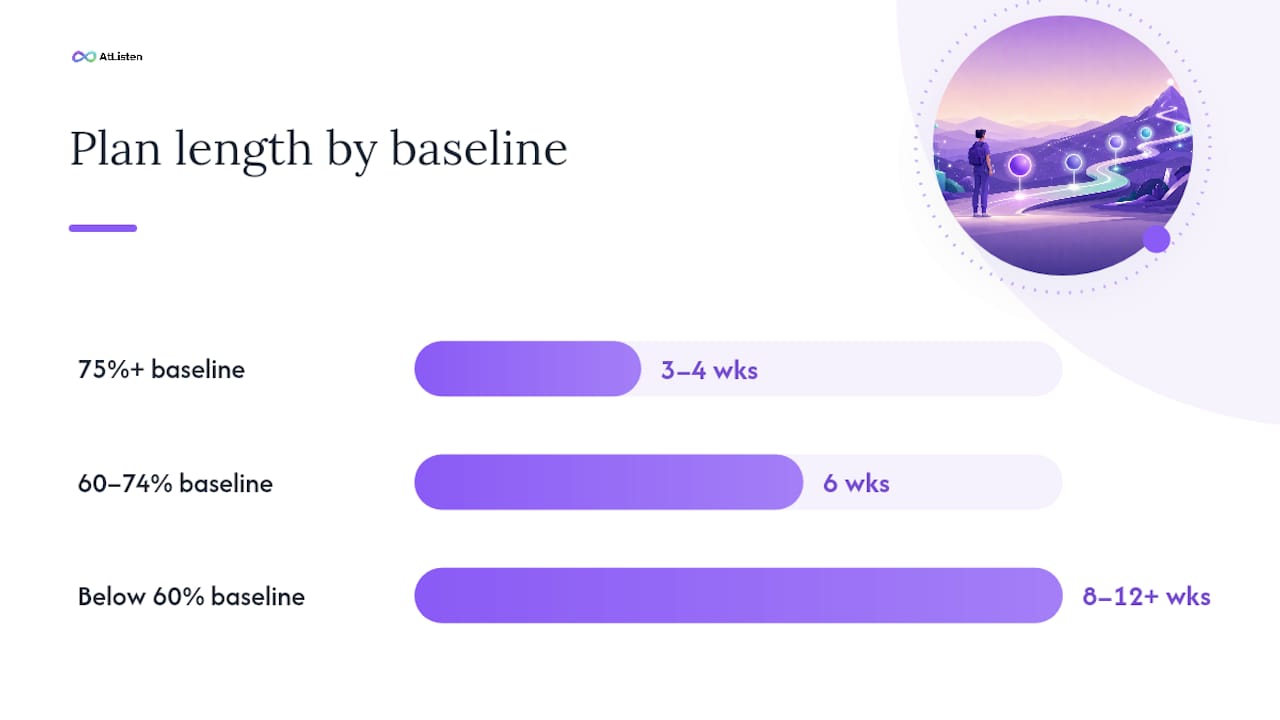
- Focus your dedicated study length on your diagnostic score, with 3 to 4 weeks for scores above 75%, and up to 12+ weeks for scores below 60%.
- Take a full, timed NBME assessment early in your planning to accurately determine your starting point and adjust your timeline accordingly.
- Use a core study stack of First Aid, UWorld, Pathoma, Sketchy, and Anki, avoiding resource overload to maximize active engagement and retention.
- Regular NBME checkpoints every 7 to 10 days help track progress and inform timely adjustments in study focus and duration.
- Build your materials efficiently with tools like Atlisten to convert lectures and notes into review-ready flashcards and summaries, saving time for practice.
Table of Contents
- What Length Should Your USMLE Step 1 Study Plan Be?
- How Do You Run a Diagnostic NBME to Set Your Timeline?
- Which Resources Actually Belong in Your Core Stack?
- Sample Week-by-Week Study Schedules for Common Timelines
- How Should a Study Day and Question Review Actually Work?
- How Do You Know If Your Study Plan Is Actually Working?
- How Do You Avoid Burning Out Before Test Day?
- What Should the Final Week Before the Exam Look Like?
- How Can Atlisten Help You Execute This Plan Faster?
- What I'd Tell a Friend Starting Their Step 1 Plan
- Turn Your Lecture Backlog Into Active Study Material
- Sources
What Length Should Your USMLE Step 1 Study Plan Be?
The honest answer depends on one number: your diagnostic percent-correct. Not your GPA, not how far behind you feel, not what your roommate is doing. A well-designed USMLE Step 1 study plan starts with a baseline test and works backward from that score to a realistic timeline.
Here's the rough mapping most advisors and institutional guides converge on, drawing on how NBME diagnostic bands correlate with dedicated length:
- 75%+ on a baseline NBME: 3 to 4 weeks of dedicated study, front-loaded with QBank practice and light content review.
- 60% to 74%: 6 weeks, the most common window, balancing systems review with steadily increasing question volume.
- Below 60%: 8 to 12+ weeks, with the first two to three weeks weighted toward Pathoma and Sketchy content review before QBank volume ramps up.
Daily hours matter as much as calendar weeks. Intensive study periods involve longer daily hours that may be less sustainable, while more moderate timelines allow fewer hours that better support retention and stamina. Stretch a 4-week intensity level over 8 weeks and you'll burn out before test day; compress an 8-week content load into 4 weeks and you'll run out of runway before you've seen everything once.
Timeline decisions shouldn't be static, either. If your first checkpoint NBME (taken roughly a week or two into dedicated) shows no movement from baseline, that's a signal to add a week rather than push through on hope. Conversely, if you're hitting your target percentage two weeks early, shifting into full-length simulation mode earlier beats padding the calendar with more of the same review.
Pro Tip: *Treat your first diagnostic score as a planning tool, not a verdict on your ability.
How Do You Run a Diagnostic NBME to Set Your Timeline?
A diagnostic only tells you the truth if you take it like the real thing. Half-timing it, pausing for snacks, or splitting it across two sessions gives you a number that has nothing to do with your actual exam-day performance.
- Pick an NBME self-assessment form, not a random third-party QBank exam, since NBME forms are normed against the actual exam and give a more honest percent-correct estimate.
- Block out the full timed window in one sitting, replicating the real exam's pacing and break structure as closely as you can.
- Take it before you've done heavy Step 1 review, ideally in the first days of your planning window, so the score reflects your true starting point rather than a partially prepped one.
- Score it and break results down by discipline and system, not just the overall percentage, since a 65% overall can hide a 40% in cardiology and a 90% in biostatistics.
- Map the composite score to a timeline band using the guidance above, then commit to that timeline in writing before you second-guess it.
- Retest at the start of week two of dedicated to confirm the trend is moving the right direction before you've sunk too much time into an approach that isn't working.
- Adjust discipline-level study time, not just total hours, based on where the weakest breakdowns showed up.
Most students can run this full sequence inside a week, and it's the single highest-leverage thing you'll do before dedicated starts. Skipping it and just picking "six weeks because that's what everyone does" is how students end up either wasting a month on content they already know or walking into test day two weeks short on preparation.
Which Resources Actually Belong in Your Core Stack?
Fewer resources, used more actively, beats a shelf full of options you never finish. The stack most high scorers converge on is First Aid, UWorld, Pathoma, and Sketchy, paired with Anki for spaced repetition, often shortened to UFAP. Each piece does a different job.
- First Aid works as your master outline and review anchor. Annotate it as you go; don't read it cover to cover as a primary learning source.
- UWorld is where the real learning happens. The evidence on Step 1 preparation is fairly blunt on this point: spaced retrieval and active question practice predict performance far more reliably than passive reading, and the volume of questions answered correlates with outcomes.
- Pathoma and Sketchy cover pathology and microbiology/pharmacology through video, which suits students who retain visual and narrative information better than dense text.
- Anki, usually the AnKing deck, handles daily spaced repetition so facts don't leak out of memory between now and test day.
The trap most students fall into isn't picking the wrong resources. It's picking too many, then splitting attention so thin that none of them get used properly. Adding a second QBank on top of UWorld, or a third video series alongside Pathoma and Sketchy, usually subtracts more time from review than it adds in content coverage.
This is also where an AI-powered tool for converting lectures and notes into study materials can fit into the workflow rather than adding to the pile. If you have hours of recorded lectures, PDF lecture notes, or textbook chapters from earlier preclinical years, such tools convert raw material into summaries, key-concept lists, and spaced-repetition flashcards in minutes, helping you spend time reviewing instead of formatting. During dedicated, when every hour matters, cutting the setup time on card creation alone can free up a meaningful chunk of your daily schedule for actual question practice.
Sample Week-by-Week Study Schedules for Common Timelines
Schedules only work when they match your actual timeline band, so pick the one that matches your diagnostic result rather than borrowing whichever version a friend used.
Pre-dedicated habits (months before your official start date):
- Run 15 to 20 Anki cards daily tied to whatever system you're covering in class, so the deck grows gradually instead of arriving all at once in dedicated.
- Work 10 to 20 UWorld questions per system block as you finish it in school, tagged by subject, to build QBank familiarity before the clock starts.
Students who build this habit early arrive at dedicated with far less new learning to absorb, which changes the entire character of the weeks that follow.
- Week 1: 60 to 80 timed UWorld questions daily, mixed subject, with same-day review; 30 minutes of Anki each morning.
- Week 2: Same question volume, shift to weaker systems flagged from week 1's error log; first checkpoint NBME at the end of the week.
- Week 3: Introduce one full-length NBME simulation midweek; otherwise maintain question volume and tighten Anki review time.
- Week 4: Taper new questions by midweek, spend remaining days on review, take the Free 120, and rest the day before the exam.
This pace is demanding and works best for students who already have strong content recall and just need exam-format reps. Six days a week of 10 to 12 hour study days is typical here, so stamina planning matters as much as content review.
6-week balanced plan (the most common path, baselines in the 60s to low 70s):
-
Weeks 1 to 2: Content review by system, paired with 40 to 60 questions daily; NBME checkpoint at the end of week 2.
-
Weeks 3 to 4: Ramp to 60 to 80 questions daily, mixed and timed; second NBME checkpoint at the end of week 4 to confirm trend.
-
Weeks 5: Push to 80 to 100 questions daily, add a full-length simulation, and start tightening Anki to high-yield leeches only.
-
Week 6: Final review week, Free 120, one last NBME early in the week, then taper into rest.
-
Weeks 1 to 3: Heavier content review through Pathoma and Sketchy, with lighter question volume (30 to 40 daily) to build foundational recall before ramping intensity.
-
Weeks 4 to 6: Increase to 60 to 80 questions daily as content review winds down; NBME checkpoints every 7 to 10 days to track the trend.
-
Weeks 7 onward: Shift into the same rhythm as the 6-week plan's final stretch, targeting 80 to 100 questions daily and full-length simulations.
Notice the pattern across every version: question volume climbs as content review recedes, and NBME checkpoints appear at regular, predictable intervals rather than randomly.
How Should a Study Day and Question Review Actually Work?
Structure beats intensity. A day built around distinct blocks with a clear review method produces more durable learning than an unstructured day with the same total hours.
- Run timed 20 to 40 question blocks for daily practice; save full-length, 7-block simulations for scheduled NBME days and the final two weeks, not as a daily habit.
- Early in your timeline, lean toward subject-specific blocks to reinforce content you're actively reviewing; shift to mixed, random blocks as you approach dedicated's back half, since the real exam doesn't organize itself by system.
- Daily question counts should climb across your timeline rather than start high: roughly 40 to 60 early on, rising to 80 to 120 questions daily in the late phase for students on faster timelines, always paired with full review of every explanation, right and wrong answers alike.
- After each block, annotate First Aid with anything you missed or guessed on, tag the error by cause (knowledge gap versus careless read), and convert the concept into an Anki card or an Atlisten-generated flashcard if you're consolidating material from an earlier lecture source.
The review step is where most of the actual learning happens, and it's also where students most often cut corners when they're behind schedule. Skimming explanations to get through more questions faster produces the illusion of progress without the retention to back it up. Better to run 50 well-reviewed questions than 100 you barely looked at twice.
How Do You Know If Your Study Plan Is Actually Working?
Confidence is a terrible metric. The only objective signal is your NBME trend line, checked at regular, predetermined intervals rather than whenever anxiety strikes.
- Schedule an NBME every 7 to 10 days during dedicated, since that cadence gives you enough separation to see real movement without wasting a full practice exam on noise.
- Break every score down by discipline and system, not just the composite number, and reassign the next week's study time toward whichever categories are lagging furthest behind your target.
- Postpone your test date if two consecutive NBMEs show a flat or declining trend. That pattern usually means the current approach isn't working, not that you need to grind harder at the same thing.
- Add weeks to your timeline if your baseline was under 50% and your checkpoint scores still haven't cracked the mid-60s by the midpoint of your original plan.
- Treat a rising trend across three or more NBMEs as your green light to shift fully into simulation and consolidation mode, even if it happens earlier than your original calendar suggested.
Regular benchmarking beats gut feeling every time, largely because gut feeling during dedicated is almost always wrong in one direction or the other: either false confidence from feeling "caught up," or false panic after one rough question block.
How Do You Avoid Burning Out Before Test Day?
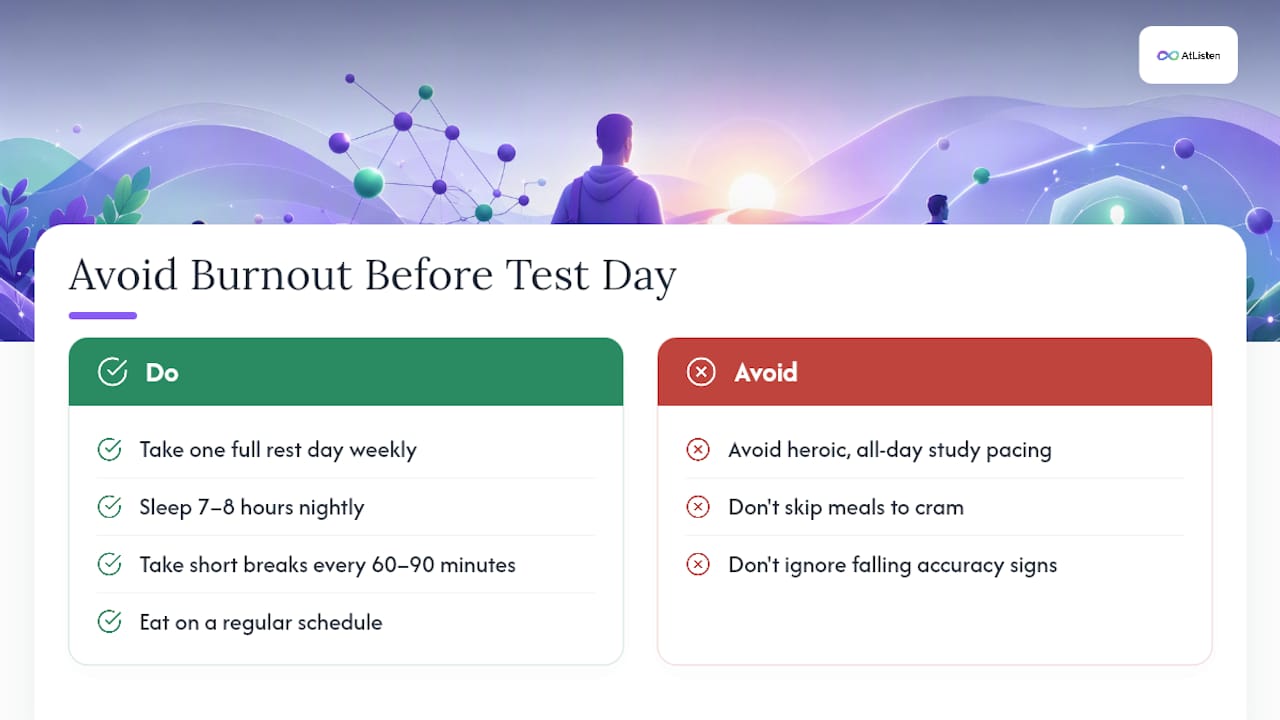
Sustainable pacing beats heroic pacing. Institutional guidance on Step 1 preparation consistently recommends one full rest day per week, not as an indulgence but as a structural part of the plan that prevents the attrition that rigid, all-day schedules produce.
Maintain 7 to 8 hours of nightly sleep during preparation to support cognitive function and prevent burnout. Build in short breaks every 60 to 90 minutes of focused study, take at least a brief walk or light exercise daily, and eat on a schedule instead of skipping meals to squeeze in more questions.
Watch for the early signs of burnout: declining accuracy on questions you'd normally get right, dread before study sessions, and sleep that stops feeling restorative. The fix is rarely more hours. It's usually a scheduled flex day, a genuine break from screens, or a frank look at whether your daily volume has quietly crept past what you can actually absorb.
Pro Tip: If you notice your accuracy dropping over several consecutive days despite putting in the same or more hours, that's your body telling you to take the rest day now rather than after you finish the week's plan.
What Should the Final Week Before the Exam Look Like?
The last seven days are for consolidation, not new content. Learning unfamiliar material this late adds more anxiety than it adds points.
- Days 7 to 5 before the exam: Stop introducing new topics entirely; review your Anki leeches, flagged questions, and weakest discipline breakdowns from your last NBME.
- Day 5 or 4: Take the Free 120, timed exactly like the real exam, to confirm software familiarity and pacing under realistic conditions.
- Days 3 to 2: Light review only, revisit high-yield summary notes, and confirm test-center logistics: address, ID requirements, and what you're allowed to bring.
- Day 1 before the exam: No new questions, no cramming. A short walk, an early dinner, and sleep matter more than one more review pass.
- Test day: Eat a real breakfast, arrive early, and pace each block by budgeting roughly 90 seconds per question with built-in buffer for your break allocation.
How Can Atlisten Help You Execute This Plan Faster?
Building the study materials for a plan like this takes real time, and that time competes directly with the hours you'd rather spend on questions and review. Atlisten shortens that setup phase by converting raw material into study-ready formats automatically.
- Upload a recorded lecture or lecture slide deck and get back a structured summary plus a key-concept list, cutting the hours normally spent rewriting notes into First Aid format.
- Convert dense textbook chapters or PDF notes into spaced-repetition flashcards, which is especially useful for the pre-dedicated habit of building your Anki deck gradually rather than all at once.
- Generate practice questions with explanations from your own course material, useful for reinforcing school-specific content that a generic QBank won't cover.
- Adjust the depth setting depending on whether you need a quick pre-dedicated refresher or a detailed review artifact during a slower content week.
The goal isn't to replace UWorld or Anki. It's to remove the friction of turning raw lecture material into the active-learning formats that actually build retention, so more of your dedicated hours go toward practice and review instead of formatting.
What I'd Tell a Friend Starting Their Step 1 Plan
The mistakes I see repeated most often aren't about intelligence or effort. They're about sequencing. Students read First Aid cover to cover before touching a single UWorld question, mistaking recognition for recall. Others switch core resources midway through dedicated because a friend swears by a different QBank, resetting momentum for no real gain. Some skip the diagnostic entirely and pick a six-week timeline because it sounded standard, then discover in week three that they needed eight.
None of that is a character flaw. It's just untested assumptions running the show instead of data.
Let your NBME trend make the hard calls: when to add a week, when to shift study time, when you're actually ready. And build in the recovery time institutional guidebooks recommend, because a burned-out test-taker in week five performs worse than a rested one who started a week later. You have more control over this outcome than the anxiety suggests.
— William
Turn Your Lecture Backlog Into Active Study Material
Atlisten cuts the time between "I have a stack of lecture recordings and PDF notes" and "I have flashcards and practice questions ready to review" from hours to minutes. That matters most during pre-dedicated, when building an Anki habit early pays off later, and during dedicated weeks when every hour spent formatting notes is an hour not spent on UWorld.
Upload a recorded lecture, a textbook chapter, or your own written notes, and Atlisten generates a summary, a key-concept breakdown, and spaced-repetition flashcards you can start reviewing the same day. If you're weighing whether it fits your workflow, the free tier is the fastest way to find out: upload one lecture, see the output, and decide from there whether it earns a spot in your weekly rotation.