

Take an official full-length diagnostic in College Board Bluebook right now, under real timed conditions, before you build anything else. Once you have that score report, pick the timeline that matches your test date and score gap, whether that's a 1-week crash plan or a 6-month buildup. Then run daily 60 to 90 minute sessions that review your error log, drill your two or three weakest question types, practice timed modules, and retest old mistakes every 3 to 5 days.
TL;DR:
- Taking a full official Bluebook diagnostic under real test conditions accurately establishes your starting score and identifies your weakest skill domains.
- Studying should focus on your two or three lowest-scoring areas, with plans ranging from 1 week for small gaps to 6 months for large ones, tailored to the hours needed for your target improvement.
- Short, 60 to 90-minute daily sessions, including error log review and targeted concept work, outperform marathon study sessions in retention and skill development.
- An effective error log categorizes mistakes by cause, question type, and retest results, guiding focused drill sessions and tracking progress across practice cycles.
- Regularly spaced full-length practice tests (every 2-3 weeks) with detailed review ensure you measure real progress and adjust your study approach accordingly.
Table of Contents
- How to Take a Diagnostic and Set a Realistic Target Score
- Choosing Your Timeline: 1-Week, 1-Month, 3-Month, and 6-Month Plans
- Building a 60 to 90 Minute Daily Study Session
- The Error Log: How to Turn Mistakes Into Points
- Bluebook and Desmos: Digital SAT Tools You Actually Need
- How Many Practice Tests Should You Take?
- The Final Week: Taper and Test-Day Checklist
- What I've Learned Watching Students Actually Improve Their Scores
- How AtListen Fits Into Your Daily Study Sessions
- Official Resources Worth Bookmarking
- Sources
- FAQ
How to Take a Diagnostic and Set a Realistic Target Score
Everything about a good sat study plan depends on one number you don't have yet: your real starting score. Guessing based on your PSAT or a gut feeling wastes weeks. Instead, run an official diagnostic the same way you'd run the real test.
Step 1: Download Bluebook. College Board built this app specifically for Digital SAT practice, and it's the only tool that mirrors the actual test's adaptive Module 2, timing, and on-screen tools with full accuracy.
Step 2: Set strict conditions. Phone in another room, no snack breaks mid-module, no pausing to look something up. Sit for the full two hours and fourteen minutes in one sitting, exactly like test day.
Step 3: Read the score report by category, not just the total. Your Bluebook report breaks performance down by skill domain: Information and Ideas, Craft and Structure, Standard English Conventions, Expression of Ideas for Reading and Writing, and Algebra, Advanced Math, Problem-Solving and Data Analysis, and Geometry and Trigonometry for Math. Find your two or three weakest domains. That's where your study hours will do the most good.
College Board itself recommends this exact sequence: start with a full diagnostic, use the report to spot your challenge areas, and space additional practice tests at least two weeks apart when your schedule allows it.
If your diagnostic score sits below that range, your target is the bottom of the range plus a small buffer, maybe 20 to 30 points.
Here's a rough hours-to-gain table many tutors and prep coaches use as a planning baseline:
| Score gap | Estimated study hours | Realistic timeline |
|---|---|---|
| 0-50 points | 20-40 hours | 2-4 weeks |
| 50-100 points | 40-80 hours | 1-2 months |
| 100-150 points | 80-150 hours | 2-4 months |
| 150-300 points | 150-300 hours | 4-6 months |
Pro Tip: Don't just look at your total score gap. Check whether your gap is concentrated in one section. A 100-point gap that's mostly Math needs a very different weekly split than a 100-point gap split evenly across Math and Reading and Writing.
Choosing Your Timeline: 1-Week, 1-Month, 3-Month, and 6-Month Plans
Your available time and your score gap decide which sat study schedule fits you. A student with a 15-point gap and a test in five days needs a different plan than a student with a 200-point gap and six months on the calendar. Below are four templates, each built around the same diagnostic-first, error-log-driven core.
1. The 1-Week Crash Plan (score gap under 30 points, or you're simply out of time)
- Day 1: Full Bluebook diagnostic if you haven't already, or a targeted mixed-practice module review.
- Days 2 to 4: Drill your top two weak question types for 60 to 90 minutes daily, reviewing every missed question immediately.
- Day 5: One timed practice module (not a full test) to check pacing.
- Day 6: Light review of error log, light vocabulary and formula refresh, no new drilling.
- Day 7 (test eve): Rest, logistics check, no studying.
Expect a modest gain in this timeframe, as a week usually doesn't allow for substantial skill rebuilding. This plan works best as damage control or a final polish, not as a primary strategy.
2. The 1-Month Plan (score gap of 50 to 100 points)
- Week 1: Diagnostic plus deep dive into your top three weak domains; build your error log.
- Week 2: Heavy targeted drilling, one Desmos-focused practice day for Math, daily 60 to 90 minute sessions.
- Week 3: Mixed practice modules, one full practice test at the end of the week, start retesting week 1 error-log entries.
- Week 4: Final full practice test around day 25, taper starting day 28, light review only in the final days.
Estimated commitment: 40 to 80 hours over the month. Realistic gain: 40 to 90 points, consistent with the conservative-versus-aggressive tracks that prep coaches use to map hours invested to score movement.
3. The 3-Month Plan (score gap of 100 to 150 points)
- Month 1: Diagnostic, error-log setup, foundational content review across all four weak domains, two full tests at the end of the month.
- Month 2: Heavier drilling, dedicated Desmos mastery week, mixed timed practice twice weekly, two more full tests.
- Month 3: Full-length tests roughly every 10 to 14 days, aggressive retesting of anything still missing above a 20% error rate, taper in the final week.
Total hours: roughly 80 to 150. This timeline lines up well with the multi-week structures that alternate focused content weeks with mixed-practice and retesting weeks, which tends to produce the steadiest 100 to 150 point gains.
4. The 6-Month Plan (score gap over 150 points, or you want a genuinely low-stress buildup)
- Months 1 to 2: Diagnostic, thorough content review, vocabulary and math fundamentals built into daily sessions, one full test monthly.
- Months 3 to 4: Question-type specialization, Desmos and Bluebook fluency, two full tests monthly, aggressive error-log retesting.
- Months 5 to 6: Full-test cadence increases to every 1 to 2 weeks, taper begins roughly 10 days before the actual test date.
Total hours: 150 to 300 spread across the plan, which keeps weekly load manageable, usually 6 to 12 hours a week rather than the crunch pace a 1-month plan demands.
Building a 60 to 90 Minute Daily Study Session
Grind1600's research on effective sat study schedules backs something almost every tutor already knew: short, frequent sessions beat marathon cramming. A 60 to 90 minute block, run 4 to 6 days a week, produces better retention than a single 5-hour Sunday session because your brain actually consolidates skills between sessions instead of just burning out mid-marathon.
Here's the structure to copy into your calendar:
- Minutes 0 to 15: Review the error log. Look at 3 to 5 entries from the past week, reread the correct approach, and confirm you still remember why you missed it.
- Minutes 15 to 35: Focused concept work. Pick your weakest active question type and study the underlying rule or method, not just more practice questions.
- Minutes 35 to 75: Timed practice questions. Do a set of 8 to 15 questions matching real test timing, ideally in Bluebook so the interface feels familiar.
- Minutes 75 to 90: Error review and quick drill. Log every miss immediately, then redo two or three similar questions to lock in the fix while it's fresh.
A sample weekly rotation might look like this: two Reading and Writing focus days, two Math focus days, one timed-module or mixed-practice day, one longer practice test or deep review block on the weekend, and one full rest day. Rotating subjects like this keeps any single skill from going stale and mirrors the balance the actual Digital SAT demands between sections.
Pro Tip: If your weekly hours target is higher than four to six sessions can hold, add length before you add days. A 90-minute session with a 10-minute stretch break in the middle beats a seventh consecutive study day. Burnout costs you more points than it saves.
If your schedule only allows 30 or 40 minutes some days, don't skip the session entirely. Cut the timed-practice block down to 5 or 6 questions and keep the error-log review intact. Consistency across the week matters more than any single session's length.
The Error Log: How to Turn Mistakes Into Points
An error log is the single highest-leverage habit in any SAT preparation schedule, and most students who plateau never built one properly. Every missed question, and honestly every question you guessed correctly on, gets logged with six pieces of information:
- Date and question type (for example, "linear equations in context" or "punctuation with independent clauses").
- Time spent on the question, since slow-but-correct is a different problem than fast-but-wrong.
- Error cause, categorized as a careless slip, a content gap, a misread question, or a pacing issue.
- Correct approach, written in your own words, not copied from the answer explanation.
- Reference rule or formula tied to that question type, so you can find it again fast.
- Retest result, filled in once you revisit that exact question type days later.
That log feeds a three-step weekly loop, and it's the same loop tutoring services rely on for targeted, question-type-driven improvement. First, drill the question types with the most entries from that week. Second, retest those exact types 3 to 5 days later using new practice questions, not the same ones you already saw.
Prioritize by volume first. If Standard English Conventions errors fill half your log, that's your low-hanging fruit, and fixing it moves your score faster than polishing a category you already miss once every ten questions.

Bluebook and Desmos: Digital SAT Tools You Actually Need
Bluebook isn't optional practice, it's the closest thing to a rehearsal you can get. The interface, the adaptive Module 2 difficulty shift, the built-in Desmos calculator, all of it matches test day exactly, which means the pacing instincts you build in Bluebook transfer directly instead of needing to be relearned under pressure.
Desmos deserves its own study block. A dedicated Desmos mastery week, where you practice using it on typical SAT Math problems instead of solving by hand, often produces outsized gains because it cuts arithmetic slips and speeds up multi-step algebra problems that would otherwise eat your clock.
Build these Desmos skills specifically:
- Graphing two equations and reading their intersection point instead of solving algebraically.
- Entering a system of equations directly to check your hand-solved answer.
- Quick function sketching to eyeball domain, range, or transformation questions.
- Using the table feature to spot-check a function at specific input values.
- Typing in a messy arithmetic expression rather than risking a hand-calculation error.
For module strategy, front-load accuracy in Module 1. Your Module 1 performance decides whether Module 2 serves you harder or easier questions, so rushing early costs you more than it saves. In Module 2, once you know your difficulty tier, educated guessing on a question that's eating too much time and trading that time toward questions you're more confident on is a legitimate, sound strategy, not a shortcut you should feel guilty about.
Between Bluebook and Khan Academy's official lessons, prioritize Standard English Conventions in Reading and Writing and Algebra or Advanced Math in Math; these domains tend to offer the fastest point recovery for the average student.
How Many Practice Tests Should You Take?
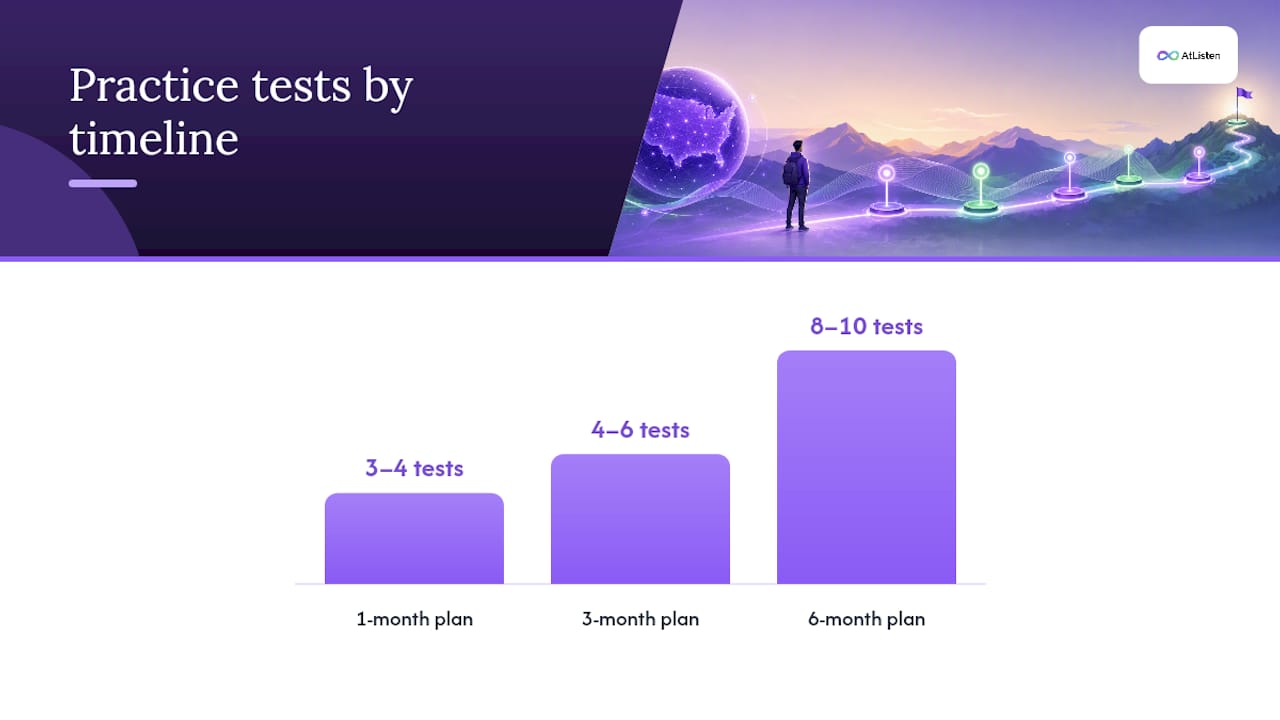
The right cadence depends entirely on your timeline. A 1-month plan supports 3 to 4 full tests. A 3-month plan supports 4 to 6. A 6-month plan can absorb 8 to 10, spaced so you're never retesting the exact same content too soon after the last attempt.
Space full tests at least two weeks apart whenever your schedule allows it. Testing more frequently than that mostly measures fatigue and familiarity with question formats, not real skill growth.
Reviewing a full test properly takes 2 to 3 hours, roughly the same length as the test itself. That review time isn't optional:
- Log every miss into your error log with the six fields from the section above.
- Track your miss rate by question type, not just your overall score, since the overall number hides exactly where your gap lives.
- Compare this test's miss-rate pattern against your last one to confirm whether targeted drilling is actually working.
Watch for plateau signals: three consecutive tests with the same or worse miss rate in a category you've been actively drilling. That's a sign the drill itself needs to change, not that you need to drill harder. Swap in a different resource, slow down and rebuild the underlying concept from scratch, or get a second explanation of the rule from a teacher or tutor before adding more repetition to a method that isn't working.
The Final Week: Taper and Test-Day Checklist
Use the 7-2-1 rule to protect your score instead of grinding it away. Seven days out, cut your study volume roughly in half and stop introducing new content entirely. Two days out, switch to light review only, plus confirming your test-center address, start time, and what you're allowed to bring. One day out, rest completely. No new practice, no cramming, no late-night review session.
Day-before and test-morning checklist:
- Valid photo ID and your admission ticket, printed or on your phone if your test center allows it.
- Test-center directions confirmed the night before, with extra time built in for traffic or parking.
- Phone fully off (not silent) before you enter the room, per test-center rules.
- A light snack and water for the break, plus a sweater since testing rooms run cold as often as they run warm.
- Familiarity with your calculator, whether that's Desmos on the built-in Bluebook tool or your own approved device.
Pro Tip: If you get stuck on a question during the real test, flag it and move on within 60 to 90 seconds. Bluebook lets you mark questions for review, and coming back with a clear head beats losing three minutes to one problem while easier points sit unanswered later in the module.
What I've Learned Watching Students Actually Improve Their Scores
Consistency beats intensity, every time. The students who gain 100-plus points aren't the ones who study the hardest for one heroic week. They're the ones who show up for 70 minutes on a Tuesday when they'd rather be doing anything else, log their mistakes even when it feels tedious, and trust the process enough to stick with one sat study plan instead of switching strategies every time a practice score dips.
The biggest mistake I see isn't laziness, it's plan-hopping. A student tries a 3-month plan for two weeks, gets frustrated with slow progress, switches to a different method, and starts the diagnostic clock over again. Pick a timeline, commit to the weekly structure, and give it the full runway before you judge whether it's working.
Where a tool actually helps is in the boring parts nobody wants to do by hand: organizing lecture notes, class handouts, and old test reviews into something you can actually study from at 9 PM on a school night. That's where AtListen fits, turning scattered material into structured flashcards and practice questions so your study time goes toward drilling, not formatting notes. AtListen also publishes its security practices openly, which matters if you're uploading school materials to any platform.
— William
How AtListen Fits Into Your Daily Study Sessions
Building an error log by hand works, but it's slow, and slow kills consistency faster than any single bad practice test does. AtListen exists for exactly this friction point in a sat study schedule: turning the raw material you already have, class notes, lecture recordings, old test review sheets, even a PDF of a textbook chapter, into structured study packages in minutes instead of hours.

Upload a lecture recording or a set of notes from your weakest domain, and AtListen generates a summary, key concepts with plain-language definitions, and practice questions with explanations, exactly the kind of targeted drill material your 60 to 90 minute sessions are built around. Smart flashcards built for spaced repetition slot directly into the retest step of your error-log loop, so the question types you missed last week resurface right when you need them to.
Atlisten's Free plan lets you try this workflow at no cost, while the Pro plan at $19.99 per month and the Max plan at $39.99 per month unlock deeper depth control and higher usage limits for students running a full 3 or 6-month timeline. If you're a parent setting this up for a younger student, AtListen's COPPA-compliant privacy policy covers users under 13. Head to AtListen and upload your first set of class notes to see your first study package generated in minutes.
Official Resources Worth Bookmarking
A handful of sources cover everything else you'll need beyond this plan itself.
- Bluebook practice tests: the only diagnostic and full-length practice environment that matches the real Digital SAT exactly.
- Khan Academy's official SAT practice: free, question-type-organized lessons that pair naturally with your error log.
- Mysat: test-day logistics, registration deadlines, and accommodations information straight from College Board.
- A downloadable weekly planner template: a ready structure if you'd rather adapt an existing sat study plan template than build your calendar from scratch.
Sources
- Build Your Study Plan - SAT Suite of Assessments
- How to Study for the SAT
- How to Create the Perfect SAT Study Schedule | Grind1600
FAQ
What is the best study plan for the SAT?
The best sat study plan starts with an official Bluebook diagnostic, then builds a timeline (1-week, 1-month, 3-month, or 6-month) around your specific score gap, with daily 60 to 90 minute sessions targeting your weakest question types. College Board itself recommends this diagnostic-first sequencing over generic content review.
What was Bill Clinton's SAT score?
Public records on this figure are not consistently documented or verifiable, so no reliable score can be stated here.
Can ChatGPT get a 1600 on the SAT?
AI chat tools have shown strong results on certain SAT question types, particularly reading comprehension and grammar rules, but performance varies significantly on multi-step math and visual data questions. There's no verified, reliable claim of a consistent perfect 1600 across full official test conditions.
Is 1200 out of 1600 a good SAT score?
Scores should be considered in context with specific college admission ranges; setting a target score against actual admissions data is more meaningful than considering any score alone.
How many hours should I study for the SAT?
Hours depend on your score gap: a 50-point gap typically needs 40 to 80 hours, while a 150-plus point gap often requires 150 to 300 hours spread across a longer timeline. Tools like AtListen can cut the time spent organizing materials, leaving more of those hours for actual drilling and timed practice.