
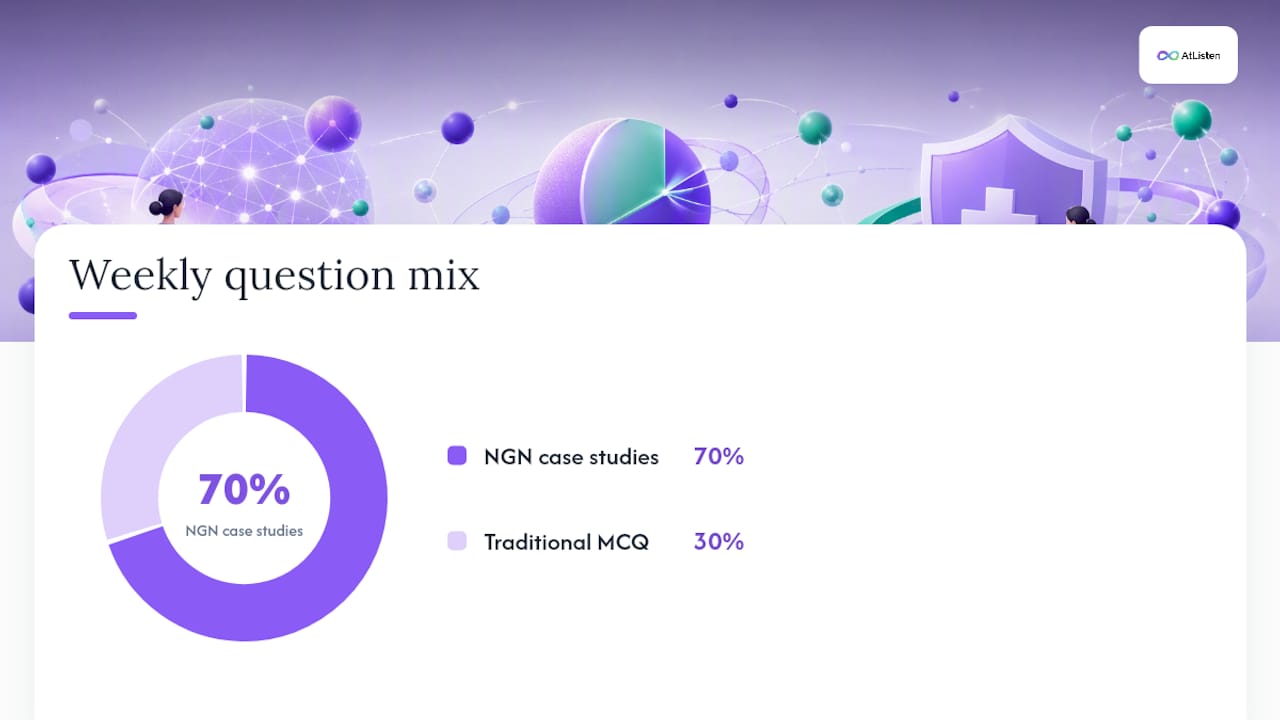
If you can study full-time, a focused 4-week plan built around 3 to 5 hours a day and 50 to 100 questions daily is the most efficient route to test day. If you're working or finishing clinical hours, consider extending your study period to several weeks or months with lighter daily sessions. Either way, aim for a substantial volume of total practice questions with roughly 70% spent on NGN case-style items, following the NCSBN 2026 NCLEX-RN test plan.
TL;DR:
- A four-week full-time study plan with 3 to 5 hours daily and around 70% NGN case questions prepares most candidates effectively for test day.
- Study blocks should be structured, alternating between question practice and rationale review, especially focusing on missed questions to reinforce reasoning skills.
- Maintaining a consistent 70/30 NGN to traditional question ratio weekly improves clinical judgment skills and aligns with the exam's emphasis on case-based reasoning.
- Candidates should adapt their timeline based on their experience, with longer plans for foundational rebuilding and shorter, intensive NGN practice for repeat test-takers.
- Using integrated study tools that convert lectures into practice questions can save time and tailor content review to individual weaknesses within the study schedule.
Table of Contents
- Choosing Your NCLEX Study Plan Timeline
- How to Structure Each Study Day
- NGN Practice and the 70/30 Rule
- The Study Loop That Actually Improves Your Score
- Study Resources That Support the Plan
- When to Register and How to Taper the Final Week
- Managing Test Anxiety Without Losing Study Time
- Combining Content Review With Practice Questions
- Adjusting the Plan for Your Experience Level
- What I'd Tell a Friend Starting Their NCLEX Plan
- Turn Your Notes Into a Ready-Made Study Plan Faster
- Sources
Choosing Your NCLEX Study Plan Timeline
The right nclex study plan isn't about picking the longest schedule you can imagine sticking to. It's about matching your available hours per week to a structure that still hits the volume of practice you need before test day. Educator-built templates generally break into five workable timelines, and each one assumes a different daily hour commitment.
A 2-week plan requires intensive daily study over several hours and works best for repeat test-takers who already have strong content knowledge. A 3- to 4-week plan involves moderate daily study suited for new graduates without major knowledge gaps. A 6-week plan reduces daily hours to a manageable pace for those working part time or managing transitions. Longer plans such as 9 or 12 weeks allow lighter daily commitments, ideal for candidates balancing work, family, or ongoing schooling, according to timeline guidance from UWorld's NCLEX study planner.
Here's how the weekly rhythm typically breaks down across timelines:
-
2-week plan involves hundreds of questions weekly with intensive content review early and practice simulations near the end.
-
4-week plan features moderate weekly question volume with alternating focus days and simulation practice mid-cycle.
-
6-week plan progresses more gradually with regular practice and end-of-week simulations.
-
9 and 12-week plans emphasize consistent, lighter weekly question sets with built-in rest, suitable for foundational knowledge building before advancing to complex practice.
Whichever timeline you choose, keep the NGN-to-traditional question ratio close to 70/30 every week, not just at the end. A 6-week candidate doing all traditional multiple-choice for a month and cramming case studies into the final two weeks is setting up a mismatch with what the actual exam tests.
How to Structure Each Study Day
A study day only works if it's built in blocks, not just a vague number of hours. Structure depends on how much time you actually have that day.
- 1-hour sessions: Do 15 to 20 questions in one uninterrupted block, then spend the remaining time reading every rationale, including the ones you got right. Correct guesses hide gaps.
- 2 to 3-hour sessions: Split into two question blocks of 25 to 40 items each, separated by a 15-minute break, with a dedicated 30 to 40 minute rationale review after each block rather than at the very end.
- Full-day sessions (4+ hours): Run three blocks: a morning content-review pass on your weakest category, a midday question set of 50 to 75 items, and an afternoon rationale deep-dive where you re-work every miss by hand.
Rationale review is where the actual learning happens, not the questions themselves. Read the rationale for every question you answer, correct or not. Spend the least time on confident correct answers, moderate time on lucky guesses (you got it right but weren't sure why), and the most time on misses, tracing the reasoning error back to its source.
Short, timed blocks (25 to 30 minutes of focused questions, then a 5-minute break) tend to hold attention better than marathon sessions, echoing the broader case for active recall over passive review. Study somewhere without your phone in reach, and read each question stem out loud in your head as if a patient were standing in front of you. That small shift forces clinical reasoning instead of pattern-matching.
Pro Tip: Keep a running "miss log" in a notebook or spreadsheet. After two weeks, patterns in your wrong answers will tell you more about what to study next than any percentage score ever will.
NGN Practice and the 70/30 Rule
The Next Generation NCLEX tests clinical judgment through case studies, bow-tie items, and matrix/grid questions, formats that ask you to trace a patient scenario from cues to action rather than pick one right answer from a list. These items reward reasoning through a whole clinical picture, not memorized facts in isolation.
Educator guidance points to a 70% NGN, 30% traditional split across your practice time, and that ratio should hold weekly, not just show up in a final cram week, per analysis from FVI's clinical judgment breakdown. In practice, that means:
- If you're doing 100 questions this week, roughly 70 should be case-study or NGN-format items.
- Full case studies (6 items tied to one patient scenario) count as more valuable practice time than an equal number of standalone questions.
- Build a habit of mapping each case: identify the cues, name the underlying problem, choose the safest action, then evaluate the outcome before checking the answer.
That four-step map (cues, problem, action, evaluation) is worth writing on a sticky note and keeping next to your laptop. It's the actual skill the NGN is measuring.
The Study Loop That Actually Improves Your Score
Most candidates study in a straight line: read content, do questions, move on. A better loop cycles back on itself. Start with a baseline diagnostic assessment, ideally in week one, and let the results dictate your weekly focus list instead of studying every topic equally.
From there, the loop runs in five steps:
- Diagnose. Take a full diagnostic to identify your three or four weakest categories.
- Practice. Do targeted question sets in those categories, not general mixed practice, until you're ready to move on.
- Review rationales. Read every explanation, marking each miss with a quick label: knowledge gap, misread, or reasoning error.
- Remediate. Match the fix to the label. A knowledge gap gets a short content review. A misread gets a question-reading drill (slow down, underline the actual question). A reasoning error gets practice with a prioritization framework like ABCs or Maslow's hierarchy.
- Recheck. Retest the same category a few days later to confirm the fix held.
Run full-length CAT simulations sparingly early on, maybe one every two weeks, and increase frequency as test day nears, per the progressive-intensity pacing many educator timelines recommend. Track consistency in your reasoning process across attempts, not just the raw score, since a single simulation result is a noisy predictor of readiness on its own, according to RN Test Pro's study guidance.
Pro Tip: A correct answer you weren't sure about is a bigger opportunity than a wrong one. Wrong answers already have your attention. The lucky guesses are the ones quietly hiding a real gap.
Study Resources That Support the Plan
No single resource covers every phase of an NCLEX study plan. You generally need four categories working together: an adaptive question bank that adjusts difficulty as you improve, an NGN-specific case library for extended clinical-judgment items, spaced-repetition flashcards for memorization-heavy content like labs and medications, and short focused content reviews for filling specific knowledge gaps.
When evaluating any resource, check for a few things before committing:
- Does it clearly separate NGN-format items from traditional multiple-choice, or lump everything together?
- Are rationales detailed enough to explain the reasoning, not just the correct answer?
- Does it track your performance by category over time, so you can see improvement instead of guessing at it?
- Can you use it in short, spaced sessions, or does it force long sittings?
Sequence matters more than most people assume. Use flashcards early in your timeline for foundational recall, shift toward NGN case studies as you build reasoning skill, and save full-length CAT simulations for the final third of your plan, once you've closed most of your knowledge gaps. Running simulations too early just tests panic response, not readiness.
When to Register and How to Taper the Final Week
Many state boards allow Pearson VUE scheduling starting some weeks after graduation, but this timing varies by state. Check your specific board's rules before scheduling, following guidance from the American Nurses Association. Build your study calendar first, then pick an exam date that lands at the end of it, not the other way around.
Final week checklist:
- Run one last full-length CAT simulation 5 to 7 days out, not the night before.
- Spend the remaining days on rationale review for your weakest categories only, not new content.
- Take at least one full rest day in the final 72 hours.
- Confirm your ID, testing center address, and appointment time the day before, and lay out what you're bringing that night.
If your diagnostic scores still show wide swings or unresolved reasoning errors a week before your test date, it's worth pushing the exam back two to three weeks rather than sitting for it underprepared.
Managing Test Anxiety Without Losing Study Time
Anxiety during NCLEX prep usually comes from uncertainty, not a lack of knowledge, which is why a structured timeline itself works as a mental-health tool. Knowing exactly what you're studying each day removes the background hum of "am I doing enough."
A few practical habits help more than most candidates expect. Keep your sleep schedule consistent through your entire prep window, not just the final week. Sleep deprivation during a 4-week sprint erodes the same clinical reasoning skills the NGN is testing. Build one full rest day into every week, even the intense ones, since recovery time is what lets practice actually consolidate into memory.
Separate "study anxiety" from "test anxiety." If practice questions themselves trigger panic, slow your daily volume and add more untimed rationale review before ramping back up. If it's specifically the exam format that worries you, run a few timed CAT simulations under realistic conditions (quiet room, no notes, standard break schedule) to desensitize yourself to the format before test day.
Talk to someone. Nursing school cohorts, online NCLEX study groups, and campus counseling centers all see this exact stress pattern every testing cycle. You are not the first candidate to feel behind schedule two weeks before your date, and isolating yourself with the material tends to make the anxiety louder, not the studying more effective.
Combining Content Review With Practice Questions
Studying content and doing questions in separate blocks, days apart, is one of the more common inefficiencies in self-built NCLEX prep. The two work best interleaved, ideally within the same session.
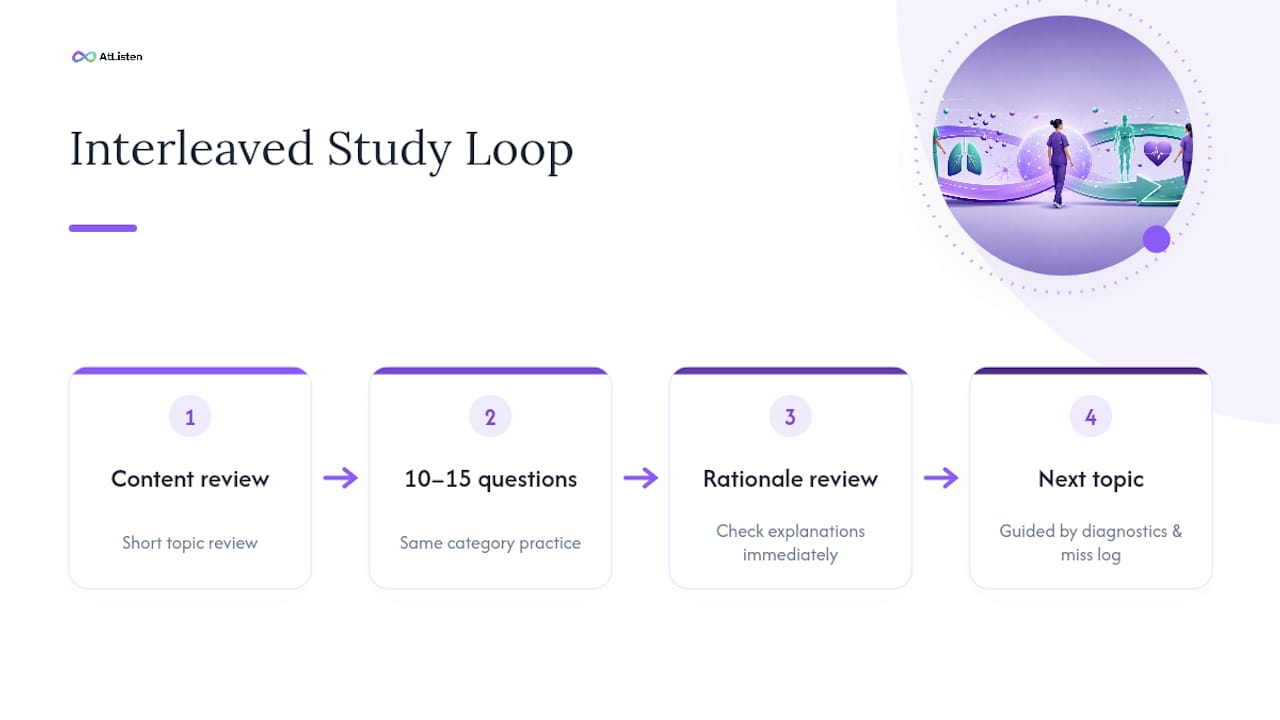
Read a short content review on a topic, immediately do 10 to 15 questions in that exact category, then review rationales before moving to a new topic. This tight loop, sometimes called interleaving, forces you to apply what you just read instead of just recognizing it, which lines up with the broader evidence that active retrieval beats passive review for long-term retention.
Avoid the trap of reading an entire content review book cover to cover before touching a single question. By the time you reach questions, you'll have forgotten half of what you read in week one. Instead, let your diagnostic results and weekly miss log dictate which short content reviews you read, and read them right before practicing that category, not weeks in advance.
Adjusting the Plan for Your Experience Level
A new graduate six months out of clinical rotations needs a different plan shape than someone testing 18 months after graduation, or a repeat test-taker who didn't pass on the first attempt.
Recent graduates with strong, current clinical exposure can often move faster through content review and spend more time straight into NGN case practice, since the clinical reasoning is still fresh. Candidates further removed from clinicals, or those who feel shaky on specific systems (cardiac, pediatric, mental health are common gaps), should stretch the content-review phase and choose a longer timeline, 9 to 12 weeks rather than 4, to rebuild that foundation without rushing.
Repeat test-takers face a different problem entirely: they usually have decent content knowledge but a specific breakdown in reasoning or test-taking strategy. For this group, a shorter, more intense 2 to 3-week plan focused almost entirely on NGN case practice and prioritization frameworks tends to outperform a long, content-heavy rebuild. The fix isn't more studying. It's different studying.
Whatever your starting point, let your baseline diagnostic assessment set the plan, not your assumptions about your own weaknesses. Candidates are frequently wrong about which categories are actually costing them points until the data shows it plainly.
What I'd Tell a Friend Starting Their NCLEX Plan
The candidates who struggle most usually aren't the ones who studied too little. They're the ones who logged hundreds of questions without ever slowing down to figure out why they missed the ones they missed. Volume feels productive. It's reviewing rationales, categorizing your errors, and going back to fix the actual reasoning gap that moves your score.
Sleep and consistency matter more than heroic study days. A steady 2-hour block every day beats one exhausting 6-hour session followed by two days of burnout recovery. Protect your rest days on the calendar the same way you protect your study blocks.
The biggest pitfall I'd flag: treating NGN case studies as optional extra practice instead of the main event. The exam has shifted its emphasis, and study habits built around old-style question banks alone will leave you underprepared for what test day actually asks. Let your diagnostic results, not your gut feeling, tell you where to spend next week's hours.
— William
Turn Your Notes Into a Ready-Made Study Plan Faster
Building the schedules above by hand, week by week, question by question, takes real time most NCLEX candidates don't have to spare. The platform converts lecture recordings, PDFs, and class notes into structured study materials, summaries, key concepts, flashcards, and practice questions with explanations, in minutes instead of hours.
Say you're running a 4-week plan and just sat through a dense pharmacology lecture. Upload the recording or your notes into the platform, which then generates spaced-repetition flashcards and practice questions you can slot straight into that evening's review block, instead of spending an hour building your own from scratch. Depth control features let you adjust how detailed each summary or question set is, so a quick refresher day and a deep-dive content-review day can pull from the same source material without extra work. For families or younger learners using the platform, Atlisten's security practices and children's privacy policy outline how data is handled.
If your study calendar is already tight, start by uploading your next lecture or review chapter to Atlisten and see how quickly it turns into a ready-to-use study set.
Sources
The 2026 NCLEX-RN test plan from NCSBN is the authoritative source for content categories and NGN format changes, straight from the organization that writes the exam. UWorld's NCLEX study planner offers detailed week-by-week timeline templates across every plan length. FVI's clinical judgment guide breaks down the 70/30 NGN practice ratio in practical terms. The American Nurses Association covers registration timing and logistics most candidates overlook until it's too late.