

Start this week by taking an AAMC sample test to find your weak spots. Everything else in your schedule should follow from that one diagnostic and your actual test date.
TL;DR:
- The 1-month MCAT plan requires nearly 300 hours with 8 to 10 hours daily, leaving little room for content review and practice separation.
- The 3-month schedule typically involves 300 to 420 hours, with a content-heavy first phase followed by a practice-intensive final stretch, including two weeks for full-length exams.
- The 6-month plan offers more flexibility with 12 to 15 hours weekly, splitting content review in early months and practice in later months, with full-lengths in the last phase.
- Content cutoff should be set 4 to 6 weeks before test day to avoid content creep, protecting the final two weeks solely for full-length practice and calibration.
- Personalization starts with completing an initial diagnostic test, then adjusting weekly hours, content focus, and resource use based on real strengths, weaknesses, and available study time.
Table of Contents
- MCAT Study Plan Templates: 1-Month, 3-Month, and 6-Month Schedules
- How Do You Personalize a Generic MCAT Study Schedule?
- The 70/30 Rule: When to Shift From Content to Practice
- What Does a Realistic Weekly MCAT Study Schedule Look Like?
- How Often Should You Take Full-Length Practice Exams?
- Common MCAT Study Plan Mistakes and How to Fix Them
- An Editorial Take on What Actually Makes MCAT Plans Work
- How AtListen Fits Into Your MCAT Study Plan
- Sources
MCAT Study Plan Templates: 1-Month, 3-Month, and 6-Month Schedules
Every timeline needs the same four ingredients: a diagnostic at the start, a content cutoff somewhere in the middle, a practice-heavy back half, and two weeks at the end reserved for AAMC full-lengths. What changes is how much room you have to work with.
The 1-month plan is the version nobody wants but plenty of people end up running, often because a retake got scheduled fast or a gap semester opened up unexpectedly. It demands close to 300 hours in 30 days, which means 8 to 10 hours daily with almost no rest days. There is no real Phase 1 here. You take the diagnostic on day one, spend roughly a week and a half hitting your weakest content areas hard, then spend the remaining two and a half weeks almost entirely in practice mode. Content review and practice run in parallel from day three onward because there simply isn't time to sequence them cleanly.
The 3-month plan is the most common runway for students studying alongside a light course load or a gap year. Total hours land between 300 and 420, spread across roughly 25 to 35 hours a week. The first five to six weeks lean content heavy (around 70/30), the middle stretch transitions, and the final three to four weeks flip to practice heavy. Content cutoff typically falls around week 9 or 10, leaving the last two weeks purely for AAMC scored exams and review.
The 6-month plan gives you the most flexibility and the lowest weekly burden, usually 12 to 15 hours a week for a total near 300 to 350 hours, which is close to what Kaplan's paced six-month blueprint recommends for students balancing coursework or a job. Months one through three stay content heavy, month four is the pivot, and months five and six run practice heavy with weekly full-lengths by the final month.
Here's how the phases map across each timeline:
| Timeline | Total hours | Weekly hours | Content cutoff | Final full-length stretch |
|---|---|---|---|---|
| 1 month | ~300+ | 60–70 | Day 10–12 | Final 5–6 days |
| 3 months | substantial total hours | moderate weekly hours | Content cutoff near week 9 or 10 | Last two weeks for full-length practice |
| 6 months | substantial total hours | lower weekly hours | Content cutoff near months 4 or 5 | Last few weeks for full-length practice |
A few things hold true regardless of which template you pick:
- Your diagnostic and Content & Skills Breakdown go in week one, no exceptions.
- Content cutoff should sit 4 to 6 weeks before test day, not 2.
- The final two weeks belong to AAMC scored full-lengths and calibration, not new content.
- Weekly hours should be realistic for your actual schedule, not aspirational.
If your available weekly hours don't fit any of these three columns cleanly, that's a sign to adjust the calendar, not to force a mismatched template onto your life.
How Do You Personalize a Generic MCAT Study Schedule?
A template only becomes a real plan once you run it through your own numbers. Start with the diagnostic, because everything downstream depends on it.
Take the AAMC sample test under timed conditions before you build a single week of your calendar. The scaled score matters less than the section breakdown. If your Chem/Phys score is dragging while CARS is solid, your weekly hours need to reflect that split immediately, not three weeks from now.
Building a personalized MCAT study schedule generally follows this sequence:
- Run the AAMC sample test and pull the Content & Skills Breakdown to identify your two or three weakest content areas.
- Count the weeks between today and test day, then multiply by your realistic weekly hours to get your total hour budget.
- Compare that total against the 300 to 400 hour range. If you're short, you have three options: push the test date, reduce your target score, or find more weekly hours.
- Pick a resource stack: one primary content source, one question bank, daily CARS practice, a spaced-repetition system for Psych/Soc terminology, and AAMC's own products reserved for the final weeks.
- Set a defensible target score based on your diagnostic baseline plus a realistic improvement curve, not a number you saw on a forum.
Front-loading your weakest topics while keeping already-strong ones warm through spaced repetition and periodic mixed practice tends to produce better score gains than working through content in outline order, according to the MCAT Study Plan Playbook. Content review that ignores your diagnostic results is study time spent on topics you already know.
On the resource question: Khan Academy's MCAT modules map directly to the AAMC content outline and cost nothing, which makes them a solid primary content source for most students. Pair that with a question bank for practice, and reserve official AAMC materials, including the scored full-lengths, for the final month when calibration matters more than volume.
Pro Tip: Don't set your target score in isolation. Set it alongside your timeline. A 520 goal with only six weeks of prep time is a math problem before it's a study problem.
The 70/30 Rule: When to Shift From Content to Practice
Every solid MCAT schedule runs on two phases, and knowing where one ends and the other begins is arguably the single highest-leverage decision in the whole plan.
This phase dominates the early weeks or months of any MCAT study schedule.
How do you know when to flip? Three signals matter more than the calendar date:
- Your practice scores plateau or dip slightly even though you're still reviewing content, which usually means you've hit the ceiling of what passive review can offer you.
- Re-reading chapters starts feeling repetitive rather than clarifying, a sign the marginal value of new content has dropped below the marginal value of practice.
- Your diagnostic-identified weak areas show measurable improvement on quick check-ins, meaning the content gap that justified Phase 1 is closing.
The practical default, absent other data: set your content cutoff 4 to 6 weeks before test day, and treat it as a hard line rather than a soft taper. A soft cutoff invites content creep: "just one more chapter" turns into two lost practice weeks. A hard cutoff protects the final two weeks for AAMC scored full-lengths, which is where your most predictive practice data comes from.
What Does a Realistic Weekly MCAT Study Schedule Look Like?
A good week protects four things simultaneously: content review, daily habit work, qbank practice, and periodic full-length testing. Miss one of these tracks for too long and the whole plan drifts.
Track 1: Content review. Deep, subject-specific blocks, usually Monday through Thursday, where you're not context-switching between biology and physics in the same session.
Track 2: Daily habits. CARS passages and spaced-repetition flashcards belong in your schedule every single day, even on rest days. These are the small, high-frequency tasks that compound over months. Skipping CARS for a week is far more costly than skipping it wouldn't be for content review, since it's a skill built through daily reps rather than a knowledge base built through study sessions.
Track 3: Qbank practice. Timed, mixed-topic question sets that force retrieval rather than recognition. This ramps up sharply as you move into Phase 2.
Track 4: Full-lengths. Scheduled deliberately, not whenever you happen to have a free Saturday.
For a student working 15 to 20 hours a week alongside MCAT prep, a realistic week might look like this:
- Monday to Thursday: 90 minutes of content review, 30 minutes of CARS, 20 minutes of flashcards.
- Friday: Mixed qbank practice, 2 hours.
- Saturday: Longer practice block, 3 to 4 hours, or a full-length every 2 to 3 weeks.
- Sunday: Rest, or light flashcard review only.
For a student studying full-time at 30 to 40 hours a week, the structure tightens:
- Monday to Thursday: 3 to 4 hour content blocks in the morning, qbank sets in the afternoon.
- Friday: Mixed practice day, pulling from multiple subjects at once.
- Saturday: Full-length exam under realistic timed conditions, once cadence ramps up.
- Sunday: Full review day tied to Saturday's exam, plus rest in the afternoon.
Block lengths matter here. Single-subject deep work for 60 to 90 minutes tends to hold focus better than three-hour marathons, and mixed-practice days should show up at least once a week even during Phase 1, since the real exam never tests one subject in isolation. Rest is not optional. A week with zero recovery time is a week that produces diminishing returns by Thursday.
How Often Should You Take Full-Length Practice Exams?
Sequencing matters as much as frequency. Use third-party full-lengths for bulk practice early on, and save every AAMC scored exam for the final four to six weeks, since AAMC's own scored exams are the single best calibration tool you have and there are only so many of them.
A workable cadence: one full-length every 2 to 3 weeks during Phase 1 and early Phase 2, then ramping to weekly in the final month. Each exam should function as a two-day unit rather than a single event. Day one is the test itself, taken under realistic timed conditions, ideally at the same time of day as your actual exam. Day two is a mandatory full review, no exceptions, where you talk through every missed question out loud and log it.
That error log is where the real score gains come from, more than the tests themselves. A useful log tracks:
- The question ID and topic.
- Your answer versus the correct answer.
- A short note on why you missed it, whether it was a content gap, a timing issue, or a careless read.
- A specific remediation action: a flashcard, a chapter revisit, or a targeted qbank set on that exact concept.
Review the log weekly, not just after each test. If the same content category keeps showing up across three separate full-lengths, that's a pattern worth a dedicated study session, not another pass through your notes.
Pro Tip: If you notice you're consistently missing questions on timing rather than content, don't add more content review. Add more timed practice under exam conditions instead. Those are two different problems with two different fixes.
Common MCAT Study Plan Mistakes and How to Fix Them
Most broken study plans fail for the same handful of reasons, and all of them are fixable if you catch them early.
Planning forward instead of backward. Starting from "today" and figuring out the schedule as you go, rather than starting from test day and counting backward, is how content review eats into your final practice weeks. Fix it by locking your test date first, then building every phase relative to that fixed point.
Content creep. "Just one more topic" before you move to practice is the most common way a content cutoff disappears entirely. Set a hard cutoff date on your calendar now, not a soft target you'll reevaluate later.
Unrealistic weekly hours. Fifteen hours a week rarely mixes well with a full course load and a part-time job, yet plenty of students schedule it anyway. If your available hours don't add up to your total hour target, extend your timeline or reduce your target score. Trying to compress 350 hours into a timeline that only allows 200 doesn't produce a shorter path to the same result.
Skipping full-length review days. Taking the test without the follow-up review day wastes the most valuable data your practice generates. If you don't have time for both the exam and the review, you don't have time for the exam yet.
When your hours consistently fall short of your plan, the honest choice is between pushing your test date or scaling back your target score. Both are better than pretending the math will work itself out.
An Editorial Take on What Actually Makes MCAT Plans Work
Most MCAT advice treats the schedule as the hard part. It isn't. The 70/30 split and the backward-planning logic are genuinely simple once you've seen them laid out. The hard part is staying accountable to a plan when week six feels identical to week two, and nobody is checking whether you actually did the CARS passage you scheduled for Tuesday.
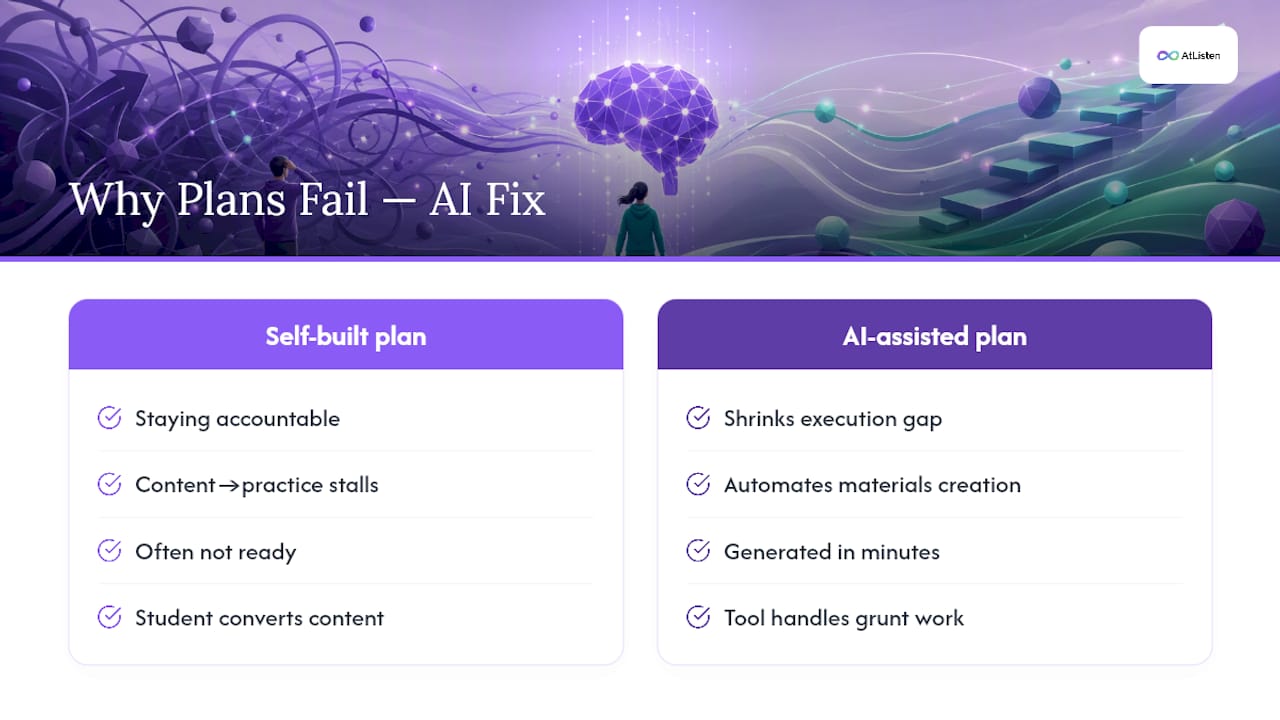
That's where most self-built plans quietly fail. Not because the template was wrong, but because turning "review Chapter 12" into an actual afternoon of retrieval practice takes more executive function than most students have left after a full day of classes or work. The content-to-practice transition specifically gets stalled here, because building your own practice questions from lecture notes is slow, tedious work that people skip when they're tired.
This is where AI-generated study materials genuinely change the equation, not by replacing the plan but by shrinking the gap between "I should study this" and "I did study this." A summary and flashcard set generated in minutes from a lecture recording removes the excuse of not having materials ready. That's not a small thing when you're running a 6-month plan and willpower is a finite resource. Atlisten's depth-control features fit naturally into the personalized-plan approach this article recommends: you still own the diagnostic, the hours math, and the target score, but the tool handles the grunt work of converting raw content into something you can actually drill.
— William
How AtListen Fits Into Your MCAT Study Plan
Building a personalized schedule is only half the battle. Executing it every week, especially during the content-heavy phase, is where most plans quietly fall apart. AtListen turns your lecture recordings, textbook chapters, and review videos into structured summaries, key concept breakdowns, and practice questions with explanations in minutes, cutting the time between "I need to review this" and "I actually reviewed this."

For spaced-repetition flashcards on Psych/Soc terminology or high-yield biochemistry pathways, you can upload a chapter or a recorded lecture and get a study-ready flashcard set without spending an evening building it manually. That extra hour matters more than it sounds like during a 6-month plan where weekly hours are already tight. If data privacy is a concern before you upload course materials, AtListen's security practices are worth a look. Subscription options include a free tier and various paid plans for different usage needs. Start with the free plan this week and see how it fits into the content-review track of your schedule.
Sources
The AAMC's own study plan guidance is the closest thing to a primary source for diagnostic testing and official content outlines. Khan Academy's MCAT modules offer free, outline-aligned content review. Shemmassian's scheduling breakdown is the clearest public explanation of the 70/30 phase logic used throughout this plan, and Kaplan's 6-month blueprint backs up the weekly full-length cadence for longer timelines. If you're building any high-stakes exam timeline from scratch, the backward-planning approach in this NCLEX study schedule guide offers a useful outside comparison, since the logic of counting backward from test day applies well beyond the MCAT.