

Take an official LawHub diagnostic before you do anything else. Your baseline score tells you whether you need a 1-month sprint or a 6-month rebuild. Most test-takers land somewhere in the middle: a 2- to 3-month plan at 10 to 20 hours a week, totaling 150 to 300 hours of prep. Start with the diagnostic today and pick your runway from there.
TL;DR:
- Most test-takers should start with an official LawHub diagnostic to determine whether they need one, two, three, or six months to prepare effectively.
- A score gap of 0 to 3 points generally requires about one month of focused review, while larger gaps need more time and consistent effort.
- Building stamina and pacing skills involves regular full practice tests with blind review, starting with a few per month and increasing frequency closer to the exam.
- Daily study sessions of 60 to 90 minutes, including warm-up, targeted drills, timed sections, and review, are most effective, especially when focused on weaker question types.
- Key progress indicators are stable scaled scores over multiple tests, pattern recognition in misses, and accurate pacing, not just the number of questions answered or completed practice tests.
Table of Contents
- How Does a Diagnostic Test Shape Your LSAT Study Plan?
- Sample LSAT Study Schedules for Every Timeline
- What Does an Effective LSAT Study Session Look Like?
- When Should You Take Full Practice Tests and How Do You Review Them?
- How Do You Build Pacing and Stamina for Test Day?
- Which LSAT Study Resources Actually Move Your Score?
- How Do You Know If Your LSAT Study Plan Is Working?
- Why Discipline Beats Talent on the LSAT
- Try AtListen to Speed Up Your LSAT Review
- Sources
- FAQ
How Does a Diagnostic Test Shape Your LSAT Study Plan?
Your first move should always be a full, timed LawHub PrepTest taken under real conditions: no phone, no pausing, no peeking at the clock early. LawHub is the official platform, and it replicates the digital test interface you'll actually see on exam day, including the on-screen timer and answer-flagging tools. A diagnostic taken on a PDF or an old paper test won't tell you the truth about your pacing.
Once you have a baseline score, compare it to your target score. That gap drives your timeline more than anything else:
- 0 to 3 point gap: roughly one month of focused retuning, mostly pacing and review of weak question types.
- 4 to 8 point gap: about two months, split between fundamentals and targeted drilling.
- 9 or more point gap: three to six months, since you're building skills from the ground up rather than sharpening what's already there.
These are starting points, not guarantees. Someone with a 9-point gap who studies with discipline can sometimes close it in less time than someone with a 4-point gap who studies erratically.
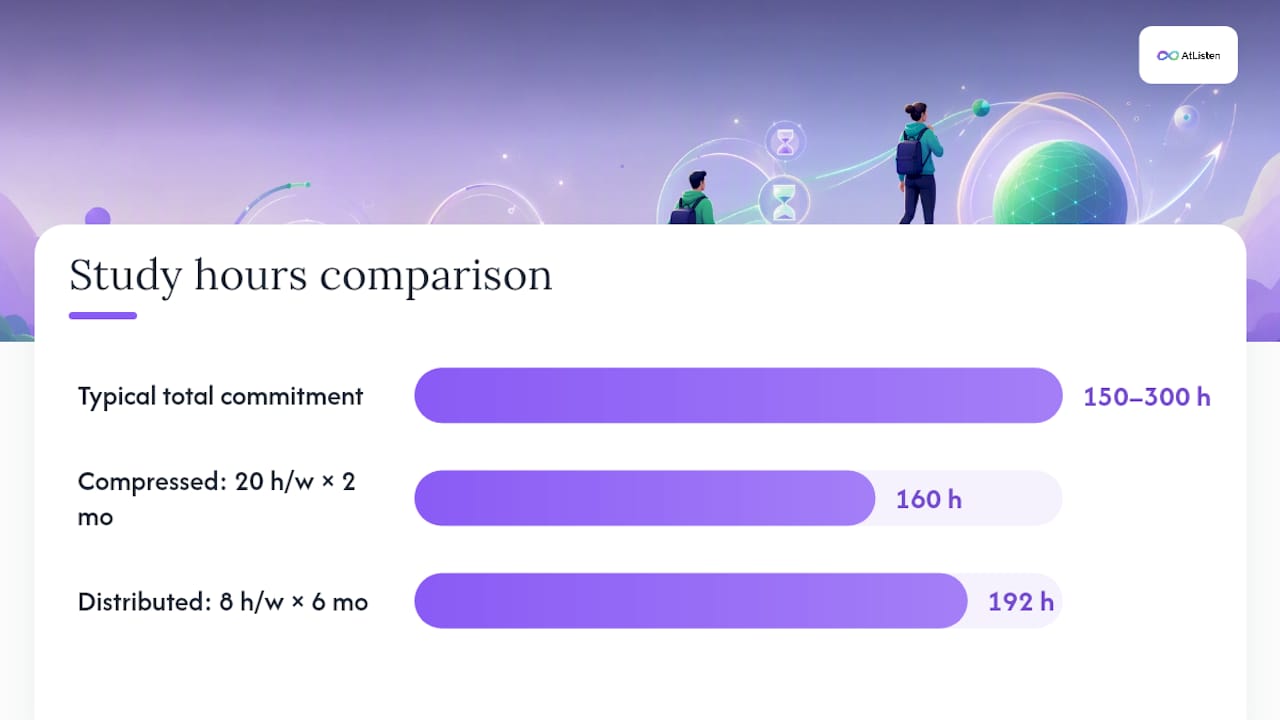
Total hours matter more than calendar time. Most people who improve their score meaningfully log 150 to 300 hours total, whether that's compressed into 20-hour weeks over two months or spread across 8-hour weeks over six. Pick your weekly hour commitment first, based on your actual schedule, and let that determine your runway. Check the official LSAT test dates early, since registration deadlines fall weeks before the actual test.
Sample LSAT Study Schedules for Every Timeline
Here's how to structure four common runways, from a crash course to a slow build.
-
One month (crash plan, 25 to 30 hours/week). Week 1 is diagnosis and triage: identify your two weakest question types and drill them daily in 45-minute untimed sets. Week 2 shifts to timed single-section practice, one section per day, with blind review immediately after. Week 3 adds full timed PrepTests every other day, alternating with targeted review of missed question types. Week 4 tapers: two full tests early in the week, then light review and rest for the final three days. This pace only works if you already read quickly and have some familiarity with formal logic. It's punishing, and it's not the plan to choose if you have a full course load or a demanding job.
-
Two months (focused plan, 15 to 20 hours/week). Weeks 1 to 2 cover fundamentals: argument structure, conditional logic, and Reading Comprehension passage mapping. Weeks 3 to 4 move into section-specific drilling, roughly 40% Logical Reasoning, 30% Reading Comprehension, 30% mixed review. Weeks 5 to 6 introduce full timed tests once a week, with the other days split between drilling and blind review of the prior test's misses. Weeks 7 to 8 increase test frequency to twice-weekly and taper intensity in the final four days before your test date.
-
Three months (standard plan, 12 to 15 hours/week). Month one builds fundamentals across all three question types with daily untimed drills. Month two introduces one full timed PrepTest per week alongside continued drilling, with blind review consuming as much time as the test itself. Month three tightens the cycle: two full tests a week, heavier remediation on whatever question type is lagging, and a deliberate taper in the last five days. This is the most commonly recommended LSAT study timeline because it balances thoroughness against burnout risk.
-
Six months (gradual plan, 6 to 10 hours/week). Months one and two stay light: fundamentals, untimed practice, and no more than one timed section per week. Months three and four add a full PrepTest every two weeks and increase daily drilling slightly. Months five and six ramp to weekly full tests, with the final three weeks mirroring the three-month plan's taper. Build in one full rest week around the two-thirds mark. Six-month plans fail more often from drift than from difficulty. Without weekly checkpoints, it's easy to coast for a month and lose momentum.
What Does an Effective LSAT Study Session Look Like?
A good study block has a shape, not just a duration. Sit down for a warm-up (five to ten easy questions to get your brain into test mode), move into a focused untimed drill on your weakest area, then run one timed section, then close with blind review of everything you missed. That structure works whether your session is 60 minutes or 90.
- Aim for study sessions of roughly an hour to an hour and a half, several times a week depending on your timeline. Shorter, frequent sessions beat rare marathon ones for most learners, since fatigue wrecks accuracy on Logical Reasoning and Reading Comprehension alike.
- Since the 2024 format change dropped Logic Games from the scored exam, the test now runs two scored Logical Reasoning sections against one Reading Comprehension section. Weight your drilling heavier on Logical Reasoning relative to Reading Comprehension.
- Reserve at least one weekly session purely for review, no new questions, just revisiting old misses to see if the pattern has actually sunk in.
Pro Tip: Never do a timed section back to back with the review of that same section on the same energy. Take a short break first. Reviewing while still frustrated from a bad section makes you rationalize wrong answers instead of learning from them.
When Should You Take Full Practice Tests and How Do You Review Them?
Full-length, timed PrepTests should start slow and ramp up. Take one or two per month during your foundation phase. Then move to weekly full tests once you enter the drilling phase of your plan, whatever runway you're on.
- Redo every missed question untimed, no answer choices hidden, no clock running.
- Write down why you missed it before checking the explanation. Was it a content gap, a misread stem, or a timing scramble?
- Classify each miss by question type (assumption, inference, parallel reasoning, and so on) so patterns emerge across tests.
- Only then check the official explanation, and compare it to your own reasoning.
This routine is called blind review, and it's the habit most repeatedly credited with turning practice tests into actual score gains rather than just practice for its own sake. Track your scaled score trend over your last four tests. If it's flat despite consistent blind review, the problem usually isn't effort. It's that you're drilling the wrong question types.
How Do You Build Pacing and Stamina for Test Day?
Pacing on the LSAT is a skill you train separately from content knowledge. A test-taker who understands every question type perfectly can still miss ten points by running out of time on the last passage.
- Set a hard per-question ceiling during practice (roughly 1 minute 20 seconds for LR, slightly more for RC) and practice skipping and flagging rather than freezing on a hard question.
- Run short, timed sprints, 10 questions in 12 minutes, to build raw throughput before you worry about perfect accuracy.
- Simulate real test-day conditions at least three times before your actual date: same time of day, same short breaks, same room if possible, using a full LawHub PrepTest end to end.
- Check the LSAT administration data for your preferred test window early, since popular dates and locations fill up.
Stamina fails quietly. You won't notice you're slower in section four until you compare timing data across a full test, which is one more reason to run complete PrepTests instead of isolated sections as your test date approaches.
Which LSAT Study Resources Actually Move Your Score?
Stick to sources with a direct line to the real exam before adding anything else.
- LawHub, run by LSAC, holds the official bank of past PrepTests and is the only place to get the exact digital interface you'll use on test day. Use it for every diagnostic and full-length practice test.
- Khan Academy's LSAT prep offers free, structured lessons that walk through argument structure, conditional logic, and passage mapping step by step. It's a strong fit for the fundamentals phase of any timeline, especially if you're building LR skills from scratch.
- AtListen can speed up the review side of your plan. Upload your blind-review notes, lecture recordings from an LSAT prep course, or dense reading passages, and it converts them into summaries, flashcards, and practice questions in minutes, which matters most in months two and three when review volume piles up fast.
- Paid courses or a private tutor make sense only after you've run a real diagnostic and drilled consistently for at least a month without the score gap closing. Jumping to paid help before that point usually just delays the same fundamentals work.
A study plan without built-in review is just a testing schedule. The score gains come from what you do with your misses, not from how many PrepTests you burn through.
How Do You Know If Your LSAT Study Plan Is Working?
Four numbers tell you almost everything: your scaled score trend across your last three or four full tests, your accuracy broken down by question type, your average time per question by section, and how much of your blind-review gains actually show up on the next test.
- If your scaled score has been flat across three consecutive full tests, extend your runway by two to four weeks rather than pushing harder on the same schedule.
- If one question type accounts for most of your misses after a month of targeted drilling, that's the point to consider a tutor or a focused paid module, not before.
- If you're missing your test date's registration window or your score is trending backward, postponing is almost always better than sitting for a test you're not ready for.
Pro Tip: Watch for burnout signs. Reread the same question three times without absorbing it, or dread opening your prep book. When that happens, take two full days off, not two hours. A short real break beats a long half-hearted study session every time.
Why Discipline Beats Talent on the LSAT
Most people overestimate how much raw aptitude matters on this test and underestimate how much a boring, repeatable routine does. The test-takers who improve the most aren't the ones who are naturally quick with logic. They're the ones who actually do blind review every single time instead of skimming the answer key and moving on.
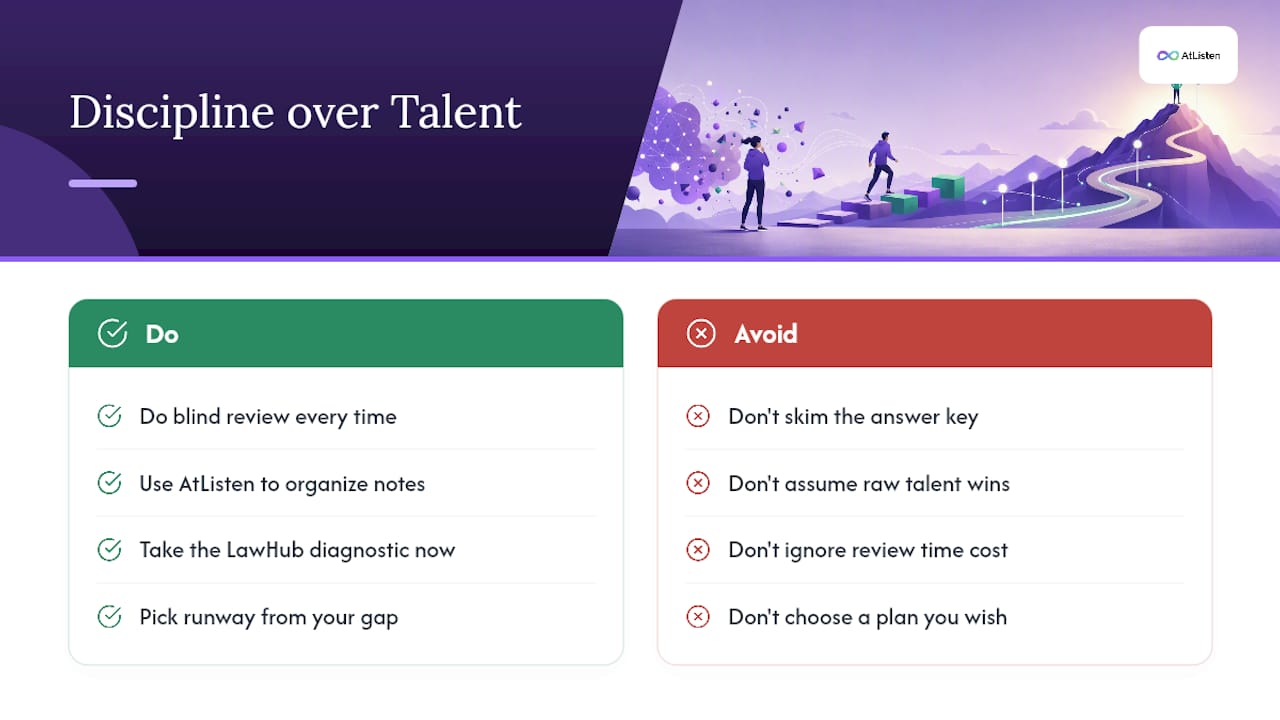
A tool like AtListen earns its place here because the bottleneck for most applicants isn't understanding the material. It's the time cost of turning scattered notes and missed questions into something reviewable. If you're working full time or finishing a senior year course load, that time savings adds up over a three-month plan.
Take the LawHub diagnostic this week. Pick your runway based on the gap you find, not the one you wish you had.
— William
Try AtListen to Speed Up Your LSAT Review
Building a study plan is one thing. Keeping up with the review load it creates is another. Some platforms turn your prep materials, lecture recordings, notes, PDFs, or your own blind-review write-ups into organized study packages: summaries, key concepts, practice questions with explanations, and flashcards built for spaced repetition.

If you're balancing a 3-month LSAT timeline against work or a full class schedule, the value is in the time you get back. Instead of manually rewriting your blind-review notes into flashcards late at night, you can use tools that upload them and generate a usable set quickly, with options to control depth so you can focus lightly on review or deeply on a weak question type. Start with the free tier at AtListen and upload your next PrepTest review session to see how it organizes your misses into a study set you can actually revisit before your next full test.
Sources
FAQ
What Is the Best Study Plan for the LSAT?
The best plan starts with an official LawHub diagnostic, then follows a timeline matched to your score gap, typically 2 to 3 months at 10 to 20 hours a week for most test-takers, built around weekly full tests and consistent blind review.
What Score Is a 67% on the LSAT?
The LSAT is scored based on the number of raw questions answered correctly, not a straight percentage, so there's no direct percentage-to-scaled-score conversion. Your raw score matters far less than how it compares to the difficulty curve of that specific test administration.
Is Two Months Enough Time to Study for the LSAT?
Two months is enough for most people with a moderate score gap (roughly 4 to 8 points from their target), provided they can commit 15 to 20 hours a week and follow a structured plan with weekly full PrepTests and blind review.
Is Three Weeks Enough Time to Study for the LSAT?
Three weeks is tight and only realistic if you're already close to your target score or have prior LSAT or formal logic experience; most people need at least a month to see meaningful score movement, even at high intensity.