

If your baseline diagnostic lands within 50 points of your target, six weeks of intensive study at 15 to 25 hours a week will get you there. If you're 50 to 100 points off, plan on 8 to 10 weeks at 10 to 15 hours weekly. A bigger gap, or a tight work schedule, calls for the full 12 weeks. Start today: take an official diagnostic on MBA.com, then block your mock-test dates before you open a single prep book.
TL;DR:
- A six-week plan is suitable only if your diagnostic score is within 50 points of your target, requiring intensive 15 to 25 hours weekly.
- An eight to ten-week schedule balances content review and practice, ideal for gaps of 50 to 100 points or limited weekly hours.
- A twelve-week plan accommodates larger score gaps over 100 points or demanding schedules, with 10 to 15 hours weekly and spaced mock exams.
- Focus your study on official GMAT questions and consistent mock testing, avoiding over-reliance on third-party resources or skipping review buffers.
- Regularly log errors and adapt your plan based on patterns across multiple mock exams, with at least four full-length tests spaced throughout your preparation.
Table of Contents
- Choosing Your GMAT Study Schedule: 6, 8, or 12 Weeks
- How to Build a Personalized GMAT Prep Plan From Your Diagnostic
- Sample 6-Week and 12-Week GMAT Study Templates
- Practice Tests and the Error Log That Actually Moves Your Score
- Pacing and Test-Day Timing Strategy
- Which Study Materials Actually Move Your Score
- How Atlisten Accelerates Your GMAT Prep
- A Quick Perspective on Intensity Versus Burnout
- Try Atlisten to Build Your GMAT Materials Faster
- Sources
- FAQ
Choosing Your GMAT Study Schedule: 6, 8, or 12 Weeks
The right GMAT study plan depends on two numbers: your diagnostic score and your target score. Everything else, including which resources you buy and how you structure your week, follows from that gap.
The 6-week intensive plan fits people who scored close to their target already, or who have a hard deadline like an early application round. It demands 15 to 25 hours a week, which usually means two to three hours on weekdays and longer weekend blocks. This pace only works if you can protect that time from work travel, exams, or family obligations. Skip a week here and the whole plan collapses.
The 8 to 10 week balanced plan is the most common choice, and for good reason. It gives you enough runway to fix real content gaps without demanding the punishing hours of a sprint. Expect 10 to 15 hours weekly, spread across 5 to 6 days rather than crammed into 3.
The 12-week thorough plan suits test-takers starting 100+ points below target, switching careers into a quant-heavy field, or juggling a demanding job. GMAT Club's 12-week template budgets 10 to 15 hours weekly, similar to the 8 to 10 week version, just stretched over more weeks with lighter daily loads.
You can compress a 12-week plan into 8 weeks by cutting review buffers, not by skipping foundational content. Never compress the mock-test cadence. Score checkpoints are what tell you whether compression is working.
How to Build a Personalized GMAT Prep Plan From Your Diagnostic
A generic GMAT study guide treats every section equally. Your actual weak points won't. Building a plan that fits you starts with data, not a template.
- Take a cold diagnostic first. Sit a full-length Mba before you study anything. This tells you your real starting point across Quantitative, Verbal, and Data Insights, not an inflated number from questions you just reviewed.
- Apply the 80% accuracy rule. Don't add timing pressure to a topic until you can solve it untimed at roughly 80% accuracy. Adding a clock to a shaky skill just teaches you to guess faster.
- Mine your error log weekly. Sort mistakes by cause, not just topic. "Careless arithmetic under time pressure" and "never learned the rule" require completely different fixes, even on the same question type.
- Set your test date, then work backward. Count the weeks available and assign your foundation, drilling, and taper phases accordingly, leaving the final week for review only.
Pro Tip: Don't rebuild your whole plan after one bad mock. Wait for a pattern across two data points before you reroute your weekly priorities.
Sample 6-Week and 12-Week GMAT Study Templates
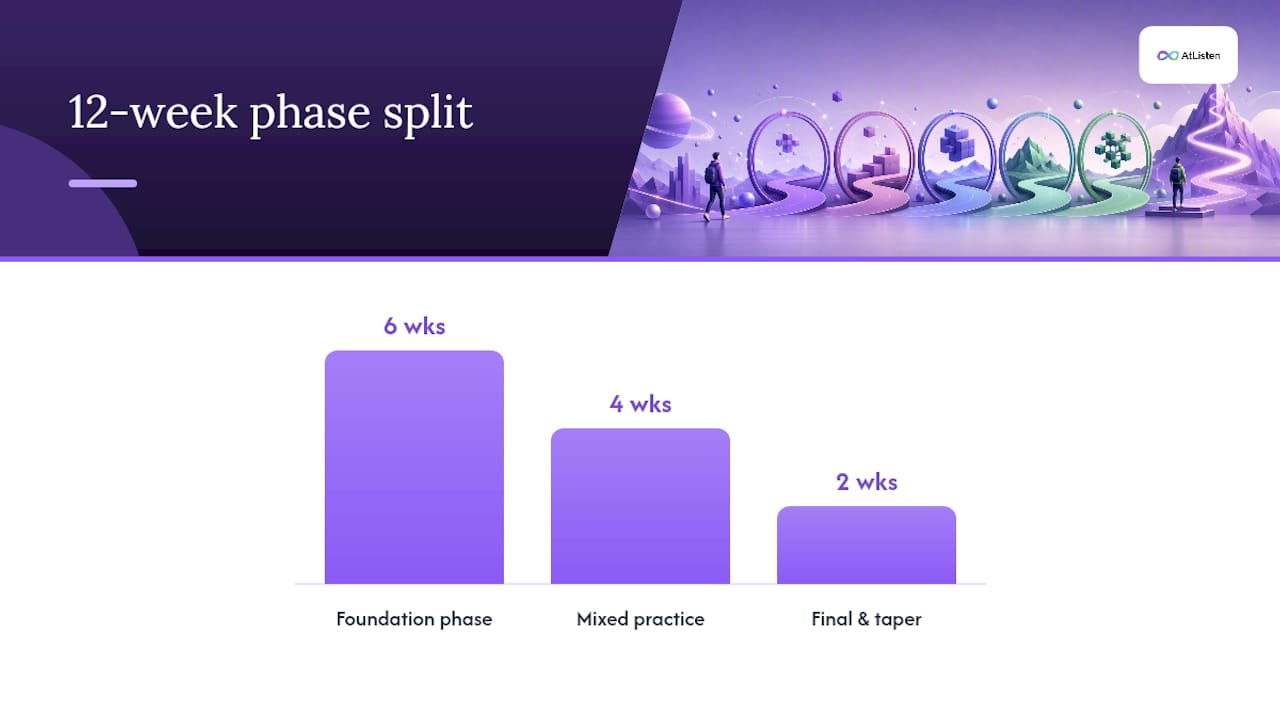
Here's a template you can drop straight into your calendar.
6-week sprint:
- Week 1: Diagnostic exam, then foundational review across all weak sections, compressed and fast-paced.
- Week 2: High-volume timed practice by section, first checkpoint mock at the end of the week.
- Weeks 3 to 4: Mixed-section timed sets, error-log drilling, second mock at the end of week 4.
- Week 5: Full-length mocks under real conditions, targeted fixes on the top 3 remaining weaknesses.
- Week 6: Light review, pacing drills only, taper hard by the final 48 hours.
12-week build:
- Weeks 1 to 6: Foundation phase, one section or question type per few days, diagnostic mock delayed until week 4 or 5 so it reflects real progress.
- Weeks 7 to 10: Mixed timed practice, shorter timed sprints, a mock roughly every two weeks.
- Weeks 11 to 12: Final full-length mocks, taper, pacing calibration, and rest.
A daily session, regardless of timeline, should follow the same skeleton: a short warm-up review of yesterday's error log, focused concept work on one weak area, a timed practice set, then 15 to 20 minutes logging new errors. Total study time across a full prep window commonly runs 120 to 240 hours, depending on your weekly hours and starting score. If you're consistently behind pace by week 3, cut supplemental reading before you cut mocks.
Practice Tests and the Error Log That Actually Moves Your Score
Mocks only help if you treat them as more than a scoreboard. GMAC recommends recreating actual test-day conditions for every full-length practice exam, including timing, breaks, and scratch materials, because pacing and mental stamina are part of what's being tested.
- Baseline mock: cold, before any studying, to set your starting point.
- Midpoint mock: after your foundation phase, to check whether drilling is closing gaps.
- Calibration mock: two to three weeks before test day, timed exactly like the real thing.
- Final mock: one week out, focused on pacing confidence, not new content.
Log every miss with four fields: topic, trap type, root cause, and the fix you tried. That structure turns a pile of wrong answers into next week's drill list instead of a source of anxiety.
Pacing and Test-Day Timing Strategy
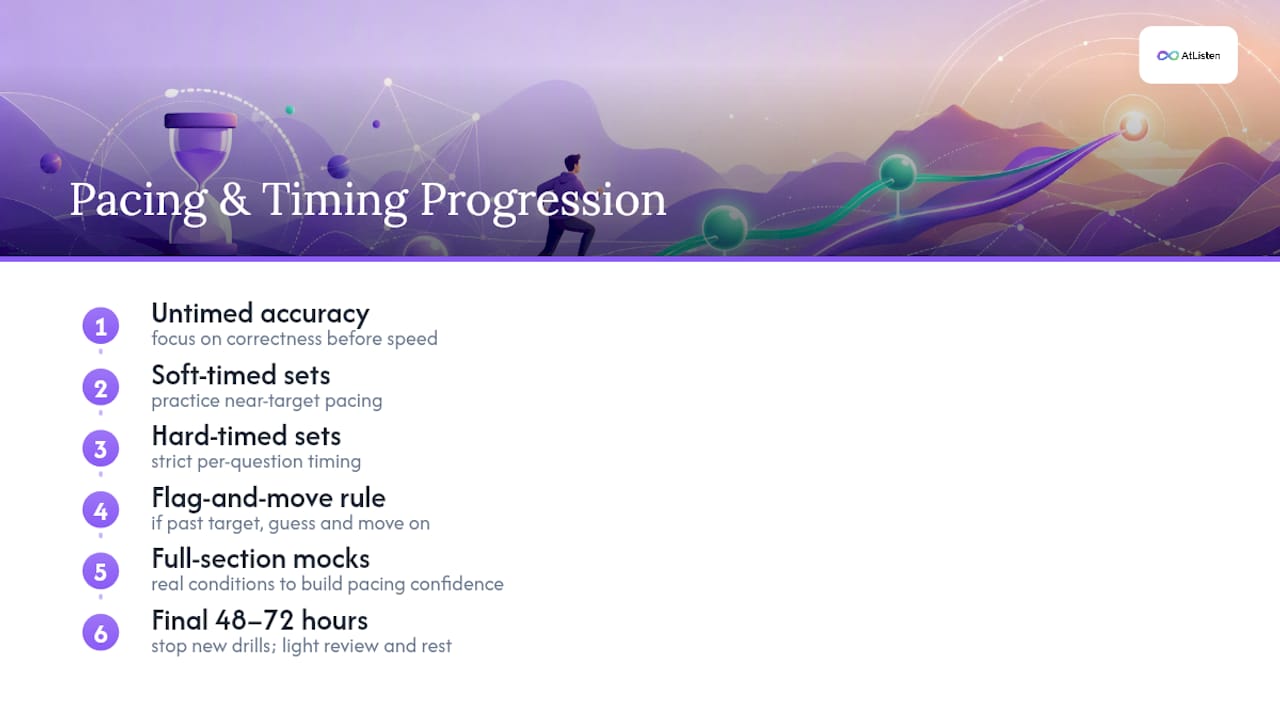
Per-question pacing benchmarks vary by section, but the drilling progression to internalize them is consistent: untimed accuracy first, then soft-timed sets, then hard-timed sets, then full-section mocks under real conditions.
Pro Tip: Build a flag-and-move rule now. If you're stuck past your target time on a question, guess your best educated answer and move on. A stalled question costs you two questions' worth of time.
Community-built plans that pair 10 to 15 weekly study hours with four full-length mocks consistently report better pacing confidence than plans that skip mock frequency to cram more content. In the final 48 to 72 hours, stop drilling new material entirely and shift to light review and rest.
Which Study Materials Actually Move Your Score
Official material belongs at the center of your plan, not on the side. Prioritizing official retired GMAT questions over third-party clones remains the highest-leverage habit in any serious prep plan, because retired questions are the only ones guaranteed to match real question logic and difficulty calibration.
- Center your mocks and Official Guide practice on the MBA.com Official Guide bundle, which pairs the book with an online question bank.
- Use third-party drills for extra volume on a specific weak topic, never as a substitute in a mock.
- Pick one or two core resources per timeline instead of scattering across five apps.
- Use spaced-repetition flashcards between sessions to keep formulas and vocabulary fresh without extra study blocks.
A calendar-based planner, like the one from Syncronos, can help you visualize a six-week timeline if you'd rather see your plan laid out day by day than track it in a spreadsheet.
How Atlisten Accelerates Your GMAT Prep
Reading dense GMAT content is one thing. Retaining it under time pressure is another. Certain AI-powered tools turn Official Guide chapters, lecture notes, or review PDFs into summaries, flashcards, and practice prompts matched to study objectives. Feed it a week's worth of readings and get back a focused 30 to 45 minute active-review set, built directly from your error-log patterns instead of generic chapter reviews.
A Quick Perspective on Intensity Versus Burnout
Steady 10-hour weeks beat frantic 25-hour weeks if your gap is large. Watch for two red flags: mock scores plateauing despite more hours, or dreading your study block. Either one means stretch the plan, don't sprint it. Consistency beats raw hours almost every time.
— William
Try Atlisten to Build Your GMAT Materials Faster
Building error-log drills and flashcards by hand eats into the study hours you should be spending on practice sets. Some tools convert readings, lecture recordings, or Official Guide chapters into structured summaries, flashcards, and practice questions quickly, so the time you'd spend organizing notes goes straight into timed drills instead.

Start by uploading your diagnostic review notes or a chapter you're struggling with, and let Atlisten generate a targeted flashcard set aligned to your weak topics. If you're studying alongside a job or classes, that time savings compounds fast over a 6 to 12 week plan. Visit Atlisten to try the free tier and build your first study set today.
Sources
- Mba
- GMAC — How to prepare for the GMAT exam
- The GMAT Strategy Blog — How to study for the GMAT
- GMAT Club — Free 12-week GMAT study plan
FAQ
How Long Should You Study for the GMAT?
Most test-takers need 6 to 12 weeks, depending on the gap between their diagnostic score and target score, with 8 to 10 weeks fitting the average case best.
Can You Score 700 on the GMAT in 3 Months?
Yes, a 12-week plan is realistic if your diagnostic score starts within roughly 100 points of your target and you follow a structured 10 to 15 hour weekly schedule with regular mocks.
Is 3 Months Enough to Prepare for the GMAT?
Three months is enough for most test-takers, and it's actually the safer choice over a 6-week sprint if you have a demanding job or a larger score gap to close.
What Is the Best Way to Study for the GMAT?
Start with a cold official diagnostic, build weekly goals around your specific error patterns, and center your practice on official retired questions rather than third-party clones, which the GMAT Strategy Blog identifies as the strongest predictor of score improvement.
How Many Practice Tests Should You Take Before the GMAT?
Four full-length mocks, spaced across your plan as a baseline, midpoint, calibration, and final check, gives you enough data to adjust pacing and content focus without over-testing.