

If you can put in 10 to 15 hours a week, a 9-month plan starting with FAR gives you the best balance of pace and safety margin. Budget roughly 100 to 150 hours per section, totaling several hundred hours across all four parts, and lock your exam dates before you start studying, not after. Your first move: check your state board's credit window and request your Notice to Schedule.
TL;DR:
- Candidates should allocate around 100 to 150 hours per section, with FAR and REG generally requiring more study hours than AUD.
- Using a 9-month plan with 10 to 15 hours weekly offers a balanced pace, allowing for buffer weeks and ensuring proper review before exam dates.
- Practice active recall through frequent full-length mocks and spaced repetition, avoiding passive rereading to maximize retention and readiness.
- Confirm your state's credit window and schedule your exam at least 7 to 10 days after content review to avoid losing validity time.
- Pairing study tools like Atlisten with official practice materials streamlines content review, saving time for more practice and mock exams.
Table of Contents
- How Long Should Your CPA Exam Study Plan Be?
- Building Your Per-Section Plan: A 9-Month Template
- What Study Methods Actually Move the Needle?
- NTS, Credit Windows, and Getting the Timing Right
- Realistic Schedules If You're Working Full Time
- How Do You Know You're Actually Ready?
- When a Section Doesn't Go Your Way
- Where AtListen Fits Into Your Study Plan
- What I'd Tell a Friend Starting This Process
- Try AtListen Alongside Your Review Course
- Where to Verify the Details
- Sources
How Long Should Your CPA Exam Study Plan Be?
Three timelines cover almost every candidate: 6 months, 9 months, and 12 months. Which one fits you depends less on how smart you are and more on how many hours you can realistically protect each week.
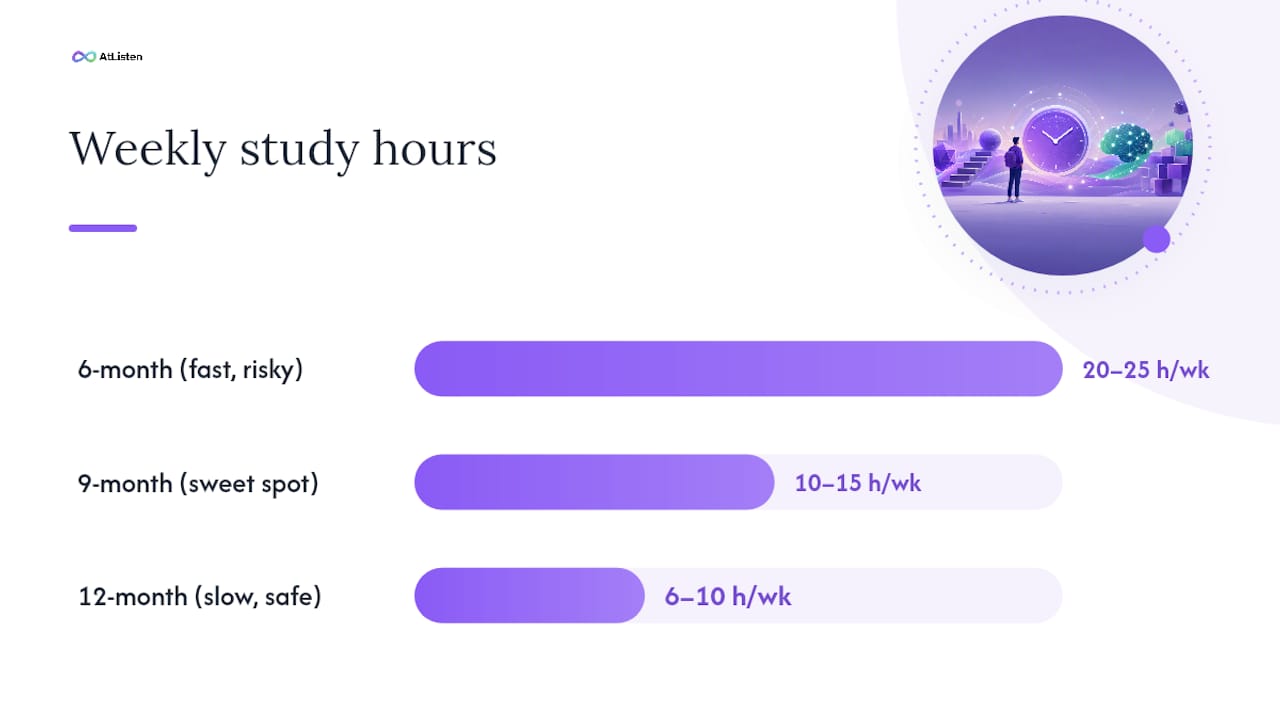
The 6 month plan suits recent grads with light work obligations or candidates between jobs. It demands 20 to 25 hours a week, which is a serious commitment, but it clears all four sections fast enough that credit-window rules rarely become a problem. The tradeoff is thin margin for error. Miss two weeks to a work crunch or a family emergency and the whole schedule slides.
The 9 month plan is the sweet spot for most working candidates. At 10 to 15 hours a week, you get enough runway to absorb a rough month at work without abandoning the calendar entirely. This is the pace Gleim's sample schedules are built around, and it maps cleanly onto a 4 section exam without forcing you into back-to-back sittings.
The 12 month plan fits people with heavy jobs, parenting responsibilities, or a genuine need to pace themselves at 6 to 10 hours a week. It's the safest option for burnout, but it carries one real risk: it can eat too much of your credit window if a section takes longer than expected.
Whatever you choose, build in buffer weeks:
- Add one buffer week for every two study months, placed before major exams, not after
- Never schedule your exam date the same week you finish content, leave at least 7 to 10 days for review only
- Track your state's specific credit window early, since NASBA's Candidate Guide notes these rules vary by jurisdiction
Building Your Per-Section Plan: A 9-Month Template
Most candidates need 100 to 150 hours per section, with FAR and REG typically pulling toward the higher end and AUD landing closer to the lower end, according to Becker's hour estimates. A 9 month plan gives you roughly 8 to 9 weeks per section if you sequence them back to back with short breaks between.
Here's a week-by-week structure you can copy directly, using FAR as the first section:
- Weeks 1 to 2: Learn foundational topics (financial statements, revenue recognition) at 60 to 70% learning time and 30 to 40% practice, per the pacing ratio MyAccountingCourse recommends.
- Weeks 3 to 5: Continue content coverage, adding daily MCQ sets of 20 to 30 questions per topic block.
- Weeks 6 to 7: Shift toward task-based simulations. Start reviewing missed questions in a dedicated error log rather than just rereading notes.
- Week 8: Run your first full-length mock exam under timed conditions. Score it honestly and flag weak areas.
- Week 9: Invert the ratio to 70 to 80% practice, 20 to 30% new content. Spend this week almost entirely on simulations and a second timed mock.
- Final 3 to 4 days: Light review only. Flashcards, formula recall, and rest. No new content this close to test day.
Repeat this cycle for AUD, REG, and your chosen Discipline section, adjusting week counts if a section runs lighter (AUD often does) or heavier (REG and TCP tend to). Schedule your full mock exam no later than 10 days before your actual test date. That leaves enough time to fix a specific weak area but not so much time that you lose momentum.
What Study Methods Actually Move the Needle?
Passive rereading is the single biggest time-waster in CPA prep. What works is retrieval practice: forcing yourself to answer a question before you look at the answer, every time.
A solid daily session runs like this:
- 15 minutes reviewing yesterday's flashcards (spaced repetition, not cramming)
- 45 to 60 minutes learning new content in short blocks, pausing every 20 minutes to summarize what you just read in your own words
- 30 to 45 minutes of MCQs tied directly to what you just studied
- 15 minutes reviewing every question you missed, writing down why you got it wrong
Build spaced repetition into your calendar deliberately. Revisit a topic 1 day, 4 days, and 10 days after first learning it. This is what separates candidates who remember material through exam day from candidates who forget it two weeks after finishing a chapter.
Your resource mix matters too. MCQs alone won't prepare you for task-based simulations, and TBS practice alone won't build the speed you need for the multiple-choice portion. You need both, plus at least two full timed mocks per section before test day.
Pro Tip: Turn a dense lecture recording or a messy set of notes into a flashcard deck the same day you learn the material. Waiting until the weekend to "organize everything" is where most study plans quietly fall apart.
NTS, Credit Windows, and Getting the Timing Right
Your Notice to Schedule (NTS) isn't just paperwork. It has a validity period, and once your first section score posts, your state's credit window starts ticking on every section you have left. NASBA's Candidate Guide lays out the administration rules, but the exact window length depends on your state board, so confirm it directly rather than assuming.
Discipline sections (BAR, ISC, TCP) run on quarterly testing windows, not continuous availability. Miss a window and you could be waiting months, a detail that can quietly wreck an otherwise tight 6 month plan.
Before you build your calendar, work through this checklist:
- Apply for your NTS only after you've confirmed education requirements with your state board
- Set your first exam date within 60 to 90 days of receiving your NTS to avoid wasted validity time
- Check your Discipline section's testing window before you finalize your section order
- Leave at least one open retake slot in your calendar, even if you don't expect to need it
Realistic Schedules If You're Working Full Time
Working candidates rarely need a different study plan philosophy, just a different weekly structure. Timeline research on working candidates shows that 15 or more hours a week can still finish all four sections in 12 to 16 months, while lighter 8 hour weeks stretch closer to 18 to 24 months.
At 8 hours a week: two 1 hour weekday sessions (lunch break or after dinner) plus a 3 to 4 hour weekend block. This pace works, but expect the 12 month timeline, not 9.
At 12 hours a week: three weekday sessions of 1.5 hours plus a 4 to 5 hour weekend block split across two days.
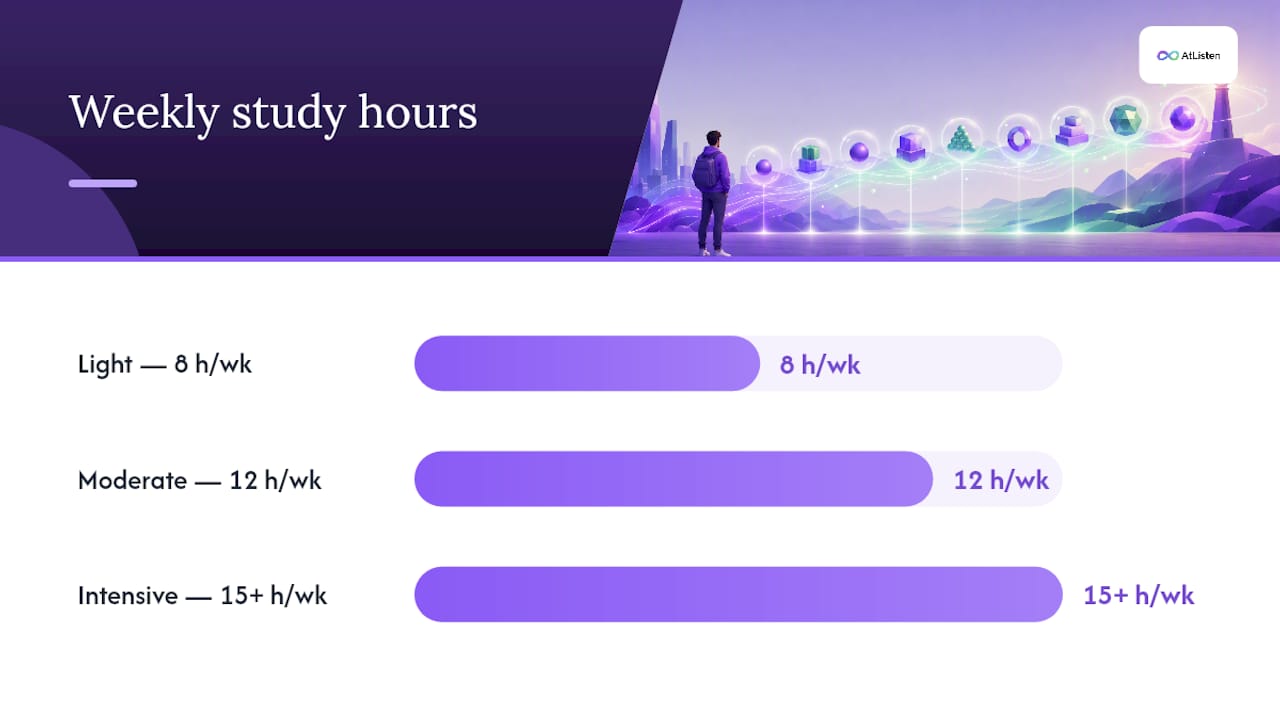
At 15 hours a week: near-daily sessions of 1.5 to 2 hours, with weekends reserved for simulations and full mocks rather than new content.
A few tactics stretch limited hours further:
- Use commute time or breaks for flashcard review instead of adding a new study block
- During a busy work stretch, drop to maintenance mode: 20 minutes of spaced-repetition review daily rather than skipping entirely
- Convert a dense lecture or textbook chapter into a summary and flashcard set in one pass, rather than rereading it three separate times, which is exactly the kind of task an AI study tool like Atlisten was built to shorten
How Do You Know You're Actually Ready?
Objective signals beat gut feeling every time. Before scheduling your exam, run through this readiness check:
- Run a full-length timed mock exam at least once, ideally twice, per section.
- Confirm your trailing MCQ average sits at 75% or higher across your last three practice sets, not just your best set.
- Check simulation accuracy separately from MCQs. A strong multiple-choice score can mask weak task-based simulation performance.
- Review your pacing. If you're consistently running out of time on mocks, that's a signal to drill speed, not just content.
- If any of the above is off, postpone. Most candidates need 1 to 2 extra weeks to close a specific gap, not a full extra month.
When a Section Doesn't Go Your Way
A failed section isn't a plan failure, it's data. In the first 48 hours, pull your score report and identify which content areas or question types dragged you down, rather than assuming you just need "more studying."
Reallocate the next 2 to 3 weeks specifically to those weak areas before touching new material for the next section. Watch your credit window closely here. Rebalancing time is fine, but letting a retake delay push you past your window is not. Give yourself one day to feel frustrated, then get back to a fixed session time. Momentum recovers faster than most candidates expect once you're back on a schedule.
Where AtListen Fits Into Your Study Plan
Atlisten turns lecture recordings, review course videos, and dense textbook chapters into summaries, key concept lists, and flashcards within minutes. For CPA candidates, that means less time transcribing notes by hand and more time actually practicing.
It is designed for compressing a long lecture into a reviewable summary, building spaced-repetition flashcard decks from key topics, and generating extra practice questions to reinforce concepts. It is not a replacement for official MCQ banks or task-based simulations. Pair it with your review course's practice materials, not instead of them. Data handling details are outlined on Atlisten's security page for candidates who want specifics before uploading course content.
What I'd Tell a Friend Starting This Process
The candidates who pass on schedule aren't the ones who study the most hours. They're the ones who run a timed mock exam every 4 to 6 weeks and actually adjust their plan based on the results, instead of just grinding forward on autopilot. Build that single habit into your calendar now, and the rest of the plan takes care of itself.
— William
Try AtListen Alongside Your Review Course
Atlisten turns your densest CPA materials, a 90 minute FAR lecture, a stack of REG notes, a review course video, into a summary and flashcard set in minutes instead of the hour or two it takes to do it by hand.
Start with whatever is eating the most of your prep time right now. If that's rewatching lectures to catch details you missed the first time, upload one and see what comes back. If it's building flashcards from your textbook, upload a chapter instead. Visit the AtListen landing page to try it with your next study session, and use the extra hours for what actually moves your score: more MCQs, more simulations, and one more timed mock before test day.
Where to Verify the Details
Confirm your credit window and NTS rules through NASBA's Candidate Guide, and check current hour and timeline guidance from Becker and Gleim.